2024 · Tan — The Effect of 14-Day Consumption of Hydrogen-Rich Water Alleviates Fatigue but Does Not Ameliorate Dyspnea in Long-COVID Patients: A Pilot, Single-Blind, and Randomized, Controlled Trial
Super-Abstract
Hydrogen-rich water alleviates exhaustion in Long-COVID — but not shortness of breath. In a 14-day randomized pilot trial (n = 32), H₂ water lowered fatigue, increased the distance in the 6-minute walk test, and markedly improved leg strength and sleep quality; shortness of breath, however, did not improve. (Nutrients, 2024.)
Commentary
Long COVID hits many people with persistent exhaustion — and that is exactly where this study comes in. It is a randomized, single-blind, placebo-controlled pilot study: of 55 originally recruited, 32 remained, 16 each in the H₂ water group and the placebo water group. Both drank either hydrogen-rich or plain water for 14 days. Testing used established instruments: the Fatigue Severity Scale, the 6-minute walk test, the 30-second chair-stand test for leg strength, a dyspnea scale, the Pittsburgh Sleep Index and a stress questionnaire. The numbers are concrete and partly clear: fatigue fell significantly (p = 0.046), the distance in the 6-minute walk test rose clearly (p < 0.001, large effect with Cohen's d = 1.01), chair-stand performance improved (p = 0.002, d = 1.19), and sleep got better too (p = 0.012, d = 1.27). Important for honesty: shortness of breath did not improve (p = 0.556), and anxiety/depression/stress also remained unchanged. What it means: H₂ water appears to help above all with exhaustion, endurance, leg strength and sleep, but not with shortness of breath. Honestly: a small sample (n = 32) and only single-blind — i.e. weaker than a double-blind design.
Key quotes
- „The effects of HRW on lowering FSS scores (p = 0.046 ...) and improving total distance in the 6WMT (p < 0.001 ..., d = 1.010), total time for the 30s-CST (p = 0.002 ..., d = 1.190), and PSQI scores (p = 0.012 ..., d = 1.274) compared to PW were of a significantly moderate effect size“ — the concrete proofs of effect with effect sizes
- „there was no significant difference in mMRC score (p = 0.556) or DASS-21 score (p > 0.143).“ — no improvement in shortness of breath, anxiety, depression, stress
- „HRW might be an effective strategy for alleviating fatigue and improving cardiorespiratory endurance, musculoskeletal function, and sleep quality. Still, it does not ameliorate dyspnea among Long-COVID patients.“ — the balanced conclusion
Our assessment
Relevant for H₂ water applications in the context of exhaustion, recovery and post-infection convalescence — a big topic since the pandemic. A strength is the honest, differentiated reporting: an effect where it is measurable (fatigue, endurance, sleep), no whitewashing on shortness of breath. The reported effect sizes (Cohen's d up to 1.27) are notable. Limitation, stated honestly: declared as a pilot study, a small sample (n = 32 of 55), only single-blind (not double-blind) — therefore classified as a pilot/near-open-label design. Subjective endpoints like fatigue are more susceptible to expectation effects when blinding is only single.
Study design
- Type: pilot RCT, randomized, single-blind, placebo-controlled · n: 32 (16 HRW / 16 placebo; recruited from 55) · Duration: 14 days · H₂ delivery: hydrogen-rich drinking water (HRW)
- Result metrics: fatigue (FSS) ↓ p = 0.046; 6-min walk distance ↑ p < 0.001 (d = 1.01); 30s chair-stand ↑ p = 0.002 (d = 1.19); sleep (PSQI) ↑ p = 0.012 (d = 1.27); dyspnea (mMRC) p = 0.556 n.s.; DASS-21 p > 0.143 n.s.
Abstract
(1) Background: Hydrogen (H2) may be a potential therapeutic agent for managing Long COVID symptoms due to its antioxidant and anti-inflammatory properties. However, more scientific literature is needed to describe the effects of H2 administration on treating symptoms. A study aimed to investigate the impact of hydrogen-rich water (HRW) administration on the fatigue and dyspnea of Long-COVID patients for 14 consecutive days. (2) Methods: In this randomized, single-blind, placebo-controlled study, 55 participants were recruited, and 23 of them were excluded. A total of 32 eligible participants were randomized into a hydrogen-rich water (HRW) group (n = 16) and a placebo water (PW) group (n = 16) in which they were instructed to consume hydrogen-rich water or placebo water for 14 days, respectively. The participants completed the Fatigue Severity Scale (FSS), Six-Minute Walk Test (6MWT), 30 s Chair Stand Test (30s-CST), Modified Medical Research Council Dyspnea Rating Scale (mMRC), Pittsburgh Sleep Quality Index (PSQI), and depression anxiety stress scale (DASS-21) before and after the intervention. A linear mixed-effects model was used to analyze the effects of HRW. Cohen's d values were used to assess the effect size when significance was observed. The mean change with 95% confidence intervals (95% CI) was also reported. (3) Results: The effects of HRW on lowering FSS scores (p = 0.046, [95% CI = -20.607, -0.198, d = 0.696] and improving total distance in the 6WMT (p < 0.001, [95% CI = 41.972, 61.891], d = 1.010), total time for the 30s-CST (p = 0.002, [95% CI = 1.570, 6.314], d = 1.190), and PSQI scores (p = 0.012, [95% CI = -5.169, 0.742], d = 1.274) compared to PW were of a significantly moderate effect size, while there was no significant difference in mMRC score (p = 0.556) or DASS-21 score (p > 0.143). (4) Conclusions: This study demonstrates that HRW might be an effective strategy for alleviating fatigue and improving cardiorespiratory endurance, musculoskeletal function, and sleep quality. Still, it does not ameliorate dyspnea among Long-COVID patients.
Source & links
Screenshot of the PubMed page
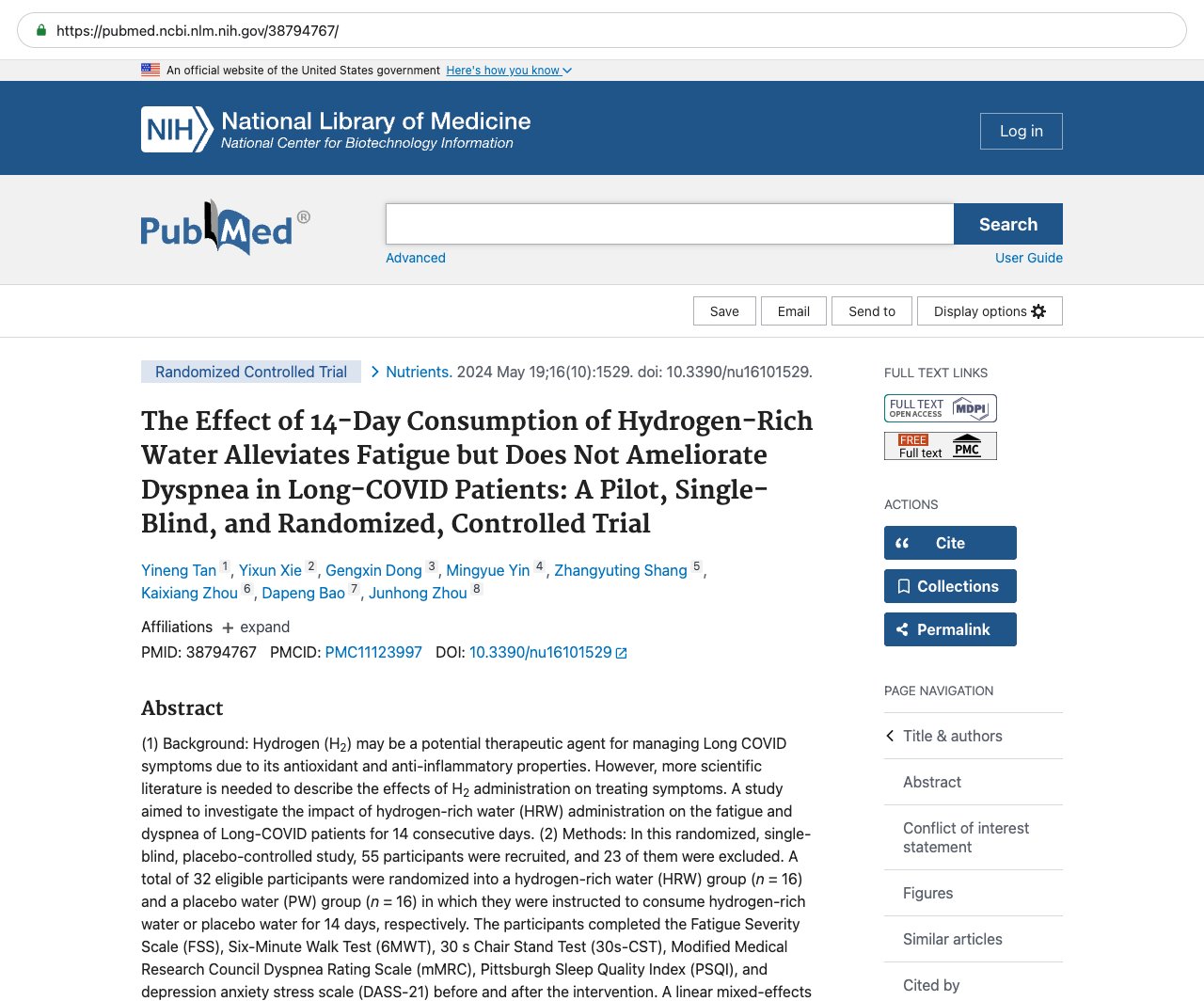
This page mirrors the published abstract (© the authors / publisher) for reference and citation. The canonical source is the PubMed record linked above. This is not medical advice.