2025 · Zhang — Hydrogen-rich water supplementation attenuates oxidative stress and inflammation in chronic high-altitude disease patients: A double-blind randomized placebo-controlled study
Super-Abstract
In chronic high-altitude disease, 60 days of hydrogen-rich water dampened inflammation-related gene pathways. In the double-blind RCT (43 evaluated patients), inflammation and cytokine pathways were upregulated in the placebo group, while hydrogen-rich water significantly downregulated them — the direct markers showed a (non-significant) downward trend. (Food Research International, 2025.)
Commentary
Chronic high-altitude disease arises at great heights mainly from oxidative damage and inflammation — a good test field for the antioxidant profile of H₂. Design: double-blind, randomized, placebo-controlled. 50 patients were recruited, after seven drop-outs 43 remained (23 hydrogen water, 20 placebo) over 60 days. Alongside oxidative and immunological markers, the transcriptome — i.e. which genes are read out and how strongly — was analyzed. The most exciting finding is at the gene level: in the placebo group, the genes differentially active between before and after were mainly linked to inflammation and cytokine pathways, while hydrogen-rich water significantly downregulated exactly these pathways. Through network analyses the authors identified six central genes, including TNF and interleukin-1-beta — classic inflammation drivers. Honestly, and this is important: the directly measured oxidative and inflammatory markers showed only a non-significant downward trend. The strong effect thus lies at the molecular signaling level, not (yet) in the hard clinical markers. Small sample (n = 43 evaluated).
Key quotes
- „differentially expressed genes in the PW group between pre- and post-intervention were predominantly associated with inflammation- and cytokine-related pathways, whereas HRW treatment significantly downregulated these pathways.“ — the core finding at the gene level
- „we identified six hub genes, including tumor necrosis factor, interleukin-1 beta, C-C motif chemokine ligand 3 ...“ — the central inflammation-driver genes
- „measurements of oxidative stress and inflammatory markers indicated a non-significant downward trend in oxidative stress and inflammation in patients with CHAD after HRW intake for 60 days.“ — the honest caveat: direct markers only as a trend
Our assessment
Relevant to inflammation and oxidative stress in chronic high-altitude disease, because a mechanistically deep piece of evidence is delivered here: H₂ not only modulates markers but dampens inflammatory gene pathways (TNF, IL-1β etc.) — fitting the anti-inflammatory mechanistic picture of H₂. Limitation, stated honestly: the directly measured oxidative/inflammatory markers reached only a non-significant downward trend — the main statement rests on transcriptome/network analyses. Small sample reduced by drop-outs (n = 43). Solid double-blind RCT design (evidence level 3), but the main finding is at the molecular, not the clinical level.
Study design
- Type: RCT, double-blind/placebo-controlled · n: 50 recruited, 43 evaluated (HRW 23, PW 20) · Duration: 60 days · H₂ delivery: hydrogen-rich drinking water (HRW) vs. placebo water
- Result figures: placebo group: upregulation of inflammation/cytokine pathways; HRW: significant downregulation of these pathways; 6 hub genes identified (incl. TNF, IL-1β, CCL3); direct oxidation/inflammation markers: non-significant downward trend
Abstract
Chronic high-altitude disease (CHAD) is primarily driven by oxidative damage and inflammation. Hydrogen-rich water (HRW) is a novel functional food with demonstrated antioxidant and anti-inflammatory properties. However, its potential effects on inflammation and oxidative stress in CHAD remain unexplored. In this study, 50 participants with CHAD were recruited and assigned to the HRW or placebo water (PW) group for 60 days. After seven participants were lost to follow-up, 43 participants (HRW, n = 23; PW, n = 20) completed the intervention and were included in the analysis. Oxidative stress indicators and inflammation-related immune cells were evaluated before and after treatment, and transcriptional profiles of all participants were analyzed to determine the potential mechanism of HRW in CHAD. Baseline characteristics did not differ significantly between the two groups. Enrichment analysis showed that differentially expressed genes in the PW group between pre- and post-intervention were predominantly associated with inflammation- and cytokine-related pathways, whereas HRW treatment significantly downregulated these pathways. By integrating weighted gene co-expression network analysis and protein-protein interaction network analysis we identified six hub genes, including tumor necrosis factor, interleukin-1 beta, C-C motif chemokine ligand 3, C-C motif chemokine ligand 3-like 1, C-C motif chemokine ligand 4-like 2, and radiation-inducible immediate-early response 3. Furthermore, measurements of oxidative stress and inflammatory markers indicated a non-significant downward trend in oxidative stress and inflammation in patients with CHAD after HRW intake for 60 days. These results suggest the potential protective role of HRW in CHAD, providing a novel adjuvant therapy for CHAD.
Source & links
Screenshot of the PubMed page
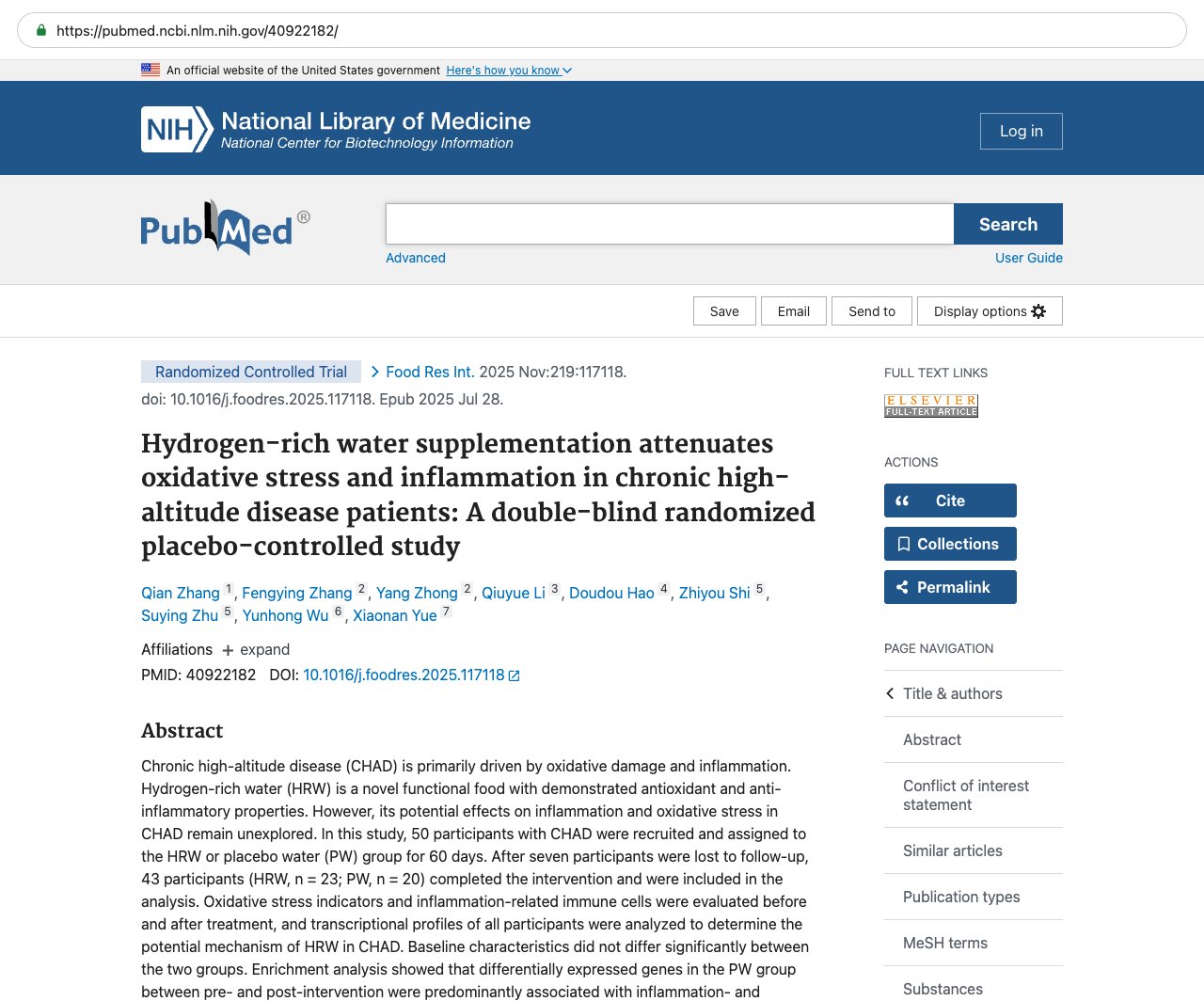
This page mirrors the published abstract (© the authors / publisher) for reference and citation. The canonical source is the PubMed record linked above. This is not medical advice.