2022 · Hong et al. — Effects of Pre-Exercise H2 Inhalation on Physical Fatigue and Related Prefrontal Cortex Activation During and After High-Intensity Exercise
Super-Abstract
In 24 young men, inhaling hydrogen gas for 20 minutes before high-intensity cycling lowered perceived exertion at every workload phase compared with a placebo gas (p < 0.032). Heart rate was lower only from 50% of the maximum workload onward (p < 0.037), and prefrontal cortex activation was higher only at 75 and 100% (p < 0.011). Thigh muscle strength after cycling showed no statistically significant difference (p = 0.074, per full text). Exercise duration was fixed, so the study did not test endurance or performance. (Frontiers in Physiology, 2022.)
Commentary
Physical fatigue limits high-intensity exercise, and the authors asked whether hydrogen inhaled beforehand eases it through the prefrontal cortex. Twenty-four young men completed four visits: two to determine each participant's maximum workload, then one with 20 minutes of hydrogen gas and one with placebo gas before cycling. Per full text, the order was randomised, the study was double-blinded and the two test visits were 1 week apart. Also per full text, the gas came through a nasal inhaler at 1800 ml/min with a maximum hydrogen concentration of 4.08%, and the placebo came from the same unit with hydrogen production switched off. Participants then cycled at 80% of peak power output for their previously measured maximum riding time (per full text). Ratings of perceived exertion (RPE), heart rate and prefrontal cortex activation by functional near-infrared spectroscopy (fNIRS) were recorded during cycling. Maximal voluntary isometric contraction (MVIC) of the thigh was measured before and after. Per full text, RPE was the primary outcome.
Key quotes
- „It was observed that compared to control, after inhaling H2 gas, participants had significantly lower RPE at each workload phase (p < 0.032) and lower HR at 50% Wmax, 75% Wmax, and 100% Wmax during cycling exercise (p < 0.037)“ — the main result on perceived exertion and heart rate during cycling
- „the PFC activation was also significantly increased at 75 and 100% Wmax (p < 0.011)“ — brain activation differed only at the two highest workload phases
- „This study demonstrated that pre-exercise inhalation of H2 gas can alleviate PF, potentially by maintaining high PFC activation during high-intensity exercise in healthy young adults.“ — the authors' conclusion, which states the brain mechanism only as possible
Our assessment
Each man was compared with himself, and per full text the order was randomised and double-blinded, with a placebo gas from the same unit. Perceived exertion, the primary outcome per full text, was lower after hydrogen at every workload phase. Heart rate did not differ at 25% of the maximum workload, prefrontal activation differed only at 75 and 100%, and post-exercise thigh strength showed no statistically significant difference (p = 0.074, per full text). Limitations: 24 young men from one sports university, a single 20-minute inhalation and a fixed exercise duration, so endurance and performance were not tested. RPE is a subjective rating. Per full text, fNIRS data from 3 participants and eight heart rate data sets were excluded, and baseline thigh strength differed between visits (p = 0.006). The link between brain activation and fatigue rests on correlations and cannot establish a mechanism. The abstract does not mention adverse events.
Study design
- Type: randomised, double-blind, placebo-controlled crossover study (randomisation and blinding per full text), 1-week washout · n: 24 young men · H₂ delivery: 20 minutes of hydrogen gas inhalation before cycling; per full text by nasal inhaler at 1800 ml/min, maximum 4.08% hydrogen
- Comparator: placebo gas, per full text from the same unit with hydrogen production switched off
- Result: RPE (primary per full text) lower at each workload phase (p < 0.032). Heart rate lower at 50, 75 and 100% Wmax (p < 0.037), not at 25%. PFC activation higher at 75 and 100% Wmax (p < 0.011). Post-exercise MVIC 34.38 vs. 34.03, p = 0.074, not significant (per full text). Change in activation correlated with RPE at 75% Wmax (p = 0.010) and heart rate at 100% Wmax (p = 0.016)
Abstract
Objective: In this study, we examined the effects of pre-exercise H2 gas inhalation on physical fatigue (PF) and prefrontal cortex (PFC) activation during and after high-intensity cycling exercise. Methods: Twenty-four young men completed four study visits. On the first two visits, the maximum workload (Wmax) of cycling exercise of each participant was determined. On each of the other two visits, participants inhaled 20 min of either H2 gas or placebo gas after a baseline test of maximal voluntary isometric contraction (MVIC) of thigh. Then participants performed cycling exercise under their maximum workload. Ratings of perceived exertion (RPE), heart rate (HR) and the PFC activation by using functional near-infrared spectroscopy (fNIRS) was measured throughout cycling exercise. The MVIC was measured again after the cycling. Results: It was observed that compared to control, after inhaling H2 gas, participants had significantly lower RPE at each workload phase (p < 0.032) and lower HR at 50% Wmax, 75% Wmax, and 100% Wmax during cycling exercise (p < 0.037); the PFC activation was also significantly increased at 75 and 100% Wmax (p < 0.011). Moreover, the H2-induced changes in PF were significantly associated with that in PFC activation, that is, those who had higher PFC activation had lower RPE at 75% Wmax (p = 0.010) and lower HR at 100% Wmax (p = 0.016), respectively. Conclusion: This study demonstrated that pre-exercise inhalation of H2 gas can alleviate PF, potentially by maintaining high PFC activation during high-intensity exercise in healthy young adults.
Source & links
Screenshot of the PubMed page
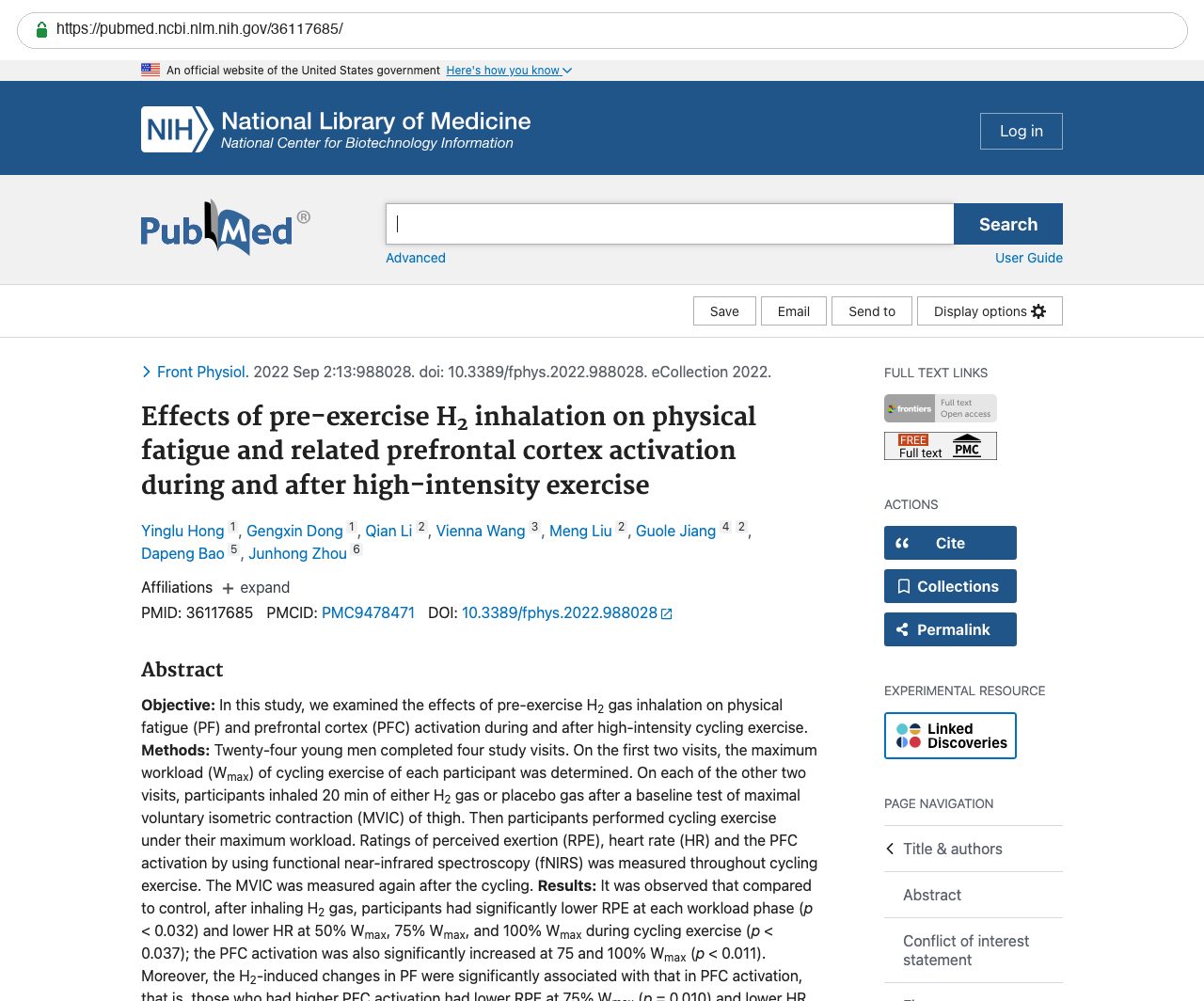
This page mirrors the published abstract (© the authors / publisher) for reference and citation. The canonical source is the PubMed record linked above. This is not medical advice.