2022 · Geng et al. — Hydrogen Helps to Ameliorate Staphylococcus aureus-Induced Mastitis in Mice
Super-Abstract
In a mouse model of bacterial mastitis, hydrogen-rich vitamin E glycerin (HR-VEG) applied topically to the mammary gland reduced tissue damage, inflammatory cytokines (TNF-α, IL-1β, IL-6), and bacterial load more effectively than regular vitamin E glycerin — by inhibiting the TLR2/Nod2-NF-κB/MAPK signalling cascade. These results are from animal experiments; therapeutic relevance to humans has not been established. (International Immunopharmacology, 2022.)
Commentary
Mastitis — inflammation of the mammary gland — is a common and costly problem in livestock and an occasional concern in humans. This study uses S. aureus-induced mastitis in mice as a model. The researchers first validated their hydrogen-rich vitamin E preparation in mammary epithelial cells (in vitro), then applied it topically to infected mice for seven days. The HR-VEG outperformed regular VEG on all inflammatory and histopathological measures. Mechanistically, H₂ appears to work here by dampening TLR2- and Nod2-mediated signalling, which normally drives NF-κB and MAPK inflammatory cascades. While the mechanistic data are solid for a mouse model, this is an animal study — extrapolation to human mastitis requires further investigation.
Key quotes
- „HR-VEG can more significantly alleviate the damage of mammary tissue than VEG, and reduce the production of tumor necrosis factor-alpha (TNF-α), IL-1β and interleukin 6 (IL-6).“ — the main efficacy finding: H₂-enriched preparation outperforms control on tissue damage and inflammatory markers
- „HR-VEG inhibited the TLR2 and Nod2 signaling pathways and reduced the phosphorylation level of MAPK and NF-κB signaling pathways in S. aureus-induced murine mastitis.“ — the molecular mechanism identified in the mouse model
- „Hydrogen helps to ameliorate S. aureus-induced mastitis in mice through attenuating TLR2 and Nod2 mediated NF-κB and MAPK activation.“ — the study's overall conclusion — specific to mice, specific to this infection model
Our assessment
This is an animal study (mouse model). The findings are mechanistically coherent with the known anti-inflammatory biology of H₂. However, results from a mouse mastitis model cannot be directly translated to human therapy. The H₂ delivery format (topical hydrogen-rich vitamin E glycerin) is also specific to this experimental setting and not a commonly used H₂ administration route. This study contributes to the mechanistic understanding of H₂'s anti-inflammatory effects in infection-driven inflammation but is not clinical evidence.
Study design
- Type: animal study (mouse model) + in-vitro cell validation · Model: S. aureus-induced mastitis in mice; mammary epithelial cells (in vitro) · H₂ delivery: topical application of hydrogen-rich vitamin E glycerin (HR-VEG) for 7 consecutive days
- Result: HR-VEG significantly reduced mammary tissue histopathological damage, bacterial load, TNF-α, IL-1β, and IL-6 compared to VEG; mechanism: inhibition of TLR2/Nod2 → reduced NF-κB and MAPK phosphorylation
Abstract
Many studies have shown that hydrogen has anti-inflammatory and anti-oxidant effects. Because of its ability to quickly pass through cell membranes, hydrogen has become a hot spot in the research of inflammatory diseases. Vitamin E glycerin (VEG) and hydrogen-rich Vitamin E glycerin (HR-VEG) were prepared, aiming to explore their anti-inflammatory activities in mice mastitis induced by Staphylococcus aureus (S. aureus). In the early part of this study, the prepared vitamin E medium (VEM) and hydrogen-rich vitamin E medium (HR-VEM) were added to mammary epithelial cells infected with S. aureus. HR-VEM was found to be more effective in reducing the phosphorylation of p65 and p38 and in reducing the production of interleukin-1 beta (IL-1β) than VEM. Whereafter, the mice model of mastitis was established by injecting S. aureus from the mammary duct. Then VEG and HR-VEG were applied to the mammary gland for seven consecutive days. After that, the clinical symptoms, histopathology, bacterial load, inflammatory factors, as well as the related pathway were analyzed. The results showed that HR-VEG can more significantly alleviate the damage of mammary tissue than VEG, and reduce the production of tumor necrosis factor-alpha (TNF-α), IL-1β and interleukin 6 (IL-6). In addition, HR-VEG inhibited the TLR2 and Nod2 signaling pathways and reduced the phosphorylation level of MAPK and NF-κB signaling pathways in S. aureus-induced murine mastitis. This study indicates that hydrogen helps to ameliorate S. aureus-induced mastitis in mice through attenuating TLR2 and Nod2 mediated NF-κB and MAPK activation.
Source & links
Screenshot of the PubMed page
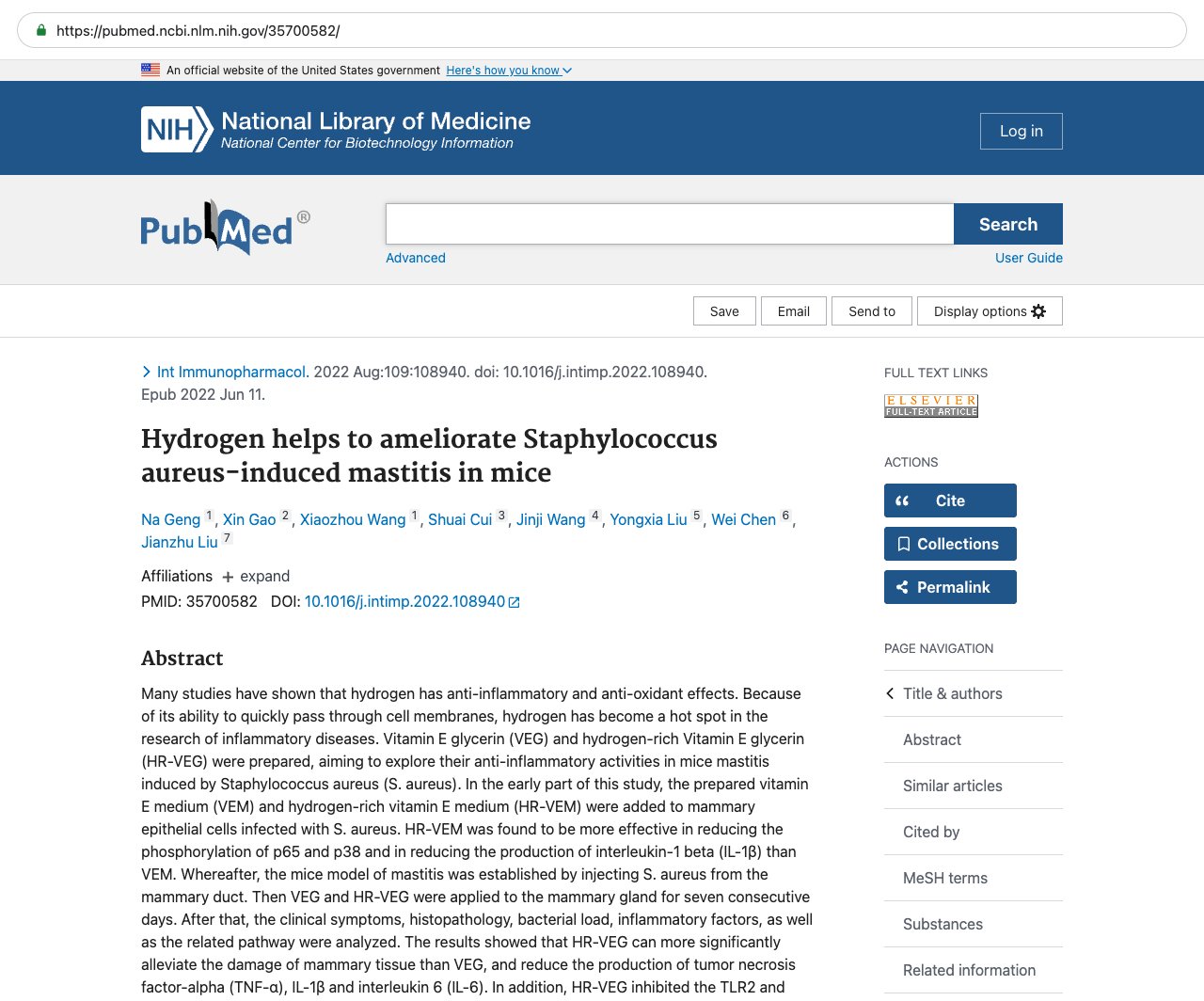
This page mirrors the published abstract (© the authors / publisher) for reference and citation. The canonical source is the PubMed record linked above. This is not medical advice.