1993 · Glamann et al. — Hydrogen inhalation for detecting intracardiac left-to-right shunting in adults
Super-Abstract
The hydrogen inhalation test reliably detected intracardiac left-to-right shunts in adults with perfect separation between the shunt and no-shunt groups (appearance times: 1.5 vs. 12 seconds). Hydrogen inhalation is used here as a sensitive diagnostic tracer — not as a therapeutic agent. The test eliminates the previous ambiguity of paediatric reference values when applied to adults. (American Journal of Cardiology, 1993.)
Commentary
This cardiology study establishes adult reference values for the hydrogen inhalation shunt test. The test works on a simple physical principle: inhaled H₂ passes from the lungs into the venous blood; if there is an abnormal opening between heart chambers (shunt), hydrogen arrives in the pulmonary artery far faster than normal. The study clarifies what „normal“ and „abnormal“ appearance times look like specifically in adults — previous data were mostly from children. The result is a clean diagnostic threshold. Molecular hydrogen therapy is not involved.
Key quotes
- „The 18 patients without shunting had an appearance time of 12 ± 3 seconds, and it was ≥ 9 seconds in all.“ — normal range in adults — clear lower boundary established
- „The 27 subjects with shunting had an appearance time of 1.5 ± 0.7 second, with only 1 of 27 being ≥ 3 seconds.“ — shunt group: dramatically faster appearance with virtually no overlap
- „The hydrogen inhalation technique easily and reliably separates adult subjects with and without intracardiac left-to-right shunting, with no overlap between the 2 groups.“ — conclusion: the test is highly discriminatory in adults
Our assessment
Important context: this study does not investigate molecular hydrogen (H₂) as a therapeutic intervention. Hydrogen inhalation is used exclusively as a diagnostic tracer in cardiac catheterisation to detect intracardiac shunts. This is one of the classic non-therapeutic clinical uses of H₂ — alongside the hydrogen clearance method for blood flow measurement. The study is prospective (n = 45 adults) with good diagnostic characterisation. Limitations: single-centre, no blinding described, no patients with very small shunts (Qp/Qs < 1.2) systematically included. Not relevant to H₂ therapy.
Study design
- Type: prospective diagnostic accuracy study · n: 45 adults (18 without, 27 with intracardiac shunting; ages 18–72) · H₂ delivery: inhalation as diagnostic cardiac tracer — not therapeutic
- Result: shunt group appearance time 1.5 ± 0.7 s vs. 12 ± 3 s in controls; no overlap between groups; test independently of shunt magnitude
Abstract
The hydrogen inhalation technique is easily performed and exquisitely sensitive for detecting intracardiac left-to-right shunting. Previous studies of this technique relied heavily on data from infants and children, and the distinction between "normal" and "abnormal" was imprecise and somewhat arbitrary. The present study was done to assess the results of hydrogen inhalation in adults with and without intracardiac left-to-right shunting. In 45 adult subjects (15 men, 30 women, aged 18 to 72 years) (18 without and 27 with intracardiac left-to-right shunting), the elapsed time from hydrogen inhalation to its appearance in the pulmonary artery was measured. The 18 patients without shunting had an appearance time of 12 +/- 3 (mean +/- SD) seconds, and it was > or = 9 seconds in all. In contrast, the 27 subjects with shunting had an appearance time of 1.5 +/- 0.7 second, with only 1 of 27 being > or = 3 seconds. There was no relation between the magnitude of left-to-right shunting and the hydrogen appearance time. Thus, the hydrogen inhalation technique easily and reliably separates adult subjects with and without intracardiac left-to-right shunting, with no overlap between the 2 groups.
Source & links
Screenshot of the PubMed page
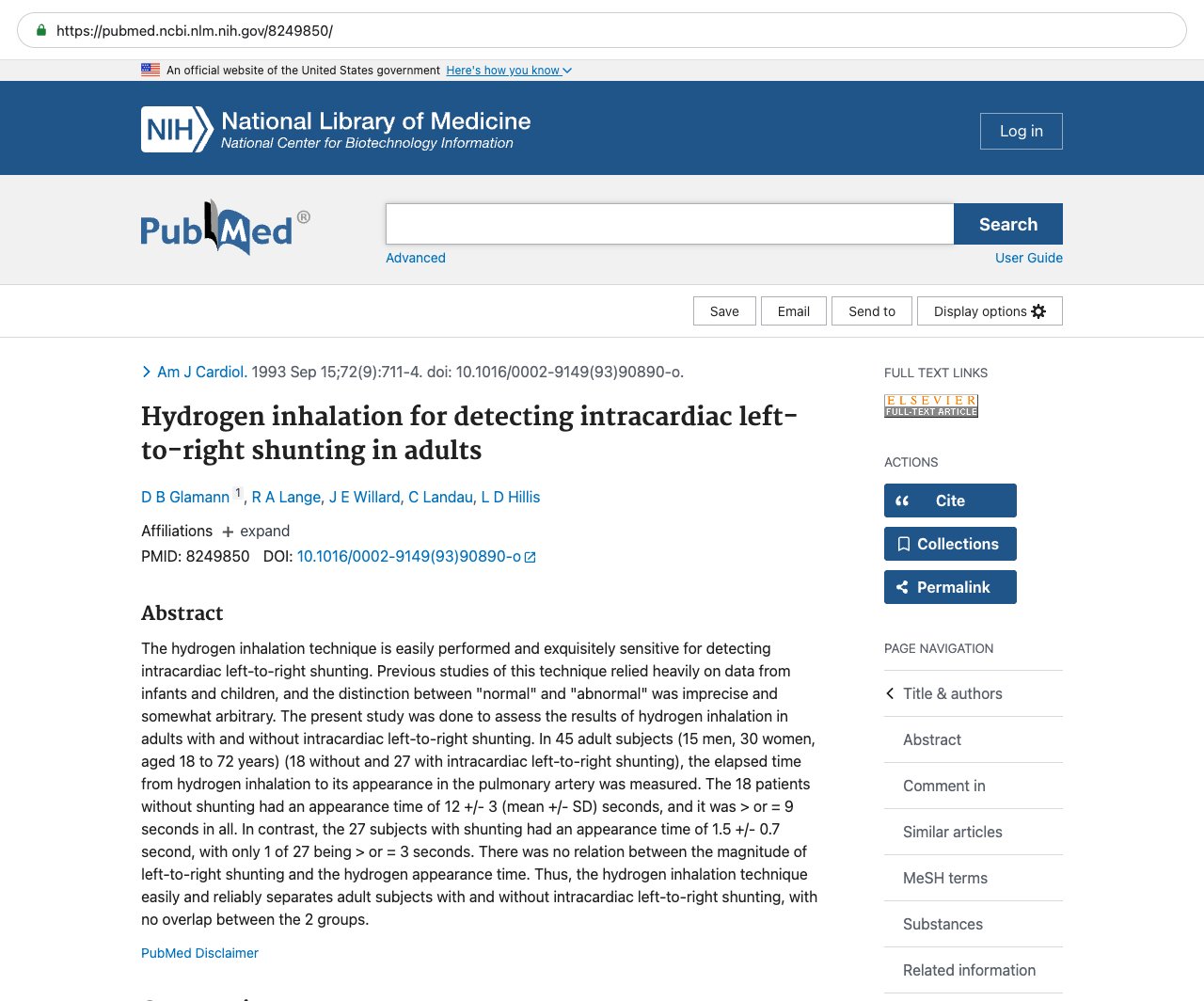
This page mirrors the published abstract (© the authors / publisher) for reference and citation. The canonical source is the PubMed record linked above. This is not medical advice.