2021 · Li — Hydrogen Attenuates Endotoxin-Induced Lung Injury by Activating Thioredoxin 1 and Decreasing Tissue Factor Expression
Super-Abstract
In a mouse model of endotoxin-induced lung injury, H₂ inhalation significantly improved survival, reduced pulmonary oedema, and decreased neutrophil infiltration — apparently by activating the antioxidant protein Thioredoxin 1 (Trx1), which in turn suppressed tissue factor (TF) and MMP-9. This preclinical study identifies Trx1 as a likely mechanistic mediator. No human patients were involved.
Commentary
Endotoxin-induced acute lung injury (ALI) is a life-threatening condition with limited treatment options. This study addresses a previously unexplored mechanistic question: how exactly does H₂ confer protection? The authors used a lipopolysaccharide (LPS) mouse model and showed that H₂ both improved macroscopic outcomes (survival rate, lung pathology, oedema) and reduced coagulation-related markers (tissue factor, MMP-9). Crucially, they used the Trx1 inhibitor PX12 to demonstrate that blocking Trx1 abolished H₂'s protective effects in cell culture — providing pharmacological evidence for Trx1 as a key mediator. The mechanistic chain proposed (H₂ → ↑Trx1 → ↓TF → ↓MMP-9 → attenuated inflammation) is clear and testable. This remains, however, entirely a mouse/cell model study.
Key quotes
- „Hydrogen significantly improved the survival rate of mice, reduced pulmonary edema and hemorrhage, infiltration of neutrophils, and IL-6 secretion.“ — multi-endpoint protective effect in the LPS lung injury mouse model
- „Inhalation of hydrogen decreased tissue factor (TF) expression and MMP-9 activity, while Trx1 expression was increased in the lungs and serum of endotoxemia mice.“ — the key mechanistic observation linking H₂ to Trx1 activation
- „Hydrogen attenuates endotoxin-induced lung injury by decreasing TF expression and MMP-9 activity via activating Trx1.“ — proposed mechanistic conclusion — preclinical
Our assessment
A mechanistically focused preclinical study that goes beyond demonstrating an effect to identifying a specific molecular target (Trx1). The use of a pharmacological inhibitor (PX12) to confirm the causal role of Trx1 is a methodological strength. Limitations: all evidence is from LPS-challenged mice and cultured cell lines (THP-1, HUVEC-C) — standard but simplified models of septic lung injury. Whether Trx1 activation by H₂ plays the same role in human endotoxemia or ALI is unknown. No clinical translation can be assumed at this stage.
Study design
- Type: animal + in-vitro (preclinical) · Model: LPS-induced lung injury mice; THP-1 monocytes; HUVEC-C endothelial cells · H₂ delivery: H₂ inhalation
- Endpoints: survival rate, lung pathology, pulmonary oedema, neutrophil infiltration, IL-6, TF expression, MMP-9 activity, Trx1 expression; Trx1 inhibitor (PX12) used to confirm mechanism in vitro
- Key finding: H₂ improved survival and attenuated lung injury; Trx1 was upregulated; Trx1 inhibition abolished H₂ anti-inflammatory effects in vitro — supporting Trx1 as a required mediator
Abstract
Endotoxin-induced lung injury is one of the major causes of death induced by endotoxemia, however, few effective therapeutic options exist. Hydrogen inhalation has recently been shown to be an effective treatment for inflammatory lung injury, but the underlying mechanism is unknown. In the current study we aim to investigate how hydrogen attenuates endotoxin-induced lung injury and provide reference values for the clinical application of hydrogen. LPS was used to establish an endotoxin-induced lung injury mouse model. The survival rate and pulmonary pathologic changes were evaluated. THP-1 and HUVECC cells were cultured in vitro. The thioredoxin 1 (Trx1) inhibitor was used to evaluate the anti-inflammatory effects of hydrogen. Hydrogen significantly improved the survival rate of mice, reduced pulmonary edema and hemorrhage, infiltration of neutrophils, and IL-6 secretion. Inhalation of hydrogen decreased tissue factor (TF) expression and MMP-9 activity, while Trx1 expression was increased in the lungs and serum of endotoxemia mice. LPS-stimulated THP-1 and HUVEC-C cells in vitro and showed that hydrogen decreases TF expression and MMP-9 activity, which were abolished by the Trx1 inhibitor, PX12. Hydrogen attenuates endotoxin-induced lung injury by decreasing TF expression and MMP-9 activity via activating Trx1. Targeting Trx1 by hydrogen may be a potential treatment for endotoxin-induced lung injury.
Source & links
Screenshot of the PubMed page
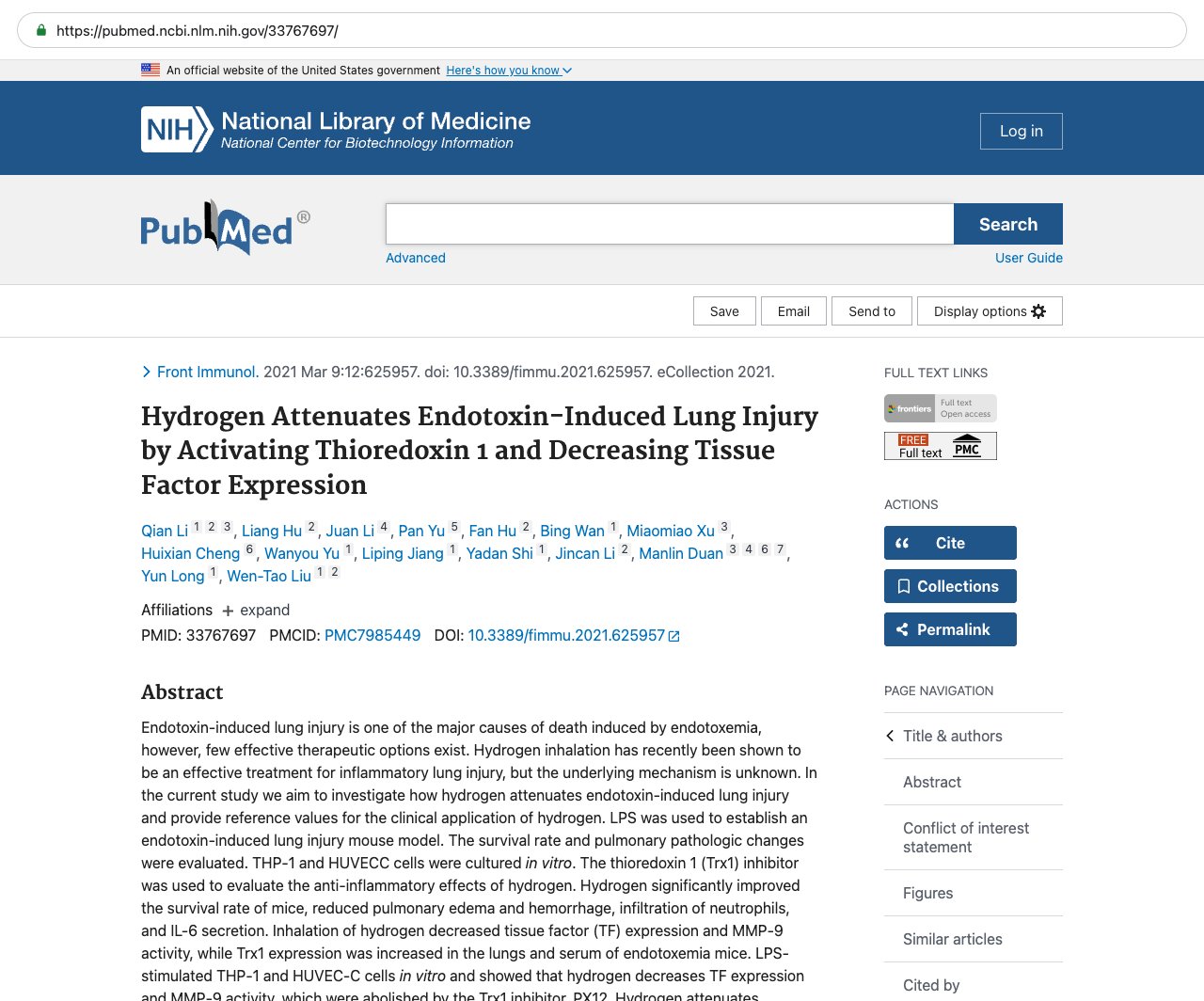
This page mirrors the published abstract (© the authors / publisher) for reference and citation. The canonical source is the PubMed record linked above. This is not medical advice.