2021 · Gopi — Cobalt-modified 2D porous organic polymer for highly efficient electrocatalytic removal of toxic urea and nitrophenol
Super-Abstract
This electrochemistry study developed a cobalt-doped porous organic polymer that can efficiently catalyse the oxidation of urea and reduction of 4-nitrophenol from wastewater. Hydrogen gas appears as a by-product of the urea oxidation reaction — it is not the subject of study and has no therapeutic relevance. This is an environmental chemistry paper, not a medical study.
Commentary
The urea oxidation reaction (UOR) is relevant to sustainable electrochemistry because it requires less energy than water electrolysis and simultaneously removes a pollutant. In the UOR, the anode oxidises urea while the cathode — in a coupled system — generates hydrogen gas. The H₂ produced here is an energy carrier and industrial by-product, not a therapeutic agent. The paper's medical relevance is zero: it addresses environmental remediation and green energy chemistry. The cobalt-doped porous organic polymer (CoPOP) materials are evaluated for their catalytic performance (Tafel slope, onset potential), and the H₂ production is characterised by gas chromatography as part of the UOR product analysis — not as a medical or biological intervention.
Key quotes
- „The urea oxidation reaction (UOR) and nitrophenol reduction are safe and key limiting reactions for sustainable energy conversion and storage.“ — context: this is sustainable energy/environmental chemistry, not medicine
- „LSV investigated the catalytic activity of materials toward UOR, producing hydrogen gas, the products of which were analyzed via gas chromatography.“ — H₂ is a catalysis by-product measured analytically — not a therapeutic target
- „cobalt metal-doped porous organic polymers can be used as efficient catalysts to remove urea and nitrophenol from wastewater.“ — actual conclusion: environmental remediation application
Our assessment
This is an environmental electrochemistry paper with no relevance to molecular H₂ as a therapeutic agent. The H₂ mentioned is a reaction by-product of electrochemical urea oxidation — a green chemistry application. No medical or biological H₂ evidence is presented. Inclusion in a medical H₂ database is an indexing artefact. The study is methodologically competent within its domain (electrocatalysis, materials science) but entirely outside the scope of hydrogen medicine.
Study design
- Type: in-vitro electrochemistry (environmental/materials science, not medical) · Model: electrochemical cell; 4-nitrophenol reduction test · H₂ role: UOR by-product, measured by gas chromatography — no therapeutic relevance
- Material: cobalt-doped porous organic polymer (CoPOP), carbonised at 400 and 600 °C; characterised by FT-IR, TEM, SEM, PXRD, XPS
- Key finding: CoPOP-2 showed lower onset potential and 80 mV dec⁻¹ Tafel slope for UOR; CoPOP-3 catalysed 4-NP reduction at 0.069 min⁻¹ — wastewater treatment performance metrics, no H₂ medicine relevance
Abstract
The urea oxidation reaction (UOR) and nitrophenol reduction are safe and key limiting reactions for sustainable energy conversion and storage. Urea and nitrophenol are abundant in industrial and agricultural wastes, human wastewater, and in the environment. Catalytic oxidative and reductive removal is the most effective process to remove urea and 4-nitrophenol from the environment, necessary to protect human health. 2D carbon-supported, cobalt nanoparticle-based materials are emerging catalysts for nitrophenol reduction and as an anode material for the UOR. In this work, cobalt modified on a porous organic polymer (CoPOP) was synthesized and carbonized at 400 and 600 °C. The formation of CoPOP was confirmed by FT-IR spectroscopy, the 2D graphitic layer and amorphous carbon with cobalt metal by TEM, SEM, and PXRD, and the elemental composition by TEM mapping, EDX, and XPS. The catalytic activity for the 4-nitrophenol reduction was studied and the related electrocatalytic UOR was scientifically evaluated. The catalytic activity toward the reduction of 4-NP to 4-AP was tested with the addition of NaBH4; CoPOP-3 exhibited enhanced activity at a rate of 0.069 min-1. Furthermore, LSV investigated the catalytic activity of materials toward UOR, producing hydrogen gas, the products of which were analyzed via gas chromatography. Among the electrocatalysts studied, CoPOP-2 exhibited a lower onset potential, and the Tafel slope was 1.34 V and 80 mV dec-1. This study demonstrates that cobalt metal-doped porous organic polymers can be used as efficient catalysts to remove urea and nitrophenol from wastewater.
Source & links
Screenshot of the PubMed page
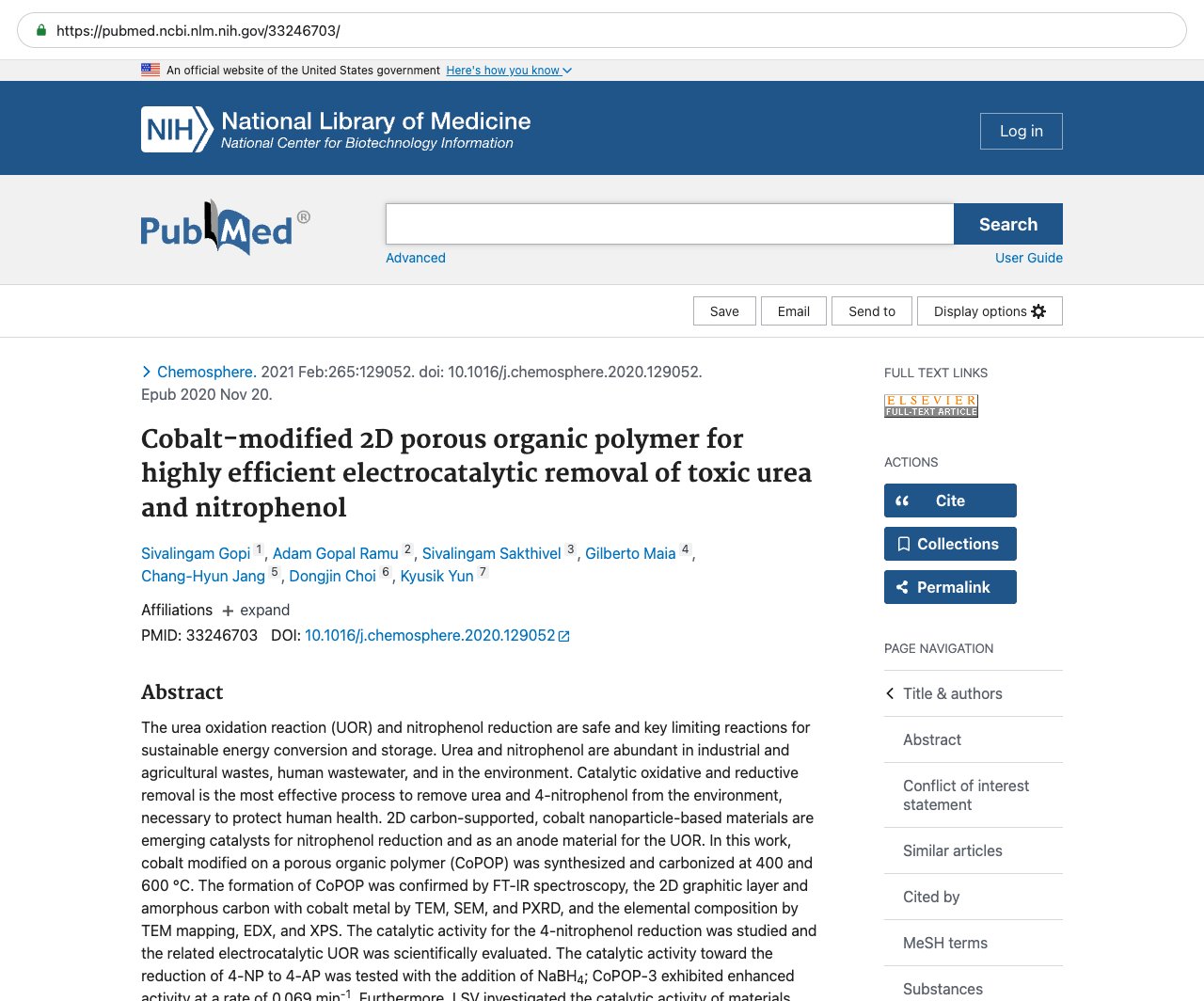
This page mirrors the published abstract (© the authors / publisher) for reference and citation. The canonical source is the PubMed record linked above. This is not medical advice.