2009 · Gray-Munro — The mechanism of deposition of calcium phosphate coatings from solution onto magnesium alloy AZ31.
Super-Abstract
This in-vitro materials science study investigated how calcium phosphate coatings can be deposited onto magnesium alloy surfaces to slow their degradation in biological environments. Magnesium alloys are of interest as bioabsorbable implant materials, but their rapid corrosion produces hydrogen gas as a byproduct — a problem this coating approach aims to address. (Journal of Biomedical Materials Research, 2009.)
Commentary
This is a biomaterials engineering paper — it belongs to the field of orthopaedic implant science, not to therapeutic hydrogen research. The connection to H₂ is purely incidental: magnesium alloys degrade in biological environments by reacting with water, and one of the corrosion byproducts is hydrogen gas evolution. The study aims to control this corrosion (and thus reduce unwanted H₂ release) by applying a protective calcium phosphate (hydroxyapatite-like) coating. The generation of H₂ here is an engineering problem to be minimized, not a therapeutic benefit. This paper does not investigate dissolved H₂ as a bioactive molecule, H₂-rich water, or any form of hydrogen therapy.
Key quotes
- „hydrogen gas evolution and an increase in alkalinity are both byproducts of the degradation process. This necessitates the development of magnesium alloys with controlled degradation rates.“ — H₂ here is an unwanted byproduct of implant corrosion — the study aims to reduce it
- „Calcium phosphate coatings have been shown to improve the biocompatibility of metallic implants for orthopedic applications.“ — the rationale for applying hydroxyapatite-like coatings
- „the deposition of the coating is related to the anodic dissolution of the substrate.“ — the mechanistic finding of the coating study
Our assessment
This paper has no relevance to therapeutic molecular hydrogen (H₂). Hydrogen gas appears only as an unwanted corrosion byproduct that the study seeks to suppress. The work is relevant to bioabsorbable orthopaedic implant engineering, not to hydrogen therapy.
Study design
- Type: in-vitro materials science study · Model: magnesium alloy AZ31 surfaces; calcium phosphate coating deposition from solution · H₂ connection: none therapeutic (H₂ = corrosion byproduct to be reduced)
- Result: calcium phosphate coating successfully deposited via anodic dissolution mechanism; XPS/SEM/XRD characterization showed poorly crystalline calcium magnesium hydroxyapatite; coating intended to slow Mg degradation and H₂ evolution
Abstract
In recent years, magnesium alloys have been proposed as a new class of metallic bioabsorbable implant material. Unfortunately, hydrogen gas evolution and an increase in alkalinity are both byproducts of the degradation process. This necessitates the development of magnesium alloys with controlled degradation rates. The development of biocompatible coatings that can delay the onset of corrosion is essential for improving the lifetime and performance of these materials in vivo. Calcium phosphate coatings have been shown to improve the biocompatibility of metallic implants for orthopedic applications. In this article, we report a solution chemistry technique for depositing calcium phosphate coatings on magnesium alloy surfaces. Our kinetic studies indicate that the deposition of the coating is related to the anodic dissolution of the substrate. Characterization of the coating by XPS, SEM/EDS, and XRD reveal that the coating produced is a poorly crystalline calcium magnesium hydroxyapatite material.
Source & links
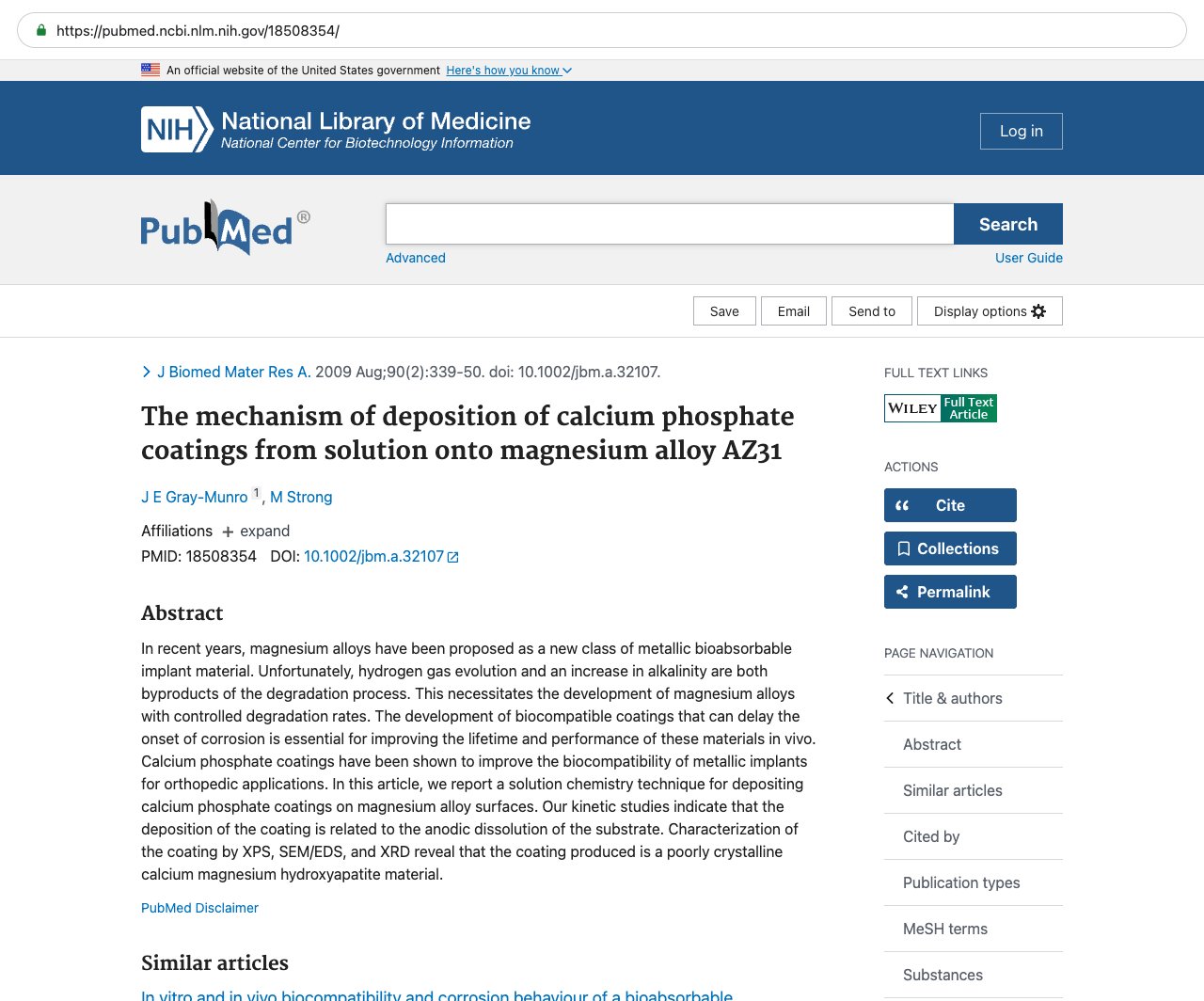
Screenshot of the PubMed page
This page mirrors the published abstract (© the authors / publisher) for reference and citation. The canonical source is the PubMed record linked above. This is not medical advice.