2020 · Shibayama — Impact of hydrogen-rich gas mixture inhalation through nasal cannula during post-exercise recovery period on subsequent oxidative stress, muscle damage, and exercise performances in men
Super-Abstract
Inhaling hydrogen gas right after intense exercise lowered a DNA oxidation marker and protected jump strength from the exercise-induced drop. Other performance and blood markers, however, remained unchanged. (Medical Gas Research, 2020, double-blind, crossover, n = 8.)
Commentary
This study looks at the recovery phase: what happens when you inhale hydrogen gas immediately after a hard training session? Eight physically active men went through a strenuous program in a double-blind crossover design — 30 minutes of treadmill running at 75% of maximal oxygen uptake plus five sets of squat jumps. Afterwards they breathed either an H₂-rich gas mixture or normal ambient air as placebo for 60 minutes. The result is nuanced: H₂ inhalation dampened the rise of 8-hydroxydeoxyguanosine in urine, an established marker of oxidative DNA damage (p < 0.05), and protected against the drop in jump height in the countermovement jump (p < 0.05). Interesting is the direct correlation: the more the DNA oxidation marker rose, the more jump performance dropped (r = −0.78, p < 0.01). All other endpoints — remaining performance tests, blood oxidation markers and muscle damage markers — showed no difference. What it means: H₂ here appears to selectively protect oxidative load and a specific performance aspect, but is no cure-all. Honestly though: tiny sample (n = 8), and only individual markers out of many reached significance — that may also be chance.
Key quotes
- „Post-exercise HG inhalation attenuated the increase in urinary 8-hydroxydeoxyguanosine excretion rate (P < 0.05), a DNA oxidation marker, and the reduction in the countermovement jump height (P < 0.05), compared with Placebo inhalation.“ — the two significant effects: less DNA oxidation, protected jump strength
- „Other exercise performances and blood oxidative stress and muscle damage markers did not differ between HG and Placebo inhalation.“ — the honest flip side: most endpoints unchanged
- „the increase in urinary 8-hydroxydeoxyguanosine excretion rate was significantly associated with countermovement jump performance reduction (r = -0.78, P < 0.01).“ — the link between oxidative damage and performance drop
Our assessment
Interesting for H₂ inhalation applications in sports recovery. The study is a good example of honest communication: there is a plausible, significant effect on oxidative DNA stress and one performance aspect — but not on the full range of markers. One should not derive a „H₂ makes you fit faster“ claim from this. Limitation, stated honestly: very small sample (n = 8), multiple comparisons (the risk that individual significances are chance hits is real), and the protective effect only concerned one of several performance tests. Mechanistically the finding (less 8-OHdG) fits the known antioxidant profile of H₂. It complements the mixed picture of the sports evidence in this batch.
Study design
- Type: RCT (double-blind, crossover, repeated measures) · n: 8 (physically active men) · Duration: 60-min inhalation in the recovery phase after an exercise session · H₂ delivery: H₂-rich gas mixture (estimated FiO₂ 21.57%, H₂ up to 4.08%) via nasal cannula
- Result: urinary 8-OHdG rise dampened (p < 0.05); countermovement jump height protected (p < 0.05); correlation 8-OHdG ↔ jump drop r = −0.78 (p < 0.01); remaining performance/blood/muscle markers n.s.
Abstract
Molecular hydrogen has been suggested to have a cytoprotective effect on the whole body and to enhance exercise performances. However, the effect of hydrogen-rich gas mixture (HG) inhalation on physiological responses has been poorly investigated. We examined the impact of acute HG inhalation on subsequent oxidative stress, muscle damage, and exercise performances during the recovery period after a strenuous exercise. This is a two-trial, double-blind, crossover, repeated measures study. Eight physically active male volunteers inhaled HG (estimated fraction of inspired oxygen and hydrogen were 21.57 and 4.08% at most, respectively) or normal gas (placebo, ambient air 400 m above sea level) during a 60-minute recovery phase after oxidative stress-inducing exercise) completion comprising 30-minute treadmill running at an intensity corresponding to 75% of maximal oxygen uptake and squat jumps (5 sets × 10 repetitions). Before oxidative stress-inducing exercise and 10 minutes after the post-exercise gas inhalation, blood and urine samples were obtained and exercise performances (jumping ability; pedaling power output; muscle strength) were evaluated. Post-exercise HG inhalation attenuated the increase in urinary 8-hydroxydeoxyguanosine excretion rate (P < 0.05), a DNA oxidation marker, and the reduction in the countermovement jump height (P < 0.05), compared with Placebo inhalation. Other exercise performances and blood oxidative stress and muscle damage markers did not differ between HG and Placebo inhalation. Moreover, the increase in urinary 8-hydroxydeoxyguanosine excretion rate was significantly associated with countermovement jump performance reduction (r = -0.78, P < 0.01). These findings suggested that HG inhalation during post-exercise recovery period might improve exercise performance via reducing systemic oxidative damage. The study was approved by the Human Research Ethics Committee of the University of Yamanashi (approval No. H29-006) on June 28, 2017.
Source & links
Screenshot of the PubMed page
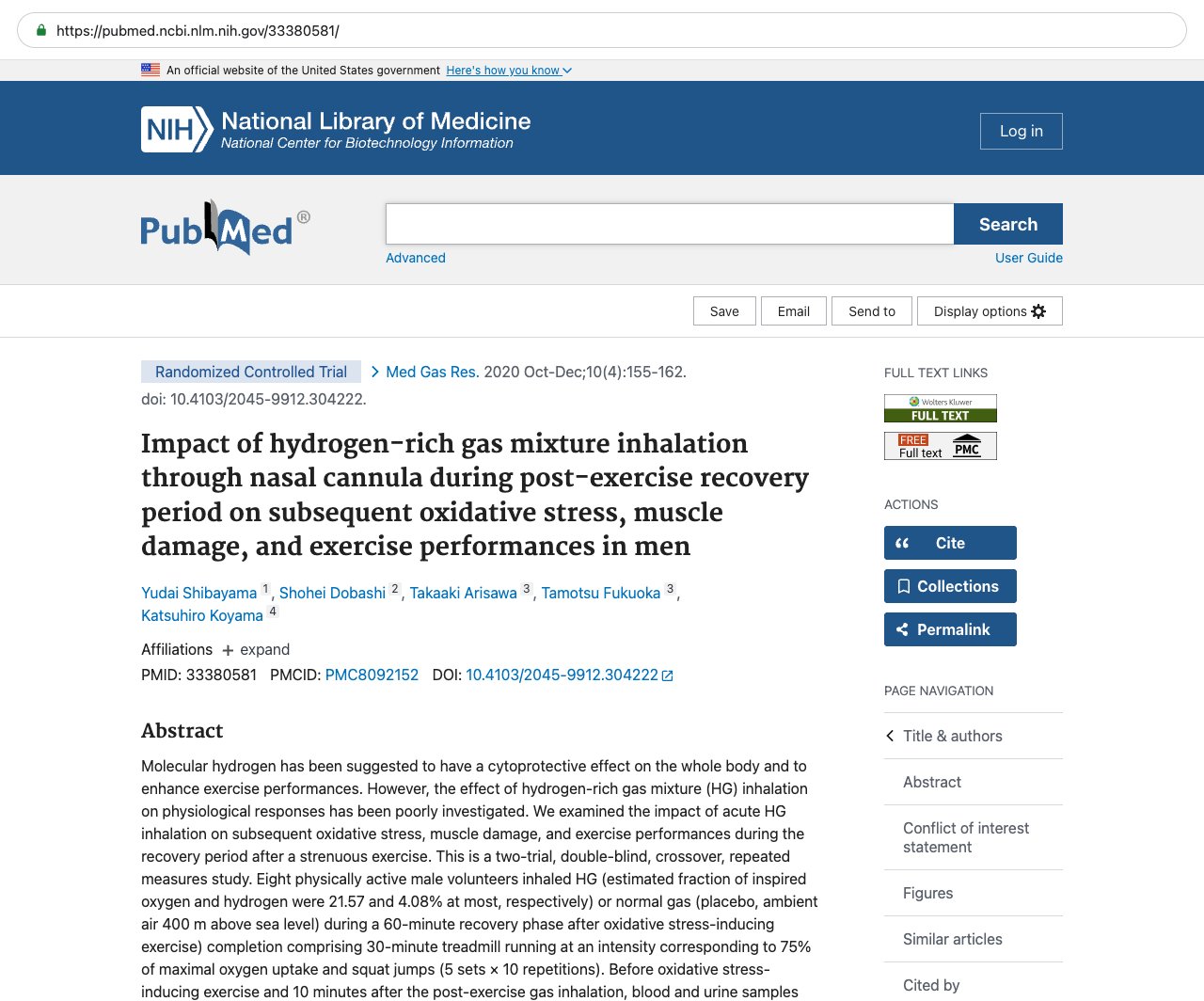
This page mirrors the published abstract (© the authors / publisher) for reference and citation. The canonical source is the PubMed record linked above. This is not medical advice.