2024 Antimicrobial Agents and Chemotherapy Pilot / Observational Human H₂ therapy InhalationBath / Topical
2024 · Salomez-Ihl — H2 inhalation therapy in patients with moderate COVID-19 (H2COVID): a prospective ascending-dose phase I clinical trial
Super-Abstract
Inhaling hydrogen is safe and well tolerated in COVID-19 patients. The first phase-I study (n = 12) showed: a mixture of 3.6% H₂ and 96.4% N₂ was tolerated over up to at least 3 days without explosion risk — every patient improved clinically. (Antimicrobial Agents and Chemotherapy, 2024.)
Commentary
This study is first about a simple but important question: is it even safe to let sick, hospitalized people inhale hydrogen? This was a phase-I study — the very first clinical step, in which safety and tolerability are in the foreground, not efficacy. 12 patients with confirmed SARS-CoV-2 infection received a gas mixture of 3.6% hydrogen and 96.4% nitrogen, in an ascending 3-plus-3 dose design over 1, 3 or 6 days. The result: the maximum tolerated duration was at least 3 days, every patient showed clinical improvement and excellent tolerability. Technically important — the device used rules out an explosion risk, which must always be considered with hydrogen. Quite honestly: with only 12 patients and no control group, this study cannot prove a healing effect. But it paves the way: the authors explicitly call for larger, controlled studies. The core value is the documented safety of H₂ inhalation in a clinical setting.
Key quotes
- „We concluded that the maximum tolerated duration is at least 3 days. Every patient showed clinical improvement and excellent tolerance to H2 therapy.“ — tolerability and clinical improvement in all patients
- „To the best of our knowledge, this phase I clinical trial is the first to establish the safety of inhaling a mixture of H2 (3.6%) and N2 (96.4%) in hospitalized COVID-19 patients.“ — first safety demonstration of this H₂ inhalation in hospitalized patients
- „The original device and method employed ensure the absence of explosion risk.“ — safety aspect: no explosion risk from the device
Our assessment
Valuable as safety evidence for H₂ inhalation in a clinical setting — an argument that counts in any serious information on hydrogen applications. The study shows that H₂ inhalation is well tolerated even in the acutely ill and can be implemented technically safely (no explosion risk). Limitation, stated honestly: it is explicitly a phase-I safety study with only 12 patients and no control group — the „clinical improvement“ here is not proof of efficacy, but an observation that can be explained by the natural course of the disease. Efficacy must yet be demonstrated in larger controlled studies.
Study design
- Type: phase-I study (open, prospective, monocentric, single ascending dose, 3+3 design) · n: 12 · Duration: target periods 1, 3 and 6 days · H₂ delivery: inhalation of a mixture of 3.6% H₂ and 96.4% N₂ (with nasal oxygen therapy)
- Result metrics: maximum tolerated duration at least 3 days; clinical improvement and excellent tolerability in all patients; no explosion risk (registered as NCT04633980)
Abstract
UNLABELLED: The coronavirus disease 2019 (COVID-19) pandemic, caused by the severe acute respiratory syndrome coronavirus 2 (SARS-CoV-2), has triggered a serious global health crisis, resulting in millions of reported deaths since its initial identification in China in November 2019. The global disparities in immunization access emphasize the urgent need for ongoing research into therapeutic interventions. This study focuses on the potential use of molecular dihydrogen (H2) inhalation as an adjunctive treatment for COVID-19. H2 therapy shows promise in inhibiting intracellular signaling pathways associated with inflammation, particularly when administered early in conjunction with nasal oxygen therapy. This phase I study, characterized by an open-label, prospective, monocentric, and single ascending-dose design, seeks to assess the safety and tolerability of the procedure in individuals with confirmed SARS-CoV-2 infection. Employing a 3 + 3 design, the study includes three exposure durations (target durations): 1 day (D1), 3 days (D2), and 6 days (D3). We concluded that the maximum tolerated duration is at least 3 days. Every patient showed clinical improvement and excellent tolerance to H2 therapy. To the best of our knowledge, this phase I clinical trial is the first to establish the safety of inhaling a mixture of H2 (3.6%) and N2 (96.4%) in hospitalized COVID-19 patients. The original device and method employed ensure the absence of explosion risk. The encouraging outcomes observed in the 12 patients included in the study justify further exploration through larger, controlled clinical trials. CLINICAL TRIALS: This study is registered with ClinicalTrials.gov as NCT04633980.
Source & links
Screenshot of the PubMed page
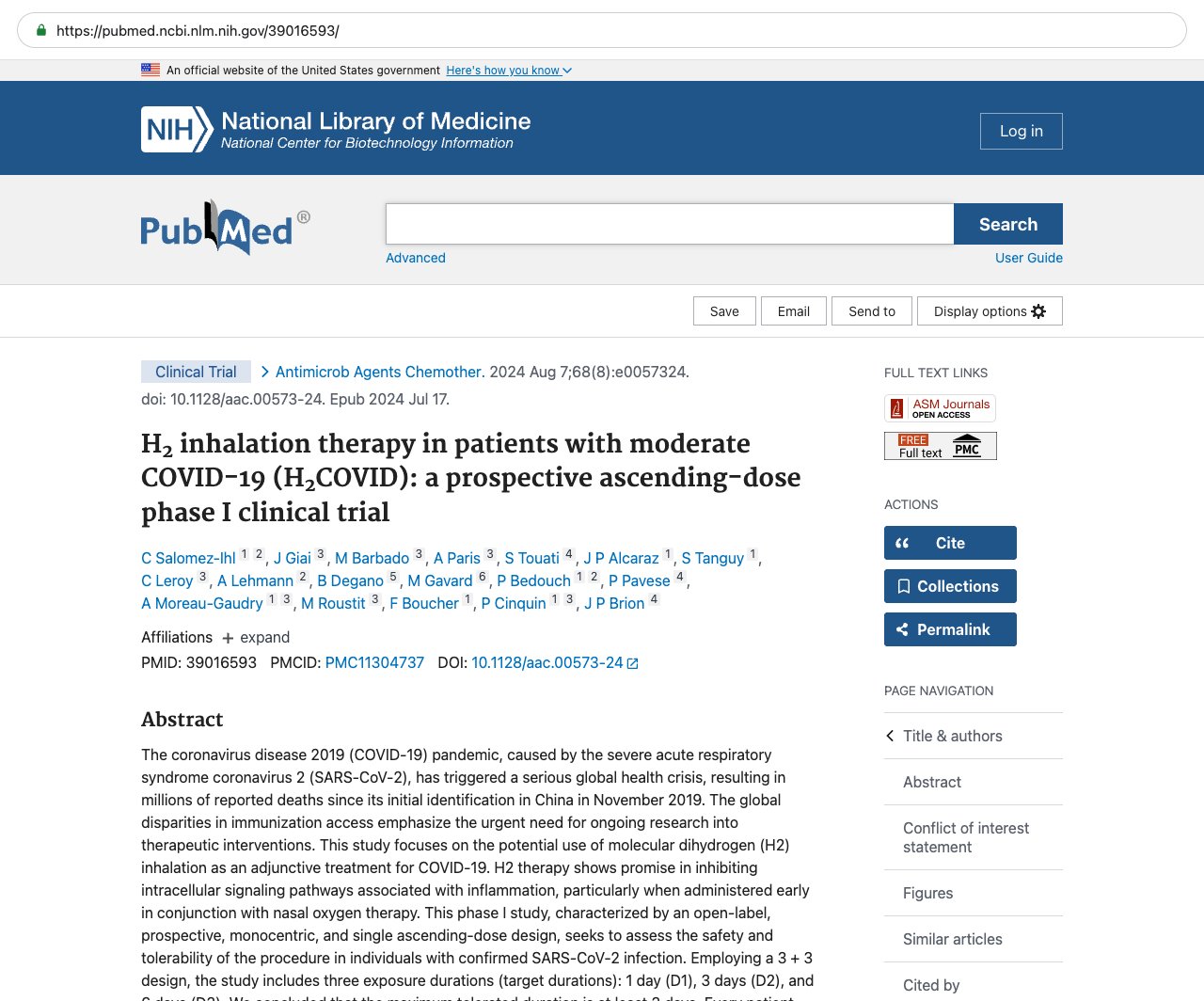
This page mirrors the published abstract (© the authors / publisher) for reference and citation. The canonical source is the PubMed record linked above. This is not medical advice.