2024 · Guan — Successful treatment of Behçet's disease ulcers and skin lesions with hydrogen water.
Super-Abstract
A case report describing the successful use of hydrogen water in treating oral ulcers and skin lesions associated with Behçet's disease — a rare systemic vasculitis for which conventional therapies often provide incomplete relief. Full abstract text was not available for this entry; the finding is based on title and metadata only. (International Journal of Dermatology, 2024.)
Commentary
Behçet's disease is a rare, chronic inflammatory disorder characterised by recurrent oral ulcers, genital ulcers, skin lesions, and ocular involvement. It is driven by dysregulated innate and adaptive immunity. Standard treatments include corticosteroids, colchicine, and immunosuppressants — none of which are curative. The use of hydrogen water in this context is plausible given H₂'s established anti-inflammatory and antioxidant properties, but the full clinical details, method of H₂ administration, duration, and outcome specifics are not available from the abstract provided. The case-report format inherently limits generalisability.
Our assessment
No abstract was available for this entry — assessment is based on title and journal metadata only. As a case report in a dermatology journal, this represents a hypothesis-generating anecdote. Behçet's disease is an appropriate target indication for H₂'s proposed anti-inflammatory mechanism, and hydrogen water is a low-risk intervention. However, no efficacy conclusions can be drawn without the full text. Limitations: n=1 (assumed); no control; details of administration, dose, and duration unknown.
Study design
- Type: case report (full abstract not available) · H₂ delivery: hydrogen water (drinking) · Indication: Behçet's disease — oral ulcers and skin lesions
- Reported outcome: described as 'successful treatment' in the title; clinical details not available from abstract
Source & links
Screenshot of the PubMed page
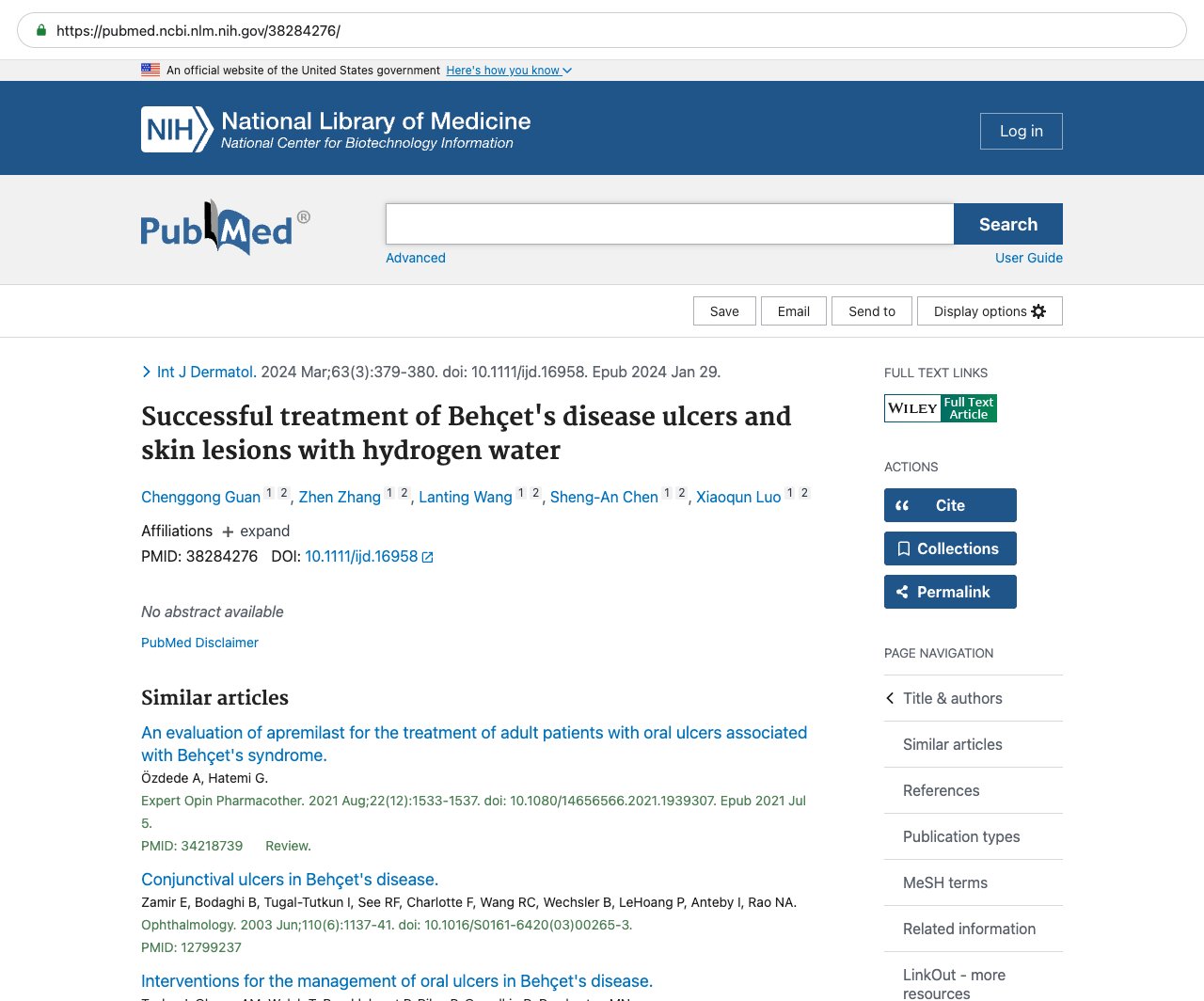
This page mirrors the published abstract (© the authors / publisher) for reference and citation. The canonical source is the PubMed record linked above. This is not medical advice.