2002 · Happe — Hydrogenases in green algae: do they save the algae's life and solve our energy problems?
Super-Abstract
Green algae are the only known eukaryotes capable of both photosynthesis and hydrogen metabolism — a dual ability that may hold the key to sustainable H₂ production. This in-vitro study shows that the enzyme [Fe]-hydrogenase acts as an electron „valve,“ allowing algae to survive anaerobic conditions. Under sulfur deprivation, algae can produce large quantities of hydrogen gas — a finding with potential relevance for future energy technology. (Trends in Plant Science, 2002.)
Commentary
This work by Happe and colleagues focuses on a fundamental biological question: why do green algae have a hydrogen metabolism at all? The answer turns out to be elegant — the [Fe]-hydrogenase functions as a safety valve that enables the algae to survive when oxygen is absent by rerouting electrons from photosynthesis into hydrogen gas production. The additional observation that sulfur-deprived algal cultures can produce substantial quantities of molecular hydrogen sparked interest in biological H₂ generation as a renewable energy concept. This is basic biochemistry and bioenergetics research, not a study of therapeutic hydrogen effects in mammals or humans.
Key quotes
- „the [Fe]-hydrogenase is an electron 'valve' that enables the algae to survive under anaerobic conditions.“ — core function of algal hydrogenase: survival under oxygen deprivation
- „During sulfur deprivation, illuminated algal cultures evolve large quantities of hydrogen gas, and this promises to be an alternative future energy source.“ — potential biotechnological application: biological H₂ production
- „The anaerobically inducible hydA genes of algae encode a special type of highly active [Fe]-hydrogenase.“ — genetic basis of algal hydrogen metabolism
Our assessment
This is a basic science paper on algal hydrogen metabolism — it is not a therapeutic study and contains no data on hydrogen effects in animals or humans. The relevance to H₂ medicine is indirect at best: the work helps explain where biological H₂ comes from and how hydrogenases work at a molecular level. The idea of using algae for large-scale H₂ production has since been explored further, though commercial viability remains an open challenge. Readers interested in H₂ therapy should note that this study provides no evidence for health effects of hydrogen in humans.
Study design
- Type: in-vitro / biochemical review · Model: green algae (Chlamydomonas reinhardtii) · H₂ relevance: biological H₂ production via [Fe]-hydrogenase
- Result: [Fe]-hydrogenase identified as electron valve for anaerobic survival; sulfur-deprived algae produce significant H₂ quantities; potential bioenergy application proposed
Abstract
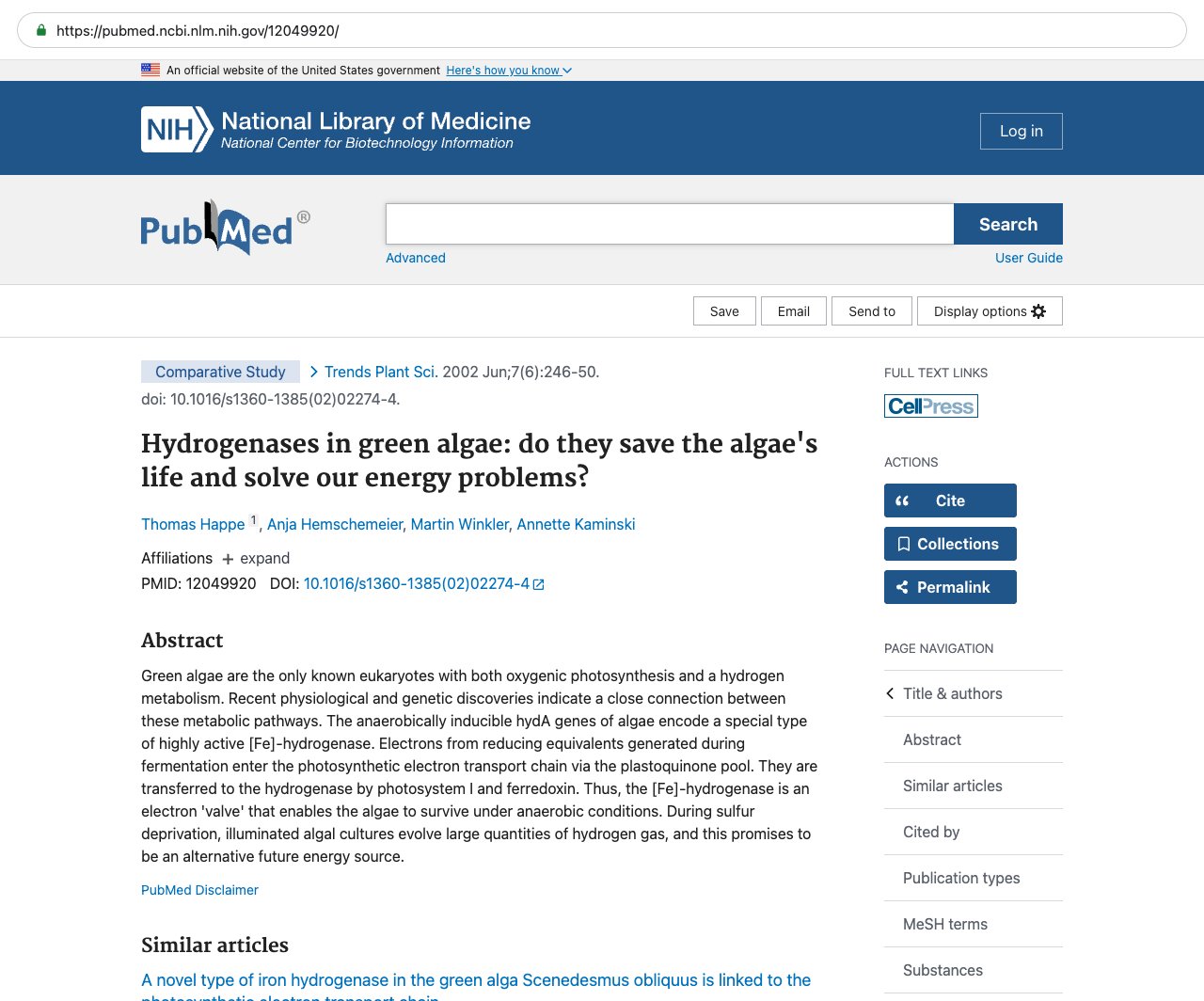
Green algae are the only known eukaryotes with both oxygenic photosynthesis and a hydrogen metabolism. Recent physiological and genetic discoveries indicate a close connection between these metabolic pathways. The anaerobically inducible hydA genes of algae encode a special type of highly active [Fe]-hydrogenase. Electrons from reducing equivalents generated during fermentation enter the photosynthetic electron transport chain via the plastoquinone pool. They are transferred to the hydrogenase by photosystem I and ferredoxin. Thus, the [Fe]-hydrogenase is an electron 'valve' that enables the algae to survive under anaerobic conditions. During sulfur deprivation, illuminated algal cultures evolve large quantities of hydrogen gas, and this promises to be an alternative future energy source.
Source & links
Screenshot of the PubMed page
This page mirrors the published abstract (© the authors / publisher) for reference and citation. The canonical source is the PubMed record linked above. This is not medical advice.