2020 · Kiyoi — Constitutive Hydrogen Inhalation Prevents Vascular Remodeling via Reduction of Oxidative Stress
Super-Abstract
In a mouse model of cuff-induced vascular injury, continuous inhalation of 1.3 % hydrogen gas for several weeks significantly reduced abnormal vascular wall thickening (neointima formation) — an effect associated with decreased DNA damage and downregulation of the NADPH oxidase NOX1. This is a preclinical animal study; its findings are not directly transferable to human cardiovascular disease. (PLOS ONE, 2020.)
Commentary
Vascular neointima formation — excessive smooth muscle proliferation after vessel injury — is a key pathological process in atherosclerosis and restenosis after angioplasty. This mouse model study uses a well-established cuff-injury model to test whether constitutive (continuous long-term) H₂ inhalation can prevent this remodelling process. The study is methodologically careful: it distinguishes between superoxide anion production (unchanged), reactive species such as hydroxyl radical and peroxynitrite (reduced), and NOX1 expression (reduced), providing nuanced mechanistic data. Notably, hydrogen did not eliminate all oxidative signalling but selectively reduced the more harmful hydroxyl radical and peroxynitrite species — consistent with H₂'s proposed role as a selective antioxidant. The suggestion that continuous environmental H₂ inhalation at safe concentrations could prevent vascular disease is an extrapolation that requires human validation.
Key quotes
- „Neointima formation, accompanied by an increase in cell proliferation, was significantly attenuated in the hydrogen group compared with the control group.“ — the primary outcome: H₂ inhalation reduced vascular wall thickening in mouse model
- „DNA damage was decreased as a result of reduction of reactive oxygen species such as hydroxyl radical (⋅OH) and peroxynitrite (ONOO-) in the hydrogen group.“ — the mechanism: H₂ selectively reduced the most damaging ROS species
- „constitutive inhalation of hydrogen gas at a safe concentration in the living environment could be an effective strategy for prevention of vascular diseases such as atherosclerosis.“ — the forward-looking conclusion — speculative, not yet proven in humans
Our assessment
This is an animal study (mouse model) — a preclinical investigation only. The data show a meaningful reduction in neointima formation with H₂ inhalation, with a plausible mechanistic explanation involving selective hydroxyl radical and peroxynitrite reduction. However, mouse cardiovascular models frequently do not translate directly to human disease, and continuous H₂ inhalation as a lifestyle intervention is impractical without substantial further development. The finding is scientifically interesting and supports further investigation, but cannot be used as evidence for cardiovascular benefit of H₂ in humans.
Study design
- Type: in-vivo animal study · Model: C57BL/6 mice; cuff-induced vascular injury of femoral artery; 2 weeks H₂ pre-conditioning + continued H₂ until sampling · H₂ delivery: constitutive inhalation in closed chamber (1.3 % H₂, 21 % O₂, 77.7 % N₂)
- Result: significant attenuation of neointima formation; NOX1 downregulation; reduced hydroxyl radical and peroxynitrite (DNA damage decreased); superoxide anion production unchanged; no H₂ drinking-water group (inhalation only)
Abstract
Molecular hydrogen is thought to have an inhibitory effect on oxidative stress, thereby attenuating the onset and progression of various diseases including cardiovascular disease; however, few reports have assessed the preventive effect of constitutive inhalation of hydrogen gas on of vascular remodeling. Here, we investigated the effect of constitutive inhalation of hydrogen gas on vascular neointima formation using a cuff-induced vascular injury mouse model. After constitutive inhalation of compressed hydrogen gas (O2 21%, N2 77.7%, hydrogen 1.3%) or compressed air only (O2 21%, N2 79%) by C57BL/6 mice for 2 weeks from 8 weeks of age in a closed chamber, inflammatory cuff injury was induced by polyethylene cuff placement around the femoral artery under anesthesia, and hydrogen gas administration was continued until sampling of the femoral artery. Neointima formation, accompanied by an increase in cell proliferation, was significantly attenuated in the hydrogen group compared with the control group. NADPH oxidase NOX1 downregulation in response to cuff injury was shown in the hydrogen group, but the expression levels of NADPH oxidase subunits, p40phox and p47phox, did not differ significantly between the hydrogen and control groups. Although the increase in superoxide anion production did not significantly differ between the hydrogen and control groups, DNA damage was decreased as a result of reduction of reactive oxygen species such as hydroxyl radical (⋅OH) and peroxynitrite (ONOO-) in the hydrogen group. These results demonstrate that constitutive inhalation of hydrogen gas attenuates vascular remodeling partly via reduction of oxidative stress, suggesting that constitutive inhalation of hydrogen gas at a safe concentration in the living environment could be an effective strategy for prevention of vascular diseases such as atherosclerosis.
Source & links
Screenshot of the PubMed page
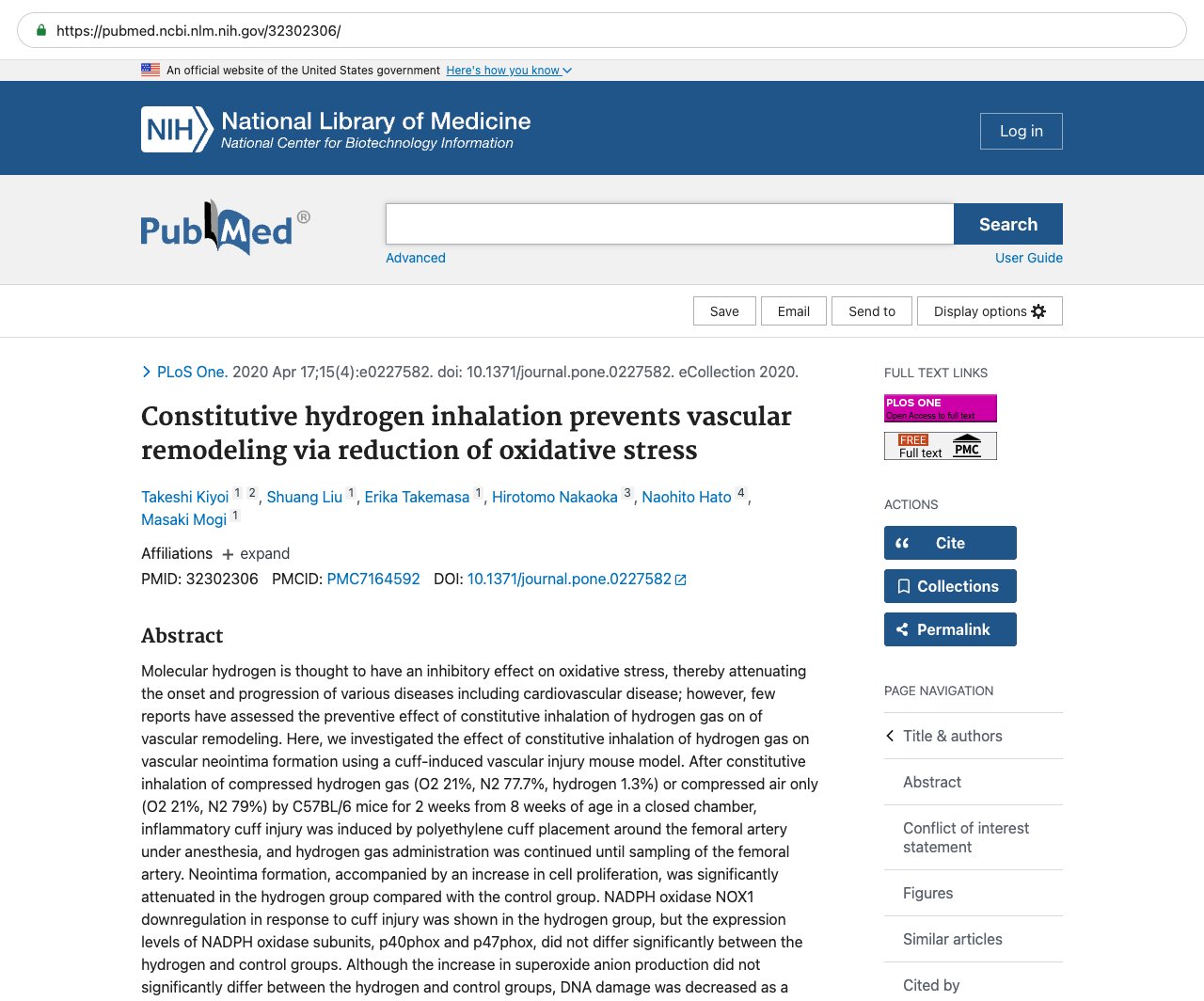
This page mirrors the published abstract (© the authors / publisher) for reference and citation. The canonical source is the PubMed record linked above. This is not medical advice.