2020 · Hirano et al. — A „philosophical molecule,” hydrogen may overcome senescence and intractable diseases
Super-Abstract
This short review argues that molecular hydrogen (H₂) is uniquely positioned to combat ageing and difficult-to-treat diseases by scavenging hydroxyl radicals (·OH) — the most damaging reactive oxygen species — which are predominantly generated in the mitochondria. H₂ is proposed as the only molecule that can both penetrate mitochondria and neutralise ·OH. (Medical Gas Research, 2020.)
Commentary
Hirano and colleagues present a concise theoretical argument with three steps: (1) senescence and disease share a common cause — mitochondrial hydroxyl radical (·OH) accumulation; (2) only H₂ can penetrate mitochondria to scavenge ·OH there; therefore (3) H₂ offers unique anti-ageing and disease-prevention potential. This is a narrative review combining established biochemistry with broad speculative claims. The selectivity of H₂ for ·OH over other ROS is experimentally supported in the literature. However, the leap from „scavenges ·OH in mitochondria” to „overcomes senescence and intractable diseases” is mechanistically vast and not directly supported by clinical data. A practical note in the abstract acknowledges that H₂ gas is flammable, requiring safe delivery devices for home use — a grounded engineering concern within an otherwise sweeping theoretical claim.
Key quotes
- „It is one and only one „molecular hydrogen” (H2) that can both penetrate into the mitochondria and scavenge the •OH.“ — the central selectivity claim: H₂ reaches the mitochondria and acts there
- „Senescence and diseases may be overcome as long as we can scavenge •OH mostly produced in mitochondria.“ — the core mechanistic hypothesis: ·OH as universal driver of ageing and disease
- „H2 gas is explosive so that a safe hydrogen inhaler has to be developed for home use.“ — a practical safety note within a theoretical framework
Our assessment
This is a narrative review with strong theoretical claims. The biochemical premise — that ·OH is central to oxidative cell damage, and that H₂ selectively neutralises it — is supported by the literature. However, the claim that H₂ can „overcome senescence and intractable diseases” is a broad extrapolation that goes significantly beyond available clinical evidence. No human trial data are cited in support of these claims. This paper should be read as a theoretical position piece, not as evidence for clinical H₂ efficacy in ageing or specific diseases.
Study design
- Type: narrative review / opinion · n: n/a (literature synthesis) · H₂ delivery: inhalation (discussed, not tested in this paper)
- Result: theoretical framework: ·OH as driver of senescence; H₂ as selective mitochondrial ·OH scavenger; no pooled clinical data
Abstract
It has been revealed that the cause of senescence and diseases is associated with the reactive oxygen species "hydroxyl radicals" (·OH). Senescence and diseases may be overcome as long as we can scavenge •OH mostly produced in mitochondria. It is one and only one "molecular hydrogen" (H2) that can both penetrate into the mitochondria and scavenge the •OH. The H2 in the body can function in disease prevention and recovery. H2 gas is explosive so that a safe hydrogen inhaler has to be developed for home use. We would like to advocate the great use of H2.
Source & links
Screenshot of the PubMed page
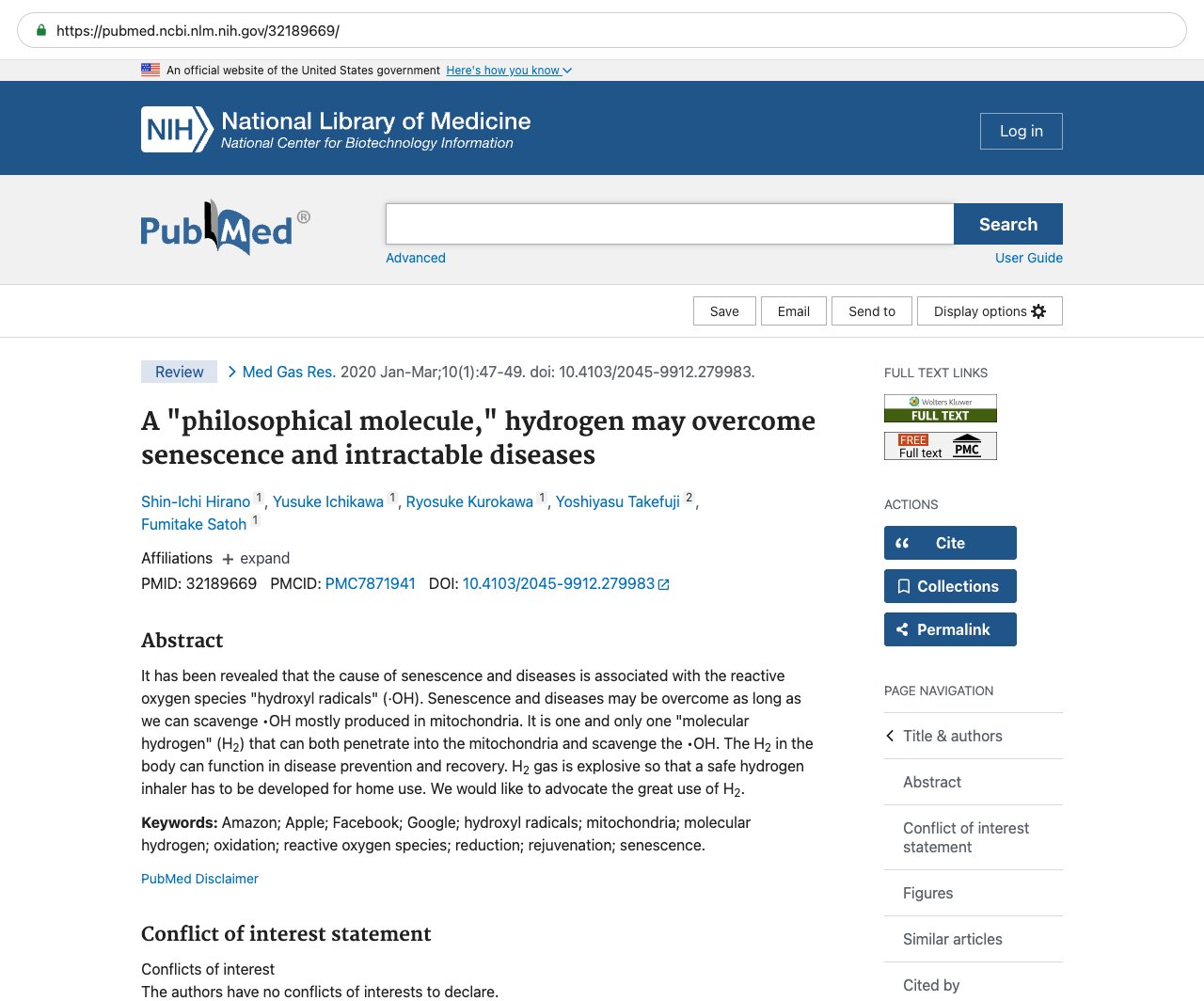
This page mirrors the published abstract (© the authors / publisher) for reference and citation. The canonical source is the PubMed record linked above. This is not medical advice.