2021 · Hirano — Molecular Hydrogen as a Novel Antitumor Agent: Possible Mechanisms Underlying Gene Expression.
Super-Abstract
This review surveys the growing evidence that molecular hydrogen (H₂) may act as an antitumor agent — not only by directly scavenging the most damaging reactive oxygen species (hydroxyl radicals), but also by regulating gene expression through indirect biological defense mechanisms. The authors emphasize that H₂ lacks the side effects of conventional anticancer drugs. (International Journal of Molecular Sciences, 2021.)
Commentary
Cancer development is closely tied to DNA mutations induced by reactive oxygen species (ROS), particularly hydroxyl radicals (·OH). Hirano et al. make the case that H₂ — which selectively neutralizes ·OH without disrupting other redox signaling — may reduce the mutational burden that drives carcinogenesis. Beyond this direct antioxidant action, the review highlights evidence that H₂ modulates gene expression: influencing pathways involved in cellular survival, apoptosis, and inflammation. The paper also surveys studies suggesting H₂ can mitigate side effects of conventional cancer treatments such as chemotherapy and radiotherapy. This is a review authored by a known advocate of H₂ research, which should be considered when assessing framing and emphasis. No new experimental data are presented. The clinical evidence for H₂ as a standalone antitumor agent remains limited; most data come from cell and animal experiments, with some preliminary human studies on quality-of-life outcomes during conventional cancer treatment.
Key quotes
- „H2 has no side effects, unlike conventional antitumor drugs, and that it is effective against many diseases caused by oxidative stress and chronic inflammation.“ — authors' claim about H₂ safety — based on the reviewed literature, not a head-to-head drug trial
- „its mechanisms may not only involve the direct scavenging of ·OH, but also other indirect biological defense mechanisms via the regulation of gene expression.“ — key mechanistic insight of the review: H₂ acts at multiple levels beyond direct radical scavenging
- „there has been an increasing number of papers on the efficacy of H2 against cancer and its effects in mitigating the side effects of cancer treatment.“ — contextualizes the growing but still early evidence base
Our assessment
This is a narrative review, not a clinical trial. It presents a compelling mechanistic argument for H₂ as an antitumor agent, but the clinical evidence base for H₂ as a primary cancer treatment is still limited and largely preclinical. Most data originate from cell culture and animal models; human studies have primarily focused on tolerability and quality of life as an adjunct to conventional therapy. The review is useful for understanding proposed mechanisms, but should not be read as proof that H₂ treats cancer in humans.
Study design
- Type: narrative review · Scope: in-vitro, in-vivo, and early clinical H₂ studies in oncology context · H₂ delivery: multiple modalities discussed
- Conclusion: H₂ may exert antitumor effects via ·OH scavenging and gene expression regulation; safety profile appears favorable; clinical evidence for efficacy as a standalone antitumor agent remains preliminary
Abstract
While many antitumor drugs have yielded unsatisfactory therapeutic results, drugs are one of the most prevalent therapeutic measures for the treatment of cancer. The development of cancer largely results from mutations in nuclear DNA, as well as from those in mitochondrial DNA (mtDNA). Molecular hydrogen (H2), an inert molecule, can scavenge hydroxyl radicals (·OH), which are known to be the strongest oxidizing reactive oxygen species (ROS) in the body that causes these DNA mutations. It has been reported that H2 has no side effects, unlike conventional antitumor drugs, and that it is effective against many diseases caused by oxidative stress and chronic inflammation. Recently, there has been an increasing number of papers on the efficacy of H2 against cancer and its effects in mitigating the side effects of cancer treatment. In this review, we demonstrate the efficacy and safety of H2 as a novel antitumor agent and show that its mechanisms may not only involve the direct scavenging of ·OH, but also other indirect biological defense mechanisms via the regulation of gene expression.
Source & links
Screenshot of the PubMed page
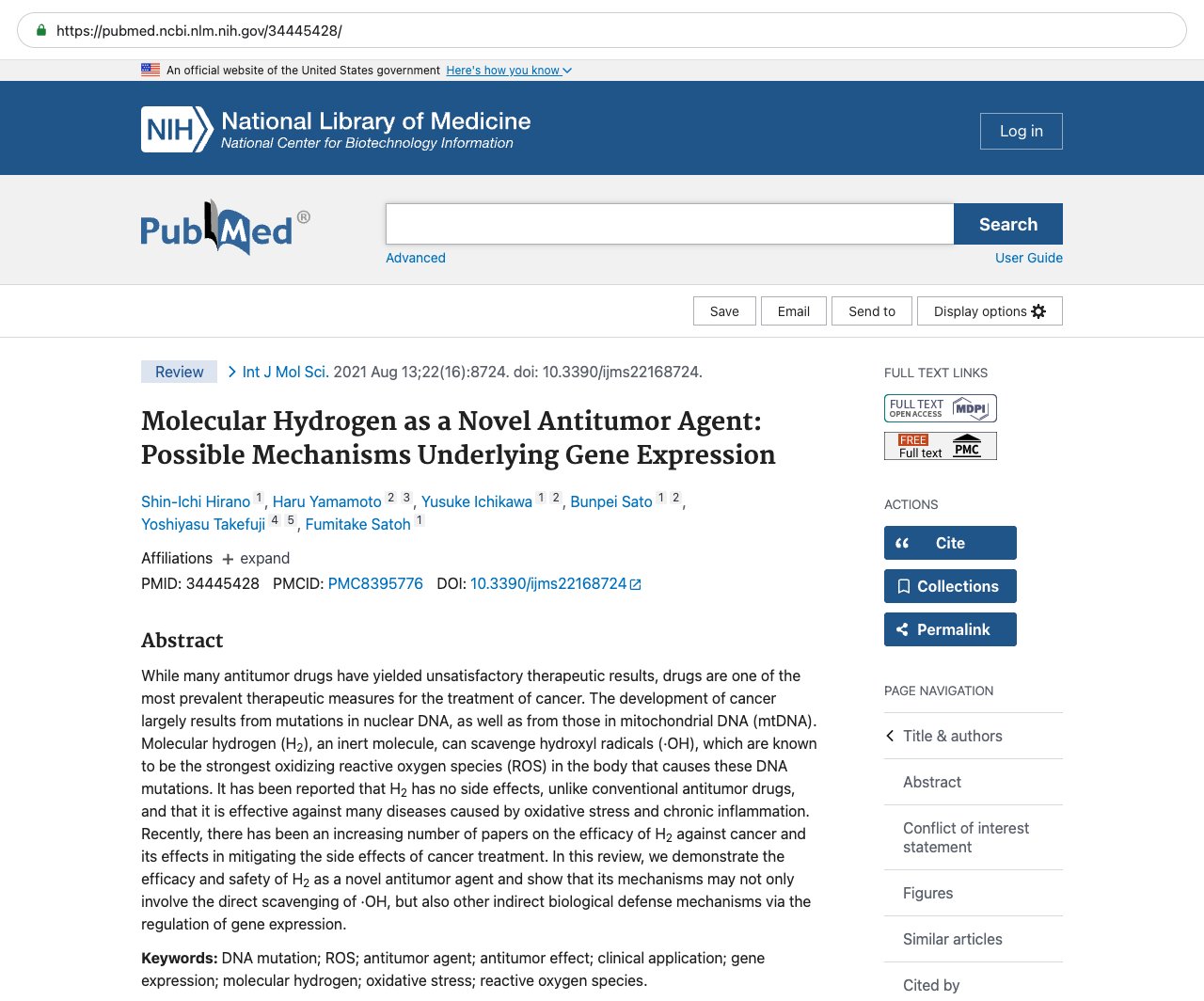
This page mirrors the published abstract (© the authors / publisher) for reference and citation. The canonical source is the PubMed record linked above. This is not medical advice.