2021 · Hirano — Molecular Hydrogen as a Potential Clinically Applicable Radioprotective Agent.
Super-Abstract
This review compiles animal and early clinical evidence showing that molecular hydrogen (H₂) can protect against radiation-induced damage — both in diagnostic and therapeutic radiation contexts — primarily by selectively scavenging the hydroxyl radicals (·OH) generated when ionizing radiation hits water molecules. (International Journal of Molecular Sciences, 2021.)
Commentary
Ionizing radiation damages DNA both directly (by absorbing radiation energy) and indirectly (through ·OH free radicals produced by water radiolysis). Low-dose radiation exposure, as encountered in diagnostic imaging, causes damage primarily through these indirect effects. Hirano et al. review the evidence that H₂ — which selectively neutralizes ·OH without disrupting other physiologically important ROS — could serve as a safe radioprotective agent. Animal experiments and early clinical trials cited in the review report that H₂ administration reduces radiation-induced oxidative damage, inflammatory response, and apoptosis, while also modulating gene expression. The safety profile of H₂ in the reviewed studies is described as highly favorable. However, this is a review written by a researcher who is an active proponent of H₂ science, and the paper should be read with that context in mind. The clinical evidence base for radioprotection in humans is still early-stage, with most robust data coming from animal models. Definitive clinical proof of radioprotection in humans receiving radiotherapy would require large randomized controlled trials.
Key quotes
- „Molecular hydrogen (H2) has the potential to be a radioprotective agent because it can selectively scavenge •OH, a reactive oxygen species with strong oxidizing power.“ — the mechanistic rationale for H₂ radioprotection
- „Animal experiments and clinical trials have reported that H2 exhibits a highly safe radioprotective effect.“ — the evidence landscape as summarized by the authors — primarily animal data plus early clinical signals
- „we demonstrate the prospects of H2 as a novel and clinically applicable radioprotective agent.“ — framed as prospects and potential, not established clinical standard
Our assessment
This is a narrative review, not a clinical trial. It makes a well-grounded mechanistic case for H₂ radioprotection and summarizes existing animal and early human data favorably. The safety profile of H₂ appears to be a genuine strength of this approach. However, large-scale clinical evidence for radioprotection in humans is still limited, and the author's known advocacy position should be kept in mind. This review is valuable as a comprehensive overview of proposed mechanisms and early evidence, but clinical applicability must await more rigorous trials.
Study design
- Type: narrative review · Scope: H₂ radioprotection mechanisms and evidence (animal + early clinical) · H₂ delivery: multiple modalities discussed (inhalation, oral, IV saline)
- Conclusion: H₂ selectively scavenges ·OH from radiation-induced water radiolysis; animal and early clinical data support radioprotective and anti-inflammatory effects; clinical validation in human radiotherapy settings still needed
Abstract
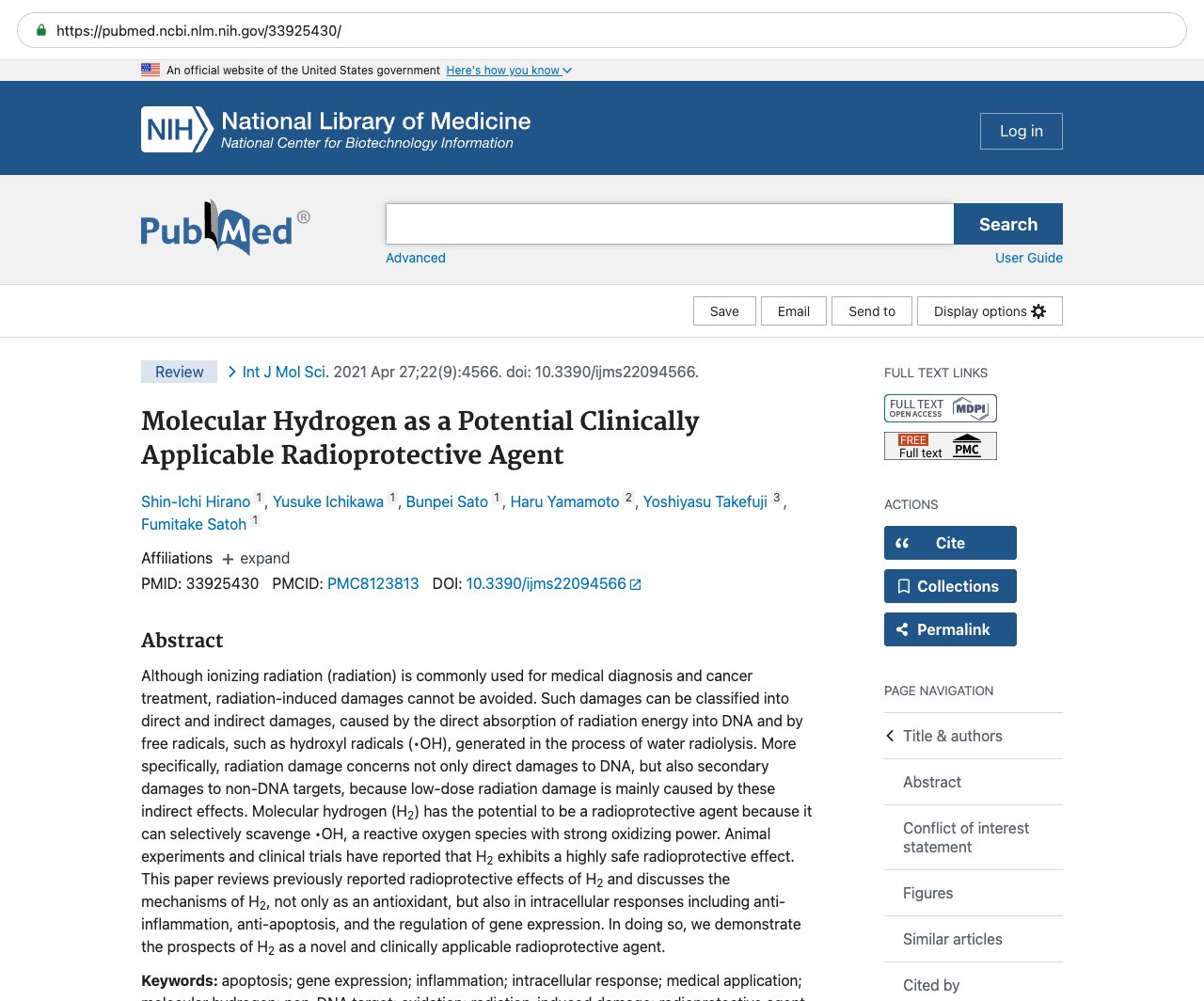
Although ionizing radiation (radiation) is commonly used for medical diagnosis and cancer treatment, radiation-induced damages cannot be avoided. Such damages can be classified into direct and indirect damages, caused by the direct absorption of radiation energy into DNA and by free radicals, such as hydroxyl radicals (•OH), generated in the process of water radiolysis. More specifically, radiation damage concerns not only direct damages to DNA, but also secondary damages to non-DNA targets, because low-dose radiation damage is mainly caused by these indirect effects. Molecular hydrogen (H2) has the potential to be a radioprotective agent because it can selectively scavenge •OH, a reactive oxygen species with strong oxidizing power. Animal experiments and clinical trials have reported that H2 exhibits a highly safe radioprotective effect. This paper reviews previously reported radioprotective effects of H2 and discusses the mechanisms of H2, not only as an antioxidant, but also in intracellular responses including anti-inflammation, anti-apoptosis, and the regulation of gene expression. In doing so, we demonstrate the prospects of H2 as a novel and clinically applicable radioprotective agent.
Source & links
Screenshot of the PubMed page
This page mirrors the published abstract (© the authors / publisher) for reference and citation. The canonical source is the PubMed record linked above. This is not medical advice.