2022 · Yan et al. — Microbial Hydrogen „Manufactory” for Enhanced Gas Therapy and Self-Activated Immunotherapy via Reduced Immune Escape
Super-Abstract
Researchers used live photosynthetic bacteria (PSB) as a biological H₂ „factory” to release sustained amounts of hydrogen at tumour sites, selectively disrupting the reactive oxygen species balance in cancer cells while simultaneously stimulating an anti-tumour immune response. Notably, this approach did not upregulate PD-L1 — a protein that helps tumours escape immune attack. This is a preclinical theory/animal study; no human data are available. (Journal of Nanobiotechnology, 2022.)
Commentary
One of the practical limitations of hydrogen gas therapy for cancer is H₂'s high diffusibility and the difficulty of achieving sustained local release at the tumour. This study proposes an innovative solution: using photosynthetic bacteria (PSB) — which naturally produce H₂ via their metabolic processes — as living „factories” injected at tumour sites. The PSB not only generate H₂ continuously but also act as bacterial adjuvants, stimulating CD4⁺ and CD8⁺ T cell infiltration. The critical finding is that PD-L1 (a checkpoint protein exploited by tumours for immune evasion) was not upregulated despite immune stimulation — potentially avoiding the immunosuppressive rebound seen with some other therapies. This is a mechanistically interesting preclinical concept but very far from human clinical application.
Key quotes
- „Photosynthetic bacteria (PSB) release a large amount of hydrogen to break the balance of oxidative stress.“ — the core mechanism: PSB as living H₂ generators disrupting tumour ROS homeostasis
- „We found that hydrogen therapy induced by our live PSB did not lead to the up-regulation of PD-L1 after stimulating the immune response, which could avoid the tumor immune escape.“ — the key immunological finding — avoiding PD-L1 upregulation may prevent tumour immune escape
- „Hydrogen-immunotherapy significantly kills tumor cells. We believe that our live microbial hydrogen production system provides a new strategy for cancer hydrogen treatment combining with enhanced immunotherapy without up-regulating PD-L1.“ — the authors' conclusion — promising concept but stated cautiously as a „new strategy,” not a proven treatment
Our assessment
This is a preclinical theory/animal study. The concept of using living bacteria as H₂ generators for cancer therapy is scientifically creative and the mechanistic data are encouraging, particularly the PD-L1 finding. However, this is not a clinical study and has not been tested in humans. Key unknowns include long-term safety of intratumoral PSB injection, immune responses to the bacteria themselves, and scalability. The results should be understood as early-stage proof-of-concept, not as evidence of anti-cancer efficacy in humans.
Study design
- Type: preclinical theory/in-vivo study (mouse tumour model) · Model: tumour-bearing mice + photosynthetic bacteria (PSB) injection · H₂ delivery: continuous intratumoral H₂ generation by live PSB via photosynthesis
- Result: PSB generated sustained H₂ at tumour sites; disrupted ROS balance in tumour cells; stimulated CD4⁺ and CD8⁺ T cell infiltration; critically, PD-L1 was not upregulated — suggesting tumour immune escape was not triggered; tumour cell killing significantly enhanced by H₂-immunotherapy combination
Abstract
BACKGROUND: As an antioxidant, hydrogen (H2) can selectively react with the highly toxic hydroxyl radical (·OH) in tumor cells to break the balance of reactive oxygen species (ROS) and cause oxidative stress. However, due to the high diffusibility and storage difficulty of hydrogen, it is impossible to achieve long-term release at the tumor site, which highly limited their therapeutic effect. RESULTS: Photosynthetic bacteria (PSB) release a large amount of hydrogen to break the balance of oxidative stress. In addition, as a nontoxic bacterium, PSB could stimulate the immune response and increase the infiltration of CD4+ and CD8+ T cells. More interestingly, we found that hydrogen therapy induced by our live PSB did not lead to the up-regulation of PD-L1 after stimulating the immune response, which could avoid the tumor immune escape. CONCLUSION: Hydrogen-immunotherapy significantly kills tumor cells. We believe that our live microbial hydrogen production system provides a new strategy for cancer hydrogen treatment combining with enhanced immunotherapy without up-regulating PD-L1.
Source & links
Screenshot of the PubMed page
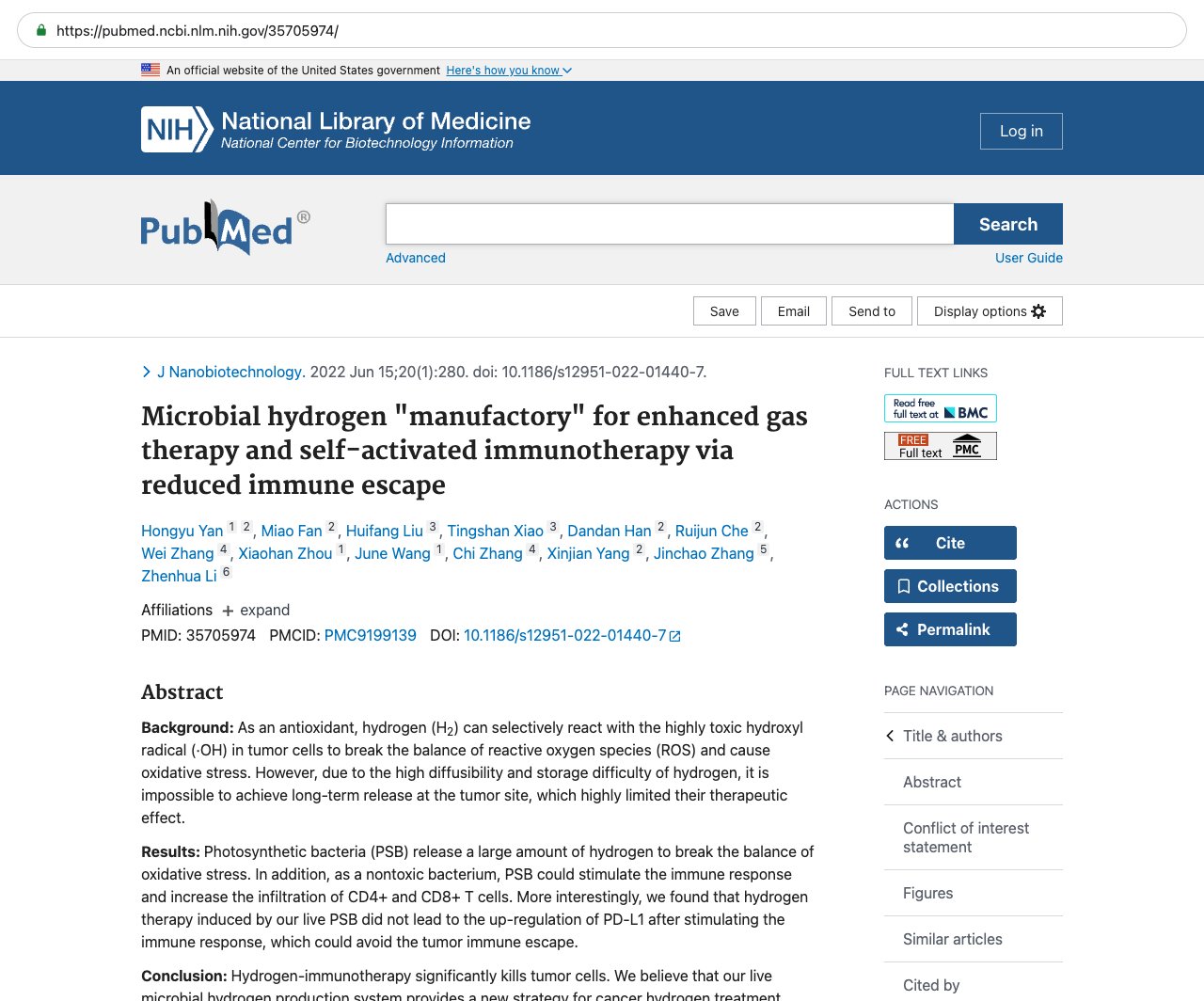
This page mirrors the published abstract (© the authors / publisher) for reference and citation. The canonical source is the PubMed record linked above. This is not medical advice.