2025 · Hruby et al. — Hydrogen-Rich Water Consumption for Acute and Residual Fatigue After Simulated Football Matches: Protocol for a Randomized, Double-Blinded, Placebo-Controlled, Parallel Trial
Super-Abstract
This publication describes the protocol for a rigorous randomised, double-blinded, placebo-controlled trial investigating whether hydrogen-rich water consumed before a simulated elite football match reduces acute and residual fatigue over a 72-hour recovery period — assessed via neuromuscular performance tests, biochemical markers, and perceptual measures. No results are available yet; data collection was scheduled for August 2025. (JMIR Research Protocols, 2025.)
Commentary
Sports recovery is one of the most intensively researched areas of applied H₂ science, yet many existing trials suffer from methodological weaknesses — small samples, absence of blinding, heterogeneous endpoints. This protocol is notable precisely because it addresses these gaps: the double-blind, placebo-controlled, parallel design in elite junior football players is considerably more rigorous than most published sports H₂ studies. The scope of outcome measurement is comprehensive: neuromuscular function (repeated sprint ability, countermovement jump), metabolic markers (creatine kinase, muscle soreness), and perceptual measures — all captured at five time points over 72 hours. The focus on residual fatigue (24–72 hours post-match) is clinically relevant because it directly addresses player availability for the next training session or match. The hypothesis — that H₂ attenuates oxidative stress, reduces muscle damage markers, and accelerates neuromuscular recovery — is well-supported by mechanistic and preliminary evidence. Whether the effect size is meaningful for elite sport remains to be demonstrated.
Key quotes
- „This study will investigate the effects of pre-exercise HRW administration versus a placebo on neuromuscular performance, biochemical markers, and perceptual measures of fatigue during a 72-hour recovery after a simulated football match.“ — the primary research question and outcome scope
- „residual fatigue, which can persist for 24-72 hours post match, depending on the intensity, match context, and recovery strategies.“ — the clinical problem targeted: multi-day impairment after high-intensity football
- „If confirmed, these effects could enhance players' readiness to return to high-intensity training and optimize the structure of microcycles in competitive periods.“ — the practical performance implication if the trial is positive
Our assessment
This is a protocol publication only — no results yet. Its value is the transparent pre-registration of a high-quality sports trial. The design (double-blind, placebo-controlled, parallel, elite athletes) is among the strongest proposed in the H₂ sports literature. What to watch: adherence to blind in a sports context (taste/smell of HRW vs. placebo); ecological validity of a simulated match; the planned sample size is not specified in the abstract (a key omission for power assessment); results expected in late 2025 or early 2026. If the trial delivers, it will provide some of the cleanest data on H₂ and exercise recovery to date.
Study design
- Type: protocol for a randomised, double-blinded, placebo-controlled, parallel trial · Population: elite junior football players · H₂ delivery: pre-exercise hydrogen-rich water (vs. placebo)
- Outcomes: repeated sprint ability, countermovement jump test (neuromuscular); creatine kinase + muscle soreness VAS (metabolic); perceptual fatigue
- Time points: post warm-up; post simulated match; 24 h, 48 h, 72 h post training · Data collection: scheduled August 2025; results expected late 2025 / early 2026
Abstract
BACKGROUND: Football matches induce acute and residual fatigue, impairing neuromuscular, metabolic, and perceptual performance. Hydrogen-rich water (HRW) is a novel intervention with antifatigue and antioxidative properties. The intermittent high-intensity nature of football, which includes frequent accelerations, decelerations, sprints, changes of direction, and physical contacts, imposes substantial demands on both central and peripheral physiological systems. This results in acute fatigue, observable during or immediately after a match, and residual fatigue, which can persist for 24-72 hours post match, depending on the intensity, match context, and recovery strategies. OBJECTIVE: This study will investigate the effects of pre-exercise HRW administration versus a placebo on neuromuscular performance, biochemical markers, and perceptual measures of fatigue during a 72-hour recovery after a simulated football match. METHODS: Using a randomized, double-blinded, placebo-controlled, parallel design, elite junior football players will undergo neuromuscular performance assessments (repeated sprint ability and countermovement jump test). Metabolic fatigue will be measured by creatine kinase level and muscle soreness, rated using a visual analog scale. These assessments will occur at critical time points: immediately post warm-up; directly following the simulated football match to detect acute fatigue; and 24, 48, and 72 hours after training sessions to detect residual fatigue. RESULTS: Data collection has been scheduled with the clubs to coincide with the beginning of the players' transition period (ie, at the start of August 2025). The expected duration of data collection, including the initial medical examination, is planned to be 1 month. We anticipate publishing the results in late 2025 or during the first half of 2026. CONCLUSIONS: This study will assess the influence of molecular hydrogen on acute fatigue manifestation and recovery quality during a 72-hour period after a simulated football match. The potential positive effects of molecular hydrogen, such as attenuation of oxidative stress, reduction in muscle damage markers, and accelerated neuromuscular recovery, may contribute to faster restoration of functional capacities. If confirmed, these effects could enhance players' readiness to return to high-intensity training and optimize the structure of microcycles in competitive periods. Additionally, understanding the recovery dynamics facilitated by HRW may inform evidence-based recovery strategies and support individualized player monitoring frameworks. The possible positive effect of molecular hydrogen would speed up the players' readiness to train after the match and help protect players against illness and noncontact injuries.
Source & links
Screenshot of the PubMed page
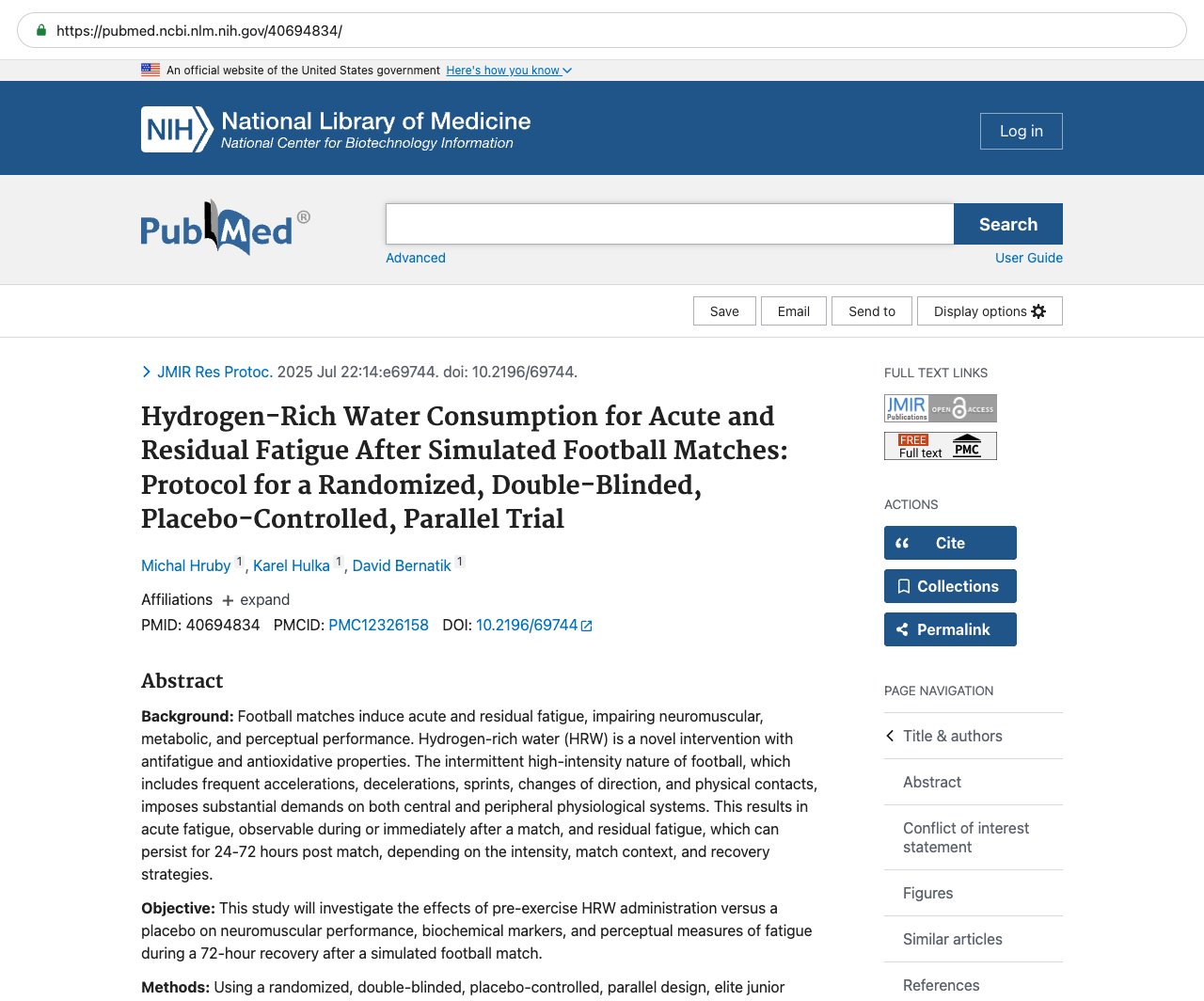
This page mirrors the published abstract (© the authors / publisher) for reference and citation. The canonical source is the PubMed record linked above. This is not medical advice.