2024 · Hu — The Molecular Biological Mechanism of Hydrogen Therapy and Its Application in Spinal Cord Injury
Super-Abstract
Spinal cord injury (SCI) causes devastating neurological damage and has very limited treatment options. This review summarises the molecular biology of hydrogen therapy and its potential application in SCI, drawing on animal experiments and in vitro cell studies showing anti-inflammatory, antioxidant, and anti-apoptotic effects. The authors provide preliminary evidence that H₂ may have protective effects in SCI models, but note that clinical application is still at an early stage. This is a literature review, not a human trial.
Commentary
SCI triggers a cascade of secondary injury processes — including oxidative stress, inflammation, and programmed cell death — that extend damage well beyond the initial trauma. Current clinical management lacks pharmacological options with proven neuroprotective benefit. This review surveys the mechanistic evidence for H₂ in SCI: its documented anti-inflammatory, antioxidant, and anti-apoptotic properties in animal and cell models are presented in the context of the SCI secondary injury cascade. The coverage of molecular mechanisms is comprehensive, though the evidence base is almost entirely preclinical. The review notes H₂ is being ‚gradually applied in clinical settings', but this should be interpreted cautiously — the clinical evidence base for H₂ in SCI specifically remains very thin.
Key quotes
- „Hydrogen has been proven to possess anti-inflammatory, selective antioxidant, and antiapoptotic effects, thus exhibiting considerable protective effects in various diseases.“ — core established properties of H₂ as a biomedical molecule
- „several studies have provided preliminary evidence for the protective effects of hydrogen on spinal cord injury (SCI).“ — honest framing: preliminary, not definitive, evidence for H₂ in SCI
- „This paper provides a comprehensive review of the potential molecular biology mechanisms of hydrogen therapy and its application in treating SCI, with an aim to better explore the medical value of hydrogen and provide new avenues for the adjuvant treatment of SCI.“ — scope and intent of the review
Our assessment
This is a narrative review drawing on preclinical (animal and in vitro) evidence for H₂ in SCI. The mechanistic case for H₂'s neuroprotective properties is plausible and built on a consistent body of animal data. However, clinical evidence in human SCI is scarce, and SCI is notoriously difficult to treat — preclinical success does not reliably predict clinical benefit in this field. The review itself frames the evidence as ‚preliminary'. Readers should not interpret this as clinical proof of H₂ efficacy in spinal cord injury.
Study design
- Type: narrative review of preclinical (animal + in vitro) literature · n: n/a (literature analysis) · H₂ delivery: multiple modalities discussed (inhalation, saline injection, drinking water)
- Result: no pooled effect sizes; H₂'s anti-inflammatory, antioxidant, and anti-apoptotic mechanisms summarised in the context of SCI secondary injury; clinical application described as early stage
Abstract
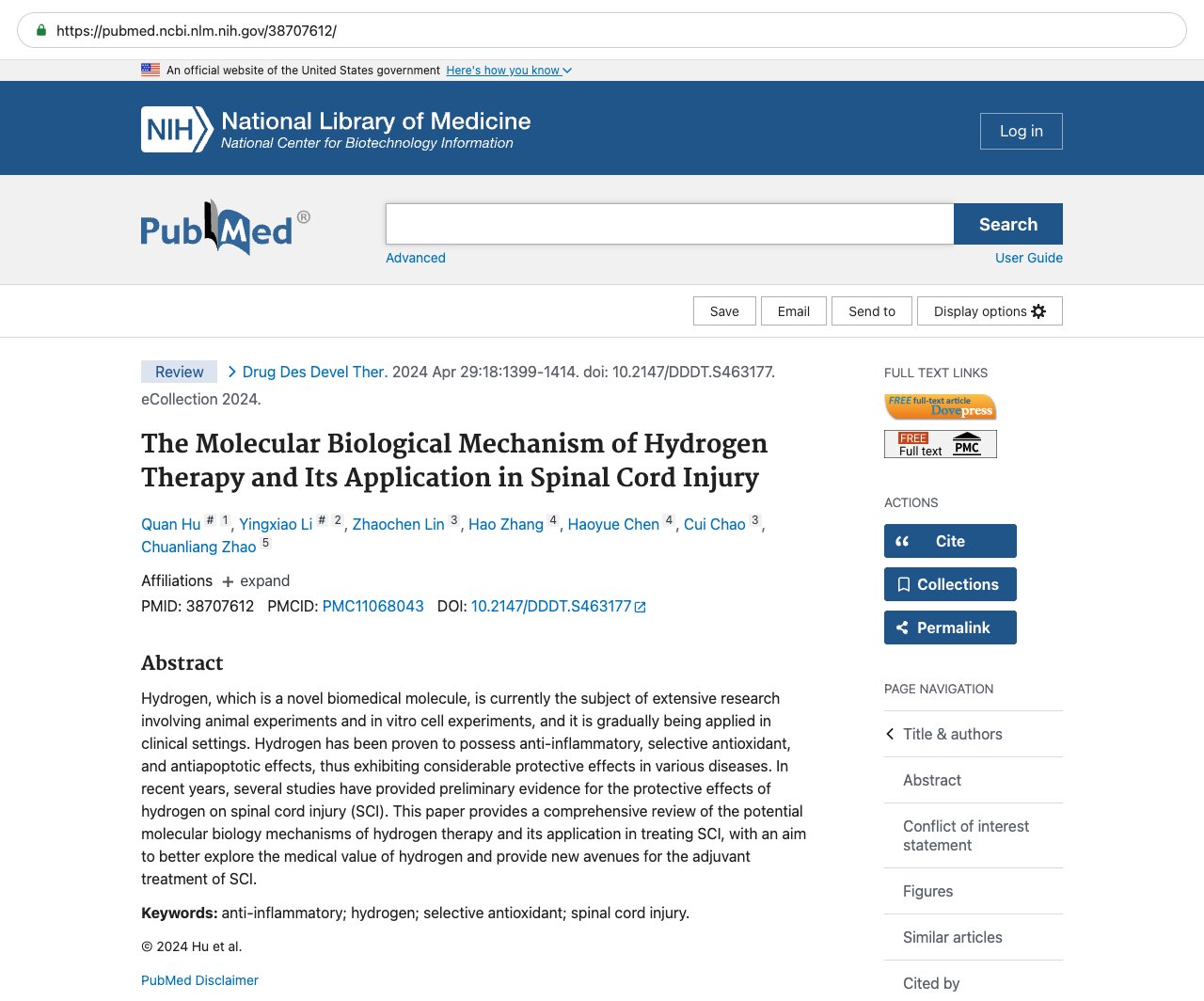
Hydrogen, which is a novel biomedical molecule, is currently the subject of extensive research involving animal experiments and in vitro cell experiments, and it is gradually being applied in clinical settings. Hydrogen has been proven to possess anti-inflammatory, selective antioxidant, and antiapoptotic effects, thus exhibiting considerable protective effects in various diseases. In recent years, several studies have provided preliminary evidence for the protective effects of hydrogen on spinal cord injury (SCI). This paper provides a comprehensive review of the potential molecular biology mechanisms of hydrogen therapy and its application in treating SCI, with an aim to better explore the medical value of hydrogen and provide new avenues for the adjuvant treatment of SCI.
Source & links
Screenshot of the PubMed page
This page mirrors the published abstract (© the authors / publisher) for reference and citation. The canonical source is the PubMed record linked above. This is not medical advice.