2006 · Huang et al. — Electrolyzed-Reduced Water Reduced Hemodialysis-Induced Erythrocyte Impairment in End-Stage Renal Disease Patients
Super-Abstract
Six months of electrolyzed-reduced water (ERW) treatment in chronic hemodialysis patients reduced oxidative stress, improved red blood cell survival, and attenuated pro-inflammatory cytokines — second only to vitamin C, and without its side effects. ERW outperformed vitamin E-coated dialyzers in most oxidative stress parameters in this 4-arm comparative study. (Kidney International, 2006.)
Commentary
Each hemodialysis session generates a burst of reactive oxygen species (ROS), primarily hydrogen peroxide — in this study a 15-fold increase was measured. This oxidative assault damages red blood cells (causing hemolysis, anemia) and promotes systemic inflammation. The team from Taiwan tested whether ERW — which contains dissolved molecular hydrogen and has antioxidant properties — could counteract this. In a well-structured 4-arm comparison (no treatment, vitamin C, vitamin E-coated dialyzer, ERW), ERW ranked second only to vitamin C in reducing oxidative stress markers, but without the risk of oxalate accumulation that vitamin C carries in patients with impaired kidney function. After 6 months, ERW also improved hematocrit and reduced pro-inflammatory cytokines. This is a high-quality study for its era, published in a top nephrology journal, with a clear mechanistic rationale and meaningful clinical endpoints.
Key quotes
- „The patients showed marked increases (15-fold) in blood reactive oxygen species, mostly H(2)O(2), after HD without any treatment.“ — establishing the oxidative problem that ERW was tested against
- „Antioxidants treatment significantly palliated single HD course-induced oxidative stress, plasma and RBC PCOOH, and plasma metHb levels, and preserved erythrocyte metHb /ferricyanide reductase activity in an order VC>ERW>VE-coated dialyzer.“ — ERW ranked second only to vitamin C in antioxidant efficacy across multiple markers
- „Six-month ERW treatment increased hematocrit and attenuated proinflammatory cytokines profile in the HD patients.“ — sustained benefit: improved anemia and reduced systemic inflammation after 6 months
Our assessment
This is a well-designed comparative study (4 arms, 15 patients each) published in a high-impact journal. The oxidative stress findings are consistent and clinically meaningful for the hemodialysis population. Limitations: Not randomized — patient assignment method not detailed; small group sizes (n=15 per arm) limit statistical power for some outcomes. ERW concentration of dissolved H₂ is not precisely reported, making cross-study comparisons difficult. The mechanism is plausible (H₂ as selective antioxidant neutralizing ROS from dialysis), but the ERW formulation also differs from simple hydrogen-rich water. The 6-month hematocrit improvement and cytokine reduction are encouraging but need replication in larger, randomized trials. Notably, the absence of oxalate accumulation is a practical clinical advantage over vitamin C in dialysis patients.
Study design
- Type: 4-arm comparative clinical study (non-randomized) · n: 43 enrolled; 15 per treatment arm (no treatment, vitamin C, vitamin E dialyzer, ERW) · H₂ delivery: electrolyzed-reduced water (ERW) administered orally for 6 months
- Result: ERW reduced HD-induced ROS, phosphatidylcholine hydroperoxide (PCOOH), methemoglobin; efficacy order: vitamin C > ERW > vitamin E dialyzer; 6-month ERW increased hematocrit and reduced pro-inflammatory cytokines; no oxalate accumulation
Abstract
Chronic hemodialysis (HD) patients increase erythrocyte susceptibility to hemolysis and impair cell survival. We explored whether electrolyte-reduced water (ERW) could palliate HD-evoked erythrocyte impairment and anemia. Forty-three patients undergoing chronic HD were enrolled and received ERW administration for 6 month. We evaluated oxidative stress in blood and plasma, erythrocyte methemoglobin (metHb)/ferricyanide reductase activity, plasma metHb, and proinflammatory cytokines in the chronic HD patients without treatment (n=15) or with vitamin C (VC)- (n=15), vitamin E (VE)-coated dialyzer (n=15), or ERW treatment (n=15) during an HD course. The patients showed marked increases (15-fold) in blood reactive oxygen species, mostly H(2)O(2), after HD without any treatment. HD resulted in decreased plasma VC, total antioxidant status, and erythrocyte metHb/ferricyanide reductase activity and increased erythrocyte levels of phosphatidylcholine hydroperoxide (PCOOH) and plasma metHb. Antioxidants treatment significantly palliated single HD course-induced oxidative stress, plasma and RBC PCOOH, and plasma metHb levels, and preserved erythrocyte metHb /ferricyanide reductase activity in an order VC>ERW>VE-coated dialyzer. However, ERW had no side effects of oxalate accumulation easily induced by VC. Six-month ERW treatment increased hematocrit and attenuated proinflammatory cytokines profile in the HD patients. In conclusion, ERW treatment administration is effective in palliating HD-evoked oxidative stress, as indicated by lipid peroxidation, hemolysis, and overexpression of proinflammatory cytokines in HD patients.
Source & links
Screenshot of the PubMed page
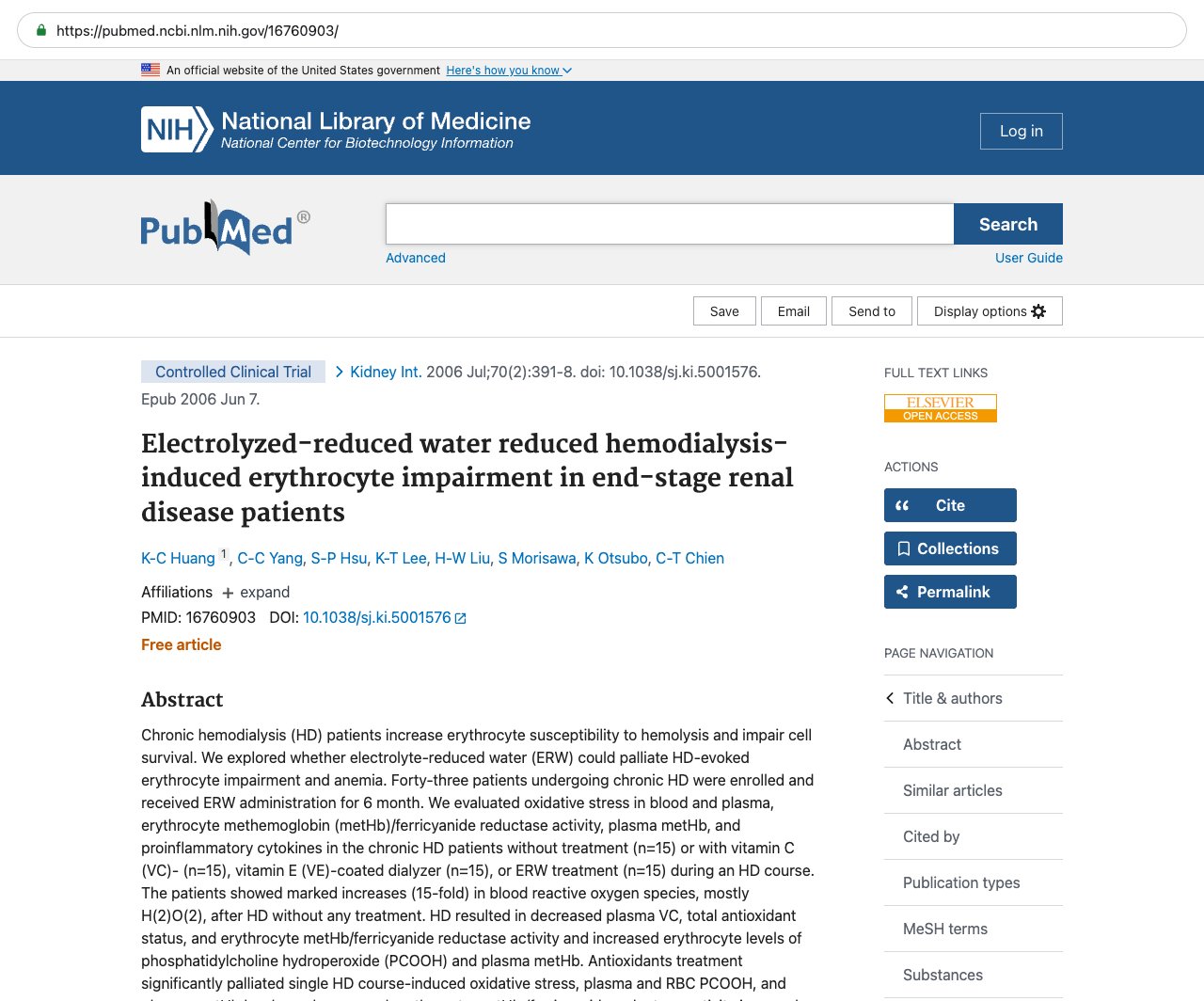
This page mirrors the published abstract (© the authors / publisher) for reference and citation. The canonical source is the PubMed record linked above. This is not medical advice.