2026 · Viana — Molecular hydrogen and kidney diseases: a scoping review based on scientometry and data analytics
Super-Abstract
Acute kidney injury and chronic kidney disease impose enormous burdens globally — and molecular hydrogen (H₂) consistently shows protective effects against apoptosis, fibrosis, inflammation and oxidative stress in kidney disease models. This scoping review combines bibliometric analysis with thematic synthesis of 69 publications, finding clear research gaps including limited international collaboration and a need for standardised clinical trials. The evidence is promising but still predominantly preclinical and Asian-dominated. (Medical Gas Research, 2026.)
Commentary
This scoping review takes an unusual methodological approach: it combines conventional qualitative synthesis with quantitative bibliometric analysis (publication trends, collaboration networks via Scopus and Web of Science). The findings confirm the trajectory seen in other H₂ fields — consistent preclinical protective effects, particularly in rodent models of acute kidney injury and nephrotoxicity, but a striking absence of robust clinical trial data. The geographical concentration (China, Japan) is explicitly flagged as a limitation for generalisability. The two activity peaks (2019 and 2024) suggest growing but still episodic research momentum. This is a useful field-mapping tool, not a meta-analytic efficacy summary.
Key quotes
- „H₂ consistently demonstrated protective effects against apoptosis, fibrosis, inflammation, and oxidative stress across acute kidney injury, nephrotoxicity, transplantation, and early chronic kidney disease models.“ — the consistent preclinical signal across kidney disease models
- „our findings suggest that hydrogen therapy holds promise for renoprotection in both acute kidney injury and chronic kidney disease.“ — the authors' cautiously positive summary
- „more robust clinical trials and standardized research methodologies are imperative to facilitate its broader adoption into clinical nephrology practice.“ — what is still missing before clinical adoption is justified
Our assessment
This is a scoping review with bibliometric analysis of 69 publications — not a meta-analysis with pooled effect sizes. The evidence reviewed is predominantly preclinical (animal models of kidney injury); the review explicitly calls for more robust clinical trials. Its methodological contribution is the scientometric mapping of the field's publication landscape. Results cannot be directly extrapolated to clinical renoprotective benefit in humans without further trial evidence.
Study design
- Type: scoping review (PRISMA-ScR) + bibliometric analysis · n: 69 publications (Scopus + Web of Science) · H₂ delivery: various (as per included studies)
- Conditions covered: acute kidney injury, nephrotoxicity, transplantation, early chronic kidney disease
- Conclusion: H₂ protective in preclinical kidney models; research dominated by China and Japan; international collaboration limited; standardised clinical trials urgently needed
Abstract
Acute kidney injury and chronic kidney disease impose substantial burdens on healthcare systems worldwide. Molecular hydrogen (H2) has emerged as a potential therapy due to its selective antioxidant, anti-inflammatory, and antiapoptotic properties. The present study reviews evidence on H₂-based renal interventions, examining therapeutic mechanisms, bibliometric trends, and existing research gaps based on data analytics. This scoping review integrates quantitative bibliometric analysis with qualitative thematic synthesis. This integration, uncommon in conventional scoping reviews, reveals important gaps. Following the Preferred Reporting Items for Systematic reviews and Meta-Analyses extension for Scoping Reviews (PRISMA-ScR) guidelines, 69 publications were identified through Scopus and Web of Science. These publications mostly originated from Asia, particularly China and Japan, with clear peaks of activity in 2019 and 2024, but international collaboration remains limited. H₂ consistently demonstrated protective effects against apoptosis, fibrosis, inflammation, and oxidative stress across acute kidney injury, nephrotoxicity, transplantation, and early chronic kidney disease models. Our findings suggest that hydrogen therapy holds promise for renoprotection in both acute kidney injury and chronic kidney disease. Nonetheless, more robust clinical trials and standardized research methodologies are imperative to facilitate its broader adoption into clinical nephrology practice.
Source & links
Screenshot of the PubMed page
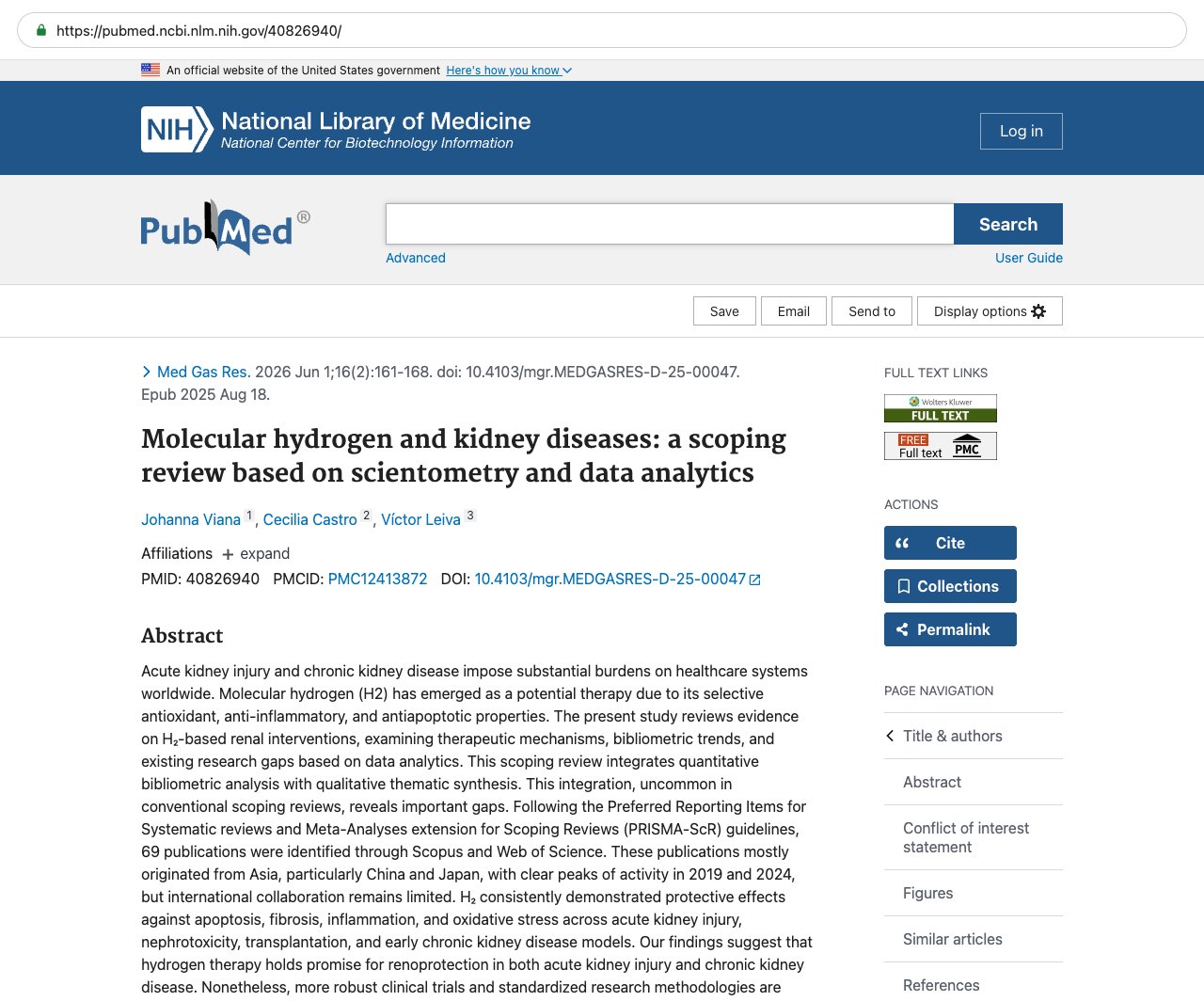
This page mirrors the published abstract (© the authors / publisher) for reference and citation. The canonical source is the PubMed record linked above. This is not medical advice.