2023 · Ichikawa et al. — The Overlooked Benefits of Hydrogen-Producing Bacteria
Super-Abstract
This review in Medical Gas Research proposes a new explanatory framework for why certain intestinal bacteria are truly „beneficial“: they produce molecular hydrogen (H₂) in the gut, which then scavenges harmful hydroxyl radicals generated in mitochondria and protects cells from oxidative stress. The authors argue that the amount of H₂ produced by gut bacteria correlates with susceptibility to various diseases — offering a fresh microbiome-centred perspective on endogenous H₂ biology.
Commentary
The concept that gut bacteria might be beneficial partly because they produce H₂ — not solely because of short-chain fatty acids, immune modulation, or vitamin synthesis — is a genuinely interesting reframing of microbiome science. Intestinal fermentation by anaerobic bacteria generates significant volumes of H₂ gas, most of which is exhaled or passed, but some of which is absorbed and distributed systemically. Given that H₂ selectively neutralises hydroxyl radicals (the most reactive and damaging ROS species) without disturbing other redox signalling, a gut-derived antioxidant mechanism is physiologically plausible. The authors' claim that H₂ production levels correlate with disease susceptibility is provocative and, if supported, would provide a quantitative metric linking diet, microbiome composition, and oxidative disease risk. However, this is a narrative review — the correlational claims require causal validation through controlled human studies and the specific studies cited are not individually detailed in the abstract. The framework is intellectually stimulating as a hypothesis-generator.
Key quotes
- „it is widely known that molecular hydrogen can react with hydroxyl radicals, generated in the mitochondria, to protect cells from oxidative stress.“ — the established mechanism underlying the H₂-producing bacteria hypothesis
- „there is a close relationship between the amount of hydrogen produced by intestinal bacteria and various diseases.“ — the central and clinically most interesting claim — gut H₂ output as a disease-relevant biomarker
Our assessment
An intellectually stimulating perspective review proposing a new reason why certain gut bacteria are beneficial: their H₂ production provides systemic antioxidant protection. The framework is biologically coherent and mechanistically grounded. Honest limitation: this is a narrative review/perspective paper, not an experimental study. The correlation between gut H₂ production and disease has not been rigorously established through controlled human trials. This paper is best read as a thought-provoking hypothesis, not as established clinical fact.
Study design
- Type: narrative review / perspective · n: n/a (literature discussion) · H₂ source: endogenous gut bacterial fermentation (not exogenous administration)
- Core thesis: H₂-producing gut bacteria may explain a significant part of what makes „beneficial bacteria“ beneficial; gut H₂ output may correlate with oxidative disease risk — preclinical and observational evidence discussed
Abstract
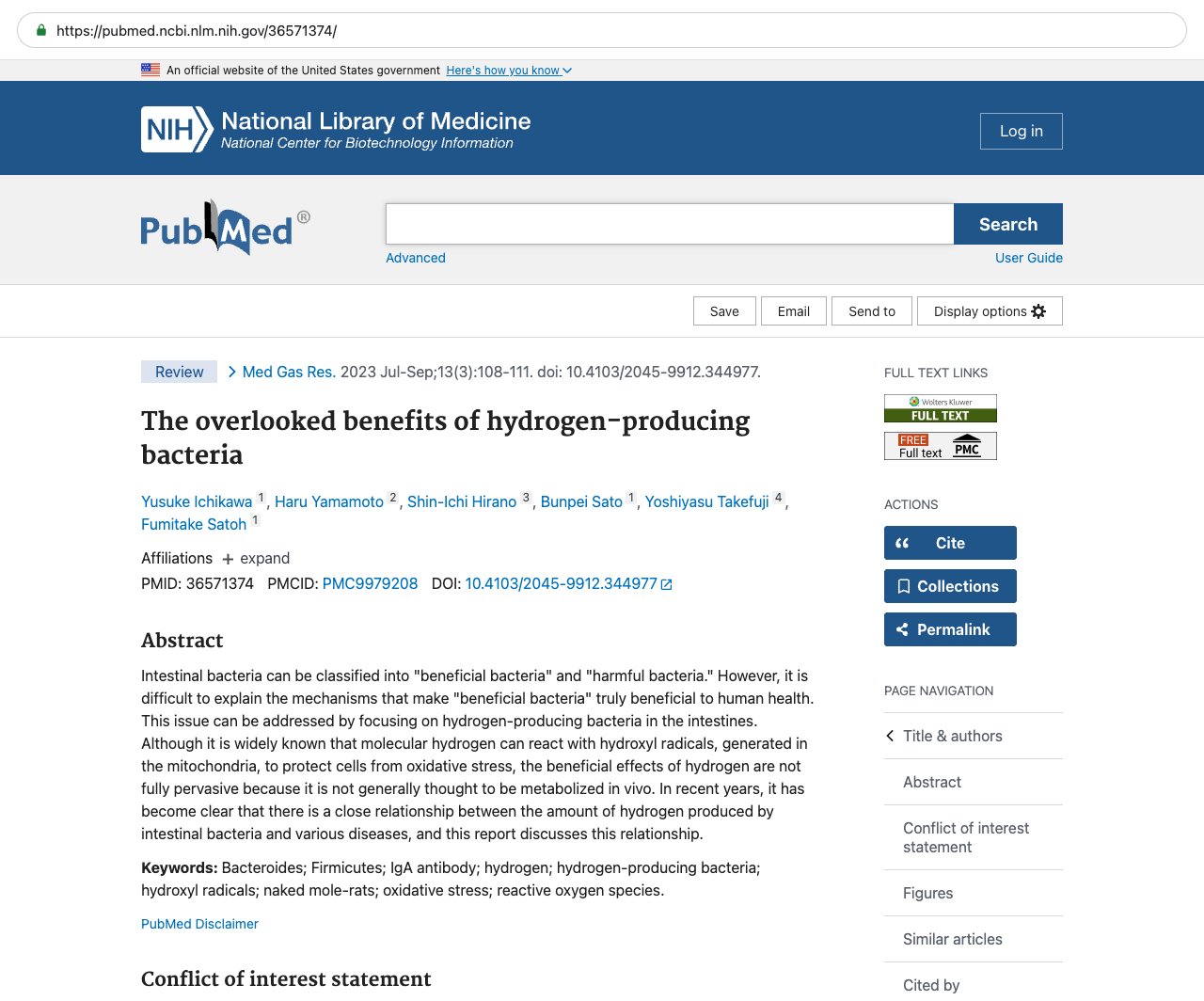
Intestinal bacteria can be classified into "beneficial bacteria" and "harmful bacteria." However, it is difficult to explain the mechanisms that make "beneficial bacteria" truly beneficial to human health. This issue can be addressed by focusing on hydrogen-producing bacteria in the intestines. Although it is widely known that molecular hydrogen can react with hydroxyl radicals, generated in the mitochondria, to protect cells from oxidative stress, the beneficial effects of hydrogen are not fully pervasive because it is not generally thought to be metabolized in vivo. In recent years, it has become clear that there is a close relationship between the amount of hydrogen produced by intestinal bacteria and various diseases, and this report discusses this relationship.
Source & links
Screenshot of the PubMed page
This page mirrors the published abstract (© the authors / publisher) for reference and citation. The canonical source is the PubMed record linked above. This is not medical advice.