2019 · Ishibashi — Therapeutic Efficacy of Molecular Hydrogen: A New Mechanistic Insight.
Super-Abstract
Beyond scavenging hydroxyl radicals, molecular hydrogen (H₂) may act directly on mitochondrial complex I — the enzyme that drives cellular energy production. This 2019 review by Ishibashi proposes a novel mechanism: H₂ could donate electrons and protons inside complex I, reducing harmful quinone intermediates and preventing the burst of reactive oxygen species that occurs when oxygen is restored after hypoxia.
Commentary
Most H₂ research frames the gas solely as a selective hydroxyl-radical and peroxynitrite scavenger. Ishibashi challenges this reductive picture by focusing on mitochondrial complex I, which shares evolutionary origins with bacterial membrane-bound [NiFe]-hydrogenases — enzymes that naturally handle H₂. He argues that H₂ could slot into the ubiquinone-binding chamber of complex I as an electron and proton donor, „rectifying“ electron flow during pathological states such as ischemia-reperfusion. This would increase the antioxidant capacity of the quinone pool and reduce ROS generation. This is a theoretical mechanistic review based on biochemical analogies, not a new experimental study.
Key quotes
- „many reports on therapeutic applications of H2 have the limitation to regard H2 only as a scavenger for the hydroxyl radical and peroxynitrite.“ — the gap in the current literature that this review addresses
- „H2 is proposed to act as the rectifier of the mitochondrial electron flow in the disordered or pathological state when the accumulation of electrons leads to ROS production.“ — the core novel hypothesis: H₂ as mitochondrial electron-flow regulator
- „H2 is proposed to convert the quinone intermediates to the fully reduced ubiquinol, thereby increasing the antioxidant capacity of the quinone pool as well as preventing the generation of ROS.“ — mechanistic detail: ubiquinol conversion as an antioxidant strategy
Our assessment
This paper offers a creative and testable mechanistic hypothesis about how H₂ interacts with mitochondrial complex I. It moves H₂ research beyond the „simple antioxidant“ framing, which is scientifically valuable. Limitations: this is a theoretical review — the complex-I hypothesis has not yet been experimentally confirmed in mammalian cells or humans in this paper. All cited data are from biochemical analogies and animal physiology. The leap from evolutionary homology (bacterial hydrogenases) to therapeutic action in human disease is speculative at this stage and requires dedicated experimental validation.
Study design
- Type: mechanistic/theoretical review · n: n/a (biochemical analysis and literature) · H₂ delivery: drinking hydrogen-rich water (context for cited therapeutic studies)
- Hypothesis: H₂ acts as electron/proton donor at mitochondrial complex I ubiquinone-binding site → converts quinone to ubiquinol → reduces pathological ROS during ischemia-reperfusion
Abstract
BACKGROUND: Molecular hydrogen (H2) is now recognized as a therapeutic gas for the treatment of numerous diseases including neurodegenerative diseases, metabolic disorders, and inflammatory diseases. Nonpolar, neutral H2 is assumed to have health benefits facilitated by its passive diffusion across the human body immediately after administration and is considered a safe therapeutic inert gas that does not interfere with physiological enzymatic reactions. The effects of H2 on mammalian cells are assumed to be based on non-enzymatic reactions with reactive oxygen species (ROS) exhibiting extremely high reactivity. However, many reports on therapeutic applications of H2 have the limitation to regard H2 only as a scavenger for the hydroxyl radical and peroxynitrite. METHODS: Apart from this proposed principle, a new possible mechanism of H2 activation and consumption in mammalian cells is considered in this review, which is specifically focused on the mitochondrial complex I that has a close evolutionary relationship with energy-converting, membrane-bound [NiFe]-hydrogenases (MBH). Notably, the possibility that H2 may function as both electron and proton donor in the ubiquinone-binding chamber of complex I is discussed. RESULTS: H2 is proposed to act as the rectifier of the mitochondrial electron flow in the disordered or pathological state when the accumulation of electrons leads to ROS production, specifically during the re-supply of O2 after hypoxia in the mitochondria. CONCLUSION: Furthermore, H2 is proposed to convert the quinone intermediates to the fully reduced ubiquinol, thereby increasing the antioxidant capacity of the quinone pool as well as preventing the generation of ROS.
Source & links
Screenshot of the PubMed page
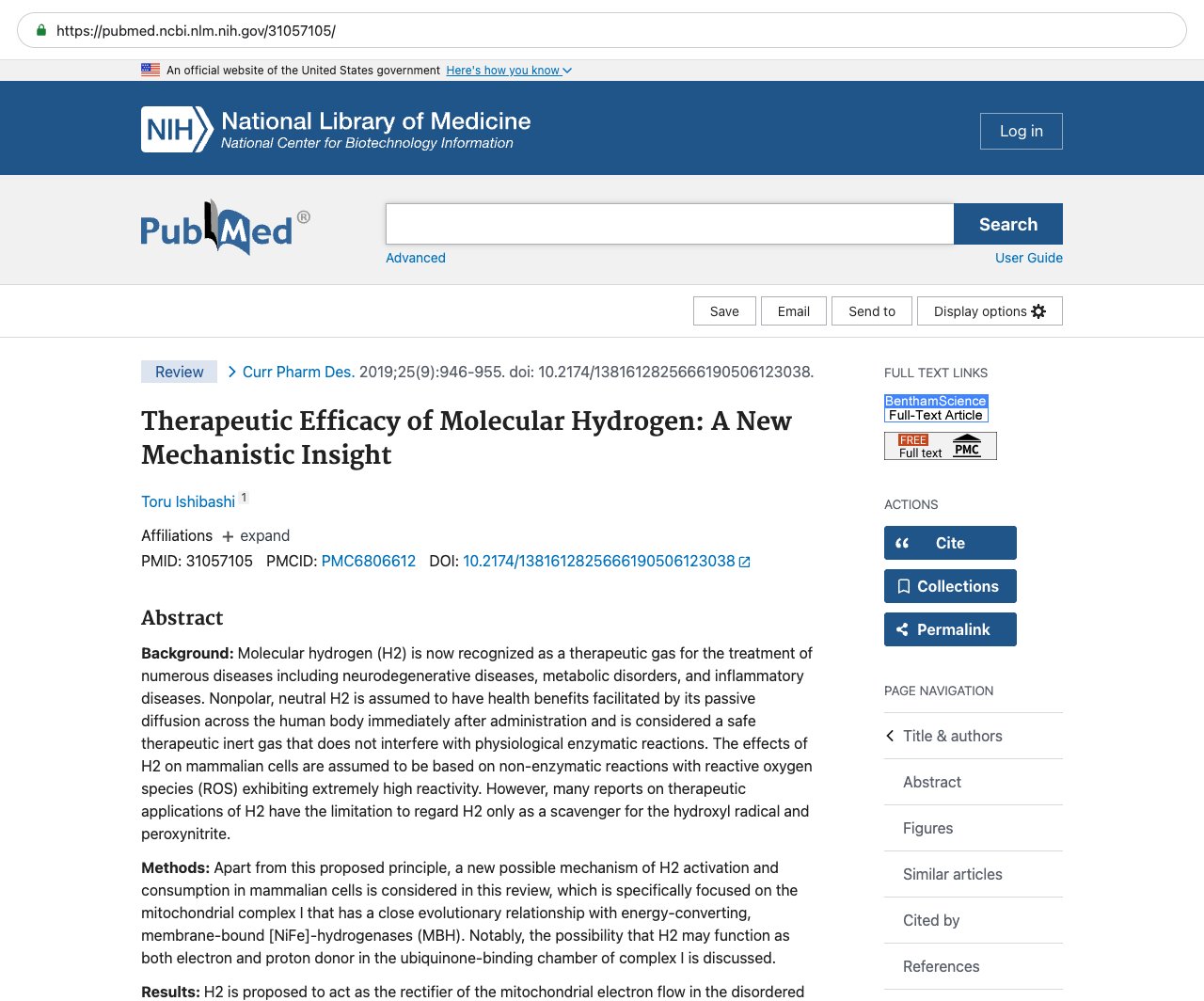
This page mirrors the published abstract (© the authors / publisher) for reference and citation. The canonical source is the PubMed record linked above. This is not medical advice.