2018 · Ostojic — Inadequate Production of H₂ by Gut Microbiota and Parkinson Disease
Super-Abstract
This theoretical paper proposes that impaired H₂ production by intestinal bacteria may contribute to the development of Parkinson's disease, and discusses supplemental H₂ as a potential therapeutic direction. This is a speculative, hypothesis-driven review — not an experimental study, and no clinical conclusions can be drawn. (Trends in Endocrinology and Metabolism, 2018.)
Commentary
Parkinson's disease (PD) is accompanied by characteristic gut microbiome alterations (dysbiosis), but the causal mechanisms remain poorly understood. This perspective piece by Ostojic presents an intriguing hypothesis: gut bacteria normally produce molecular H₂, and if PD-associated dysbiosis reduces this production, the loss of H₂'s antioxidant, anti-inflammatory, and cytoprotective effects might contribute to neurodegeneration. The paper summarises H₂'s known biological properties and discusses epidemiological observations suggesting that populations with certain H₂-producing gut bacteria may have lower PD prevalence. This is a hypothesis paper, not an experimental study — no new data are presented, no patients are studied, and the causal chain from gut dysbiosis to H₂ deficiency to PD pathogenesis remains speculative. It is a thought-provoking framework that could guide future research, but it should not be interpreted as evidence that H₂ supplementation prevents or treats Parkinson's disease.
Key quotes
- „The gut microbiota produce molecular hydrogen (H2), a ubiquitous molecule recently recognized as a biologically active gas with antioxidant, antiapoptotic, anti-inflammatory, cytoprotective, and signaling properties.“ — summary of H₂'s documented biological roles, as the basis for the hypothesis
- „an impaired production of endogenous H2 by intestinal microbiota might play a role in PD pathogenesis, with supplemental H2 debated as a possible therapy for this progressive neurodegenerative disease.“ — the core hypothesis — note the careful hedging: „might play a role“, „debated as a possible therapy“
- „Dysbiosis of the gut flora accompanies Parkinson disease (PD), yet no specific cause-effect link has been identified so far.“ — honest framing: the dysbiosis-PD link is observed but not causally proven
Our assessment
This is a theoretical perspective paper — no experiment, no clinical data, no new measurements. The hypothesis (gut microbiota H₂ → neuroprotection → PD risk) is mechanistically plausible and worth investigating, and aligns with the general direction of gut-brain-axis and H₂ research. However, it remains unproven. The observation that PD patients have altered gut microbiomes does not establish that reduced H₂ production is causally involved. This paper should be read as a research agenda, not as evidence of efficacy.
Study design
- Type: theoretical perspective / hypothesis paper · n: n/a (no experimental data) · Method: narrative literature synthesis and hypothesis construction
- Core argument: gut microbiota H₂ production ↓ in PD → loss of antioxidant/anti-inflammatory protection → neurodegeneration; supplemental H₂ proposed as candidate therapy
- Result: no experimental findings; hypothesis requires experimental validation in animal models and clinical trials
Abstract
Dysbiosis of the gut flora accompanies Parkinson disease (PD), yet no specific cause-effect link has been identified so far. The gut microbiota produce molecular hydrogen (H2), a ubiquitous molecule recently recognized as a biologically active gas with antioxidant, antiapoptotic, anti-inflammatory, cytoprotective, and signaling properties. Here, we discuss an idea that an impaired production of endogenous H2 by intestinal microbiota might play a role in PD pathogenesis, with supplemental H2 debated as a possible therapy for this progressive neurodegenerative disease.
Source & links
Screenshot of the PubMed page
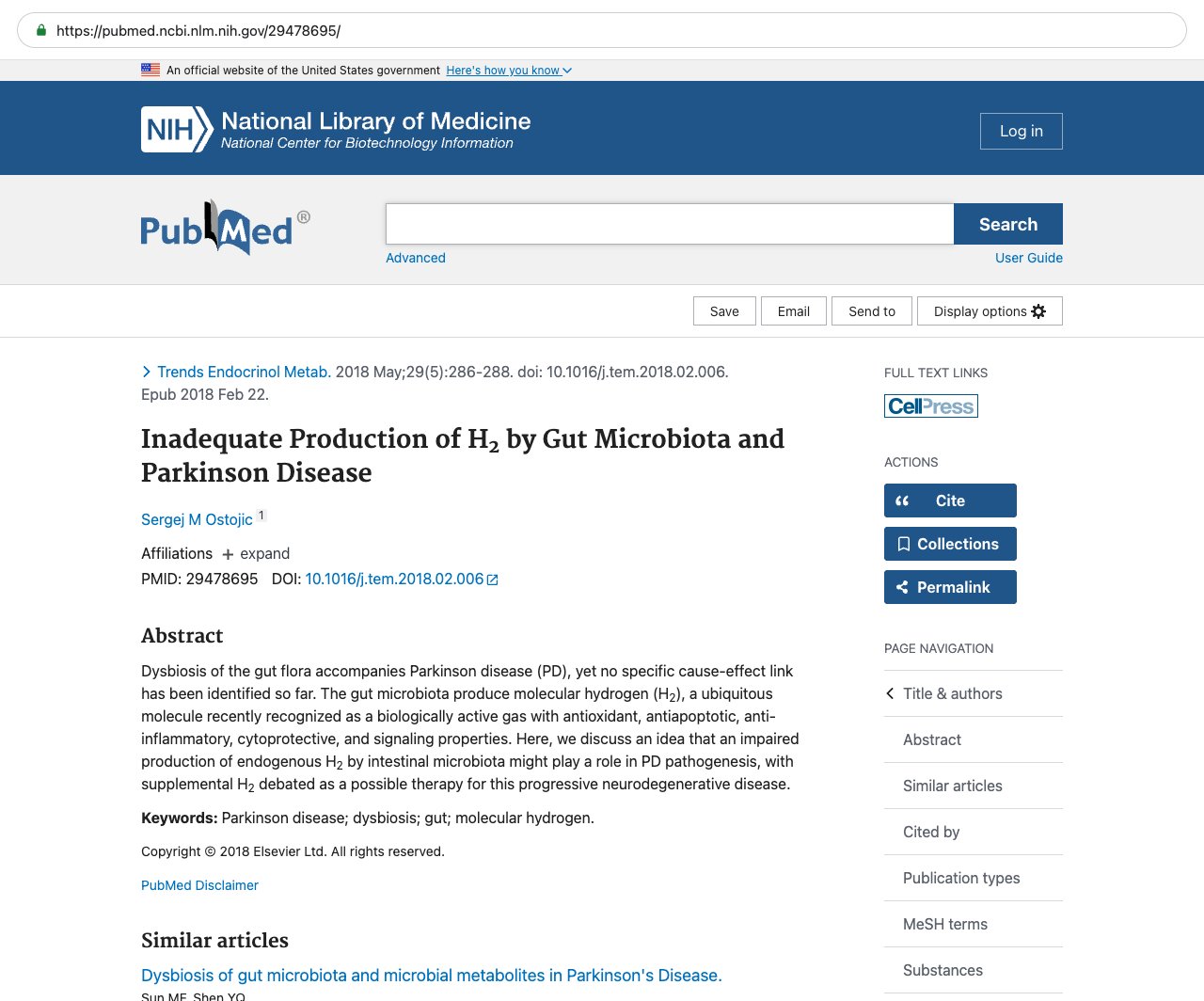
This page mirrors the published abstract (© the authors / publisher) for reference and citation. The canonical source is the PubMed record linked above. This is not medical advice.