2020 · Ishibashi — Peripheral endothelial function can be improved by daily consumption of water containing over 7 ppm of dissolved hydrogen: A randomized controlled trial
Super-Abstract
Highly concentrated hydrogen water (over 7 ppm) improves the endothelial function of the small arteries. In a randomized controlled trial (n = 68), the reactive hyperemia index rose by 22.2% as soon as 24 hours after the first intake and by 25.4% after two weeks of daily drinking (p < 0.05 each). (PLoS One, 2020.)
Commentary
Endothelial function — i.e. how well the inner lining of our blood vessels can dilate — is considered an early warning system for cardiovascular disease. Here it is measured with the reactive hyperemia index via peripheral arterial tonometry at the finger arteries, an established non-invasive method. 68 healthy volunteers were randomized into two groups: one drank placebo water with dissolved nitrogen, the other highly concentrated H₂ water with 7 ppm — that is 3.5 mg of hydrogen in 500 ml. The result is remarkably fast: as soon as 24 hours after the first serving the index in the H₂ group was 22.2 percent better than in the placebo group (p < 0.05), and after two weeks of daily drinking 25.4 percent (p < 0.05). This indicates that sustained drinking of highly concentrated H₂ water can contribute to cardiovascular health. Honestly though: these were healthy people, not heart patients, the sample of 68 is moderate, and the decisive factor is the high concentration — over 7 ppm. That is considerably more than in many commercial H₂ products and an important point to understand: the dose makes the difference.
Key quotes
- „Sixty-eight volunteers were randomly divided into two groups: a placebo group (n = 34) that drank molecular nitrogen (N2)-containing water and a high H2 group (n = 34) that drank high H2 water (containing 7 ppm of H2: 3.5 mg H2 in 500-mL water).“ — the study design with placebo and the specific H₂ dose
- „Ln_RHI improved by 22.2% (p<0.05) at 24 h after the first ingestion of high H2 water and by 25.4% (p<0.05) after the daily consumption of high H2 water for 2 weeks.“ — the hard efficacy figures
- „The results suggest that the continuous consumption of high H2 water contributes to improved cardiovascular health.“ — the cardiovascular conclusion of the authors
Our assessment
One of the most directly relevant studies for H₂ drinking-water research: it measures an established cardiovascular early marker (endothelial function) and shows a clear, fast effect already after 24 hours. Especially notable is the explicit dose threshold of over 7 ppm — this indicates why a high hydrogen concentration matters and that lower concentrations may not deliver the same effect. It is a real RCT with placebo (N₂ water), which increases its informative value. Limitations, stated honestly: the participants were healthy (no patients with established vascular disease), the sample of n = 68 is moderate, and the abstract gives no information on possible conflicts of interest of the company that produced the water. The measured endpoint is a surrogate marker, not a clinical event like a heart attack.
Study design
- Type: RCT (randomized, placebo-controlled with N₂ water) · n: 68 (34 H₂ / 34 placebo) · Duration: measurements at baseline, 1 h, 24 h and after 14 days of daily intake · H₂ delivery: drinking highly concentrated H₂ water (7 ppm = 3.5 mg H₂ in 500 ml)
- Result: Ln_RHI +22.2% after 24 h (p < 0.05); +25.4% after 2 weeks daily (p < 0.05); H₂ group with significantly greater improvement than placebo
Abstract
BACKGROUND: Measurement of the reactive hyperemia index (RHI) using peripheral arterial tonometry (PAT) has shown benefits in the evaluation of vascular endothelial function and prediction of cardiovascular disease prognosis. Thus, it is important to examine the factors that promote the RHI. In this study, we aimed to investigate the effect of molecular hydrogen (H2) on reactive hyperemia-PAT of the small arteries of fingers in healthy people. METHODS: To determine the efficacy of H2 for improving peripheral vascular endothelial function, water containing high H2 concentrations was administered to participants, and the Ln_RHI was measured in the finger vasculature. Sixty-eight volunteers were randomly divided into two groups: a placebo group (n = 34) that drank molecular nitrogen (N2)-containing water and a high H2 group (n = 34) that drank high H2 water (containing 7 ppm of H2: 3.5 mg H2 in 500-mL water). The Ln_RHI was measured before ingesting the placebo or high H2 water, 1 h and 24 h after the first ingestion, and 14 days after daily ingestion of high H2 water or the placebo. The mixed effects model for repeated measures was used in data analysis. RESULTS: The high H2 group had a significantly greater improvement in Ln_RHI than the placebo group. Ln_RHI improved by 22.2% (p<0.05) at 24 h after the first ingestion of high H2 water and by 25.4% (p<0.05) after the daily consumption of high H2 water for 2 weeks. CONCLUSIONS: Daily consumption of high H2 water improved the endothelial function of the arteries or arterioles assessed by the PAT test. The results suggest that the continuous consumption of high H2 water contributes to improved cardiovascular health.
Source & links
Screenshot of the PubMed page
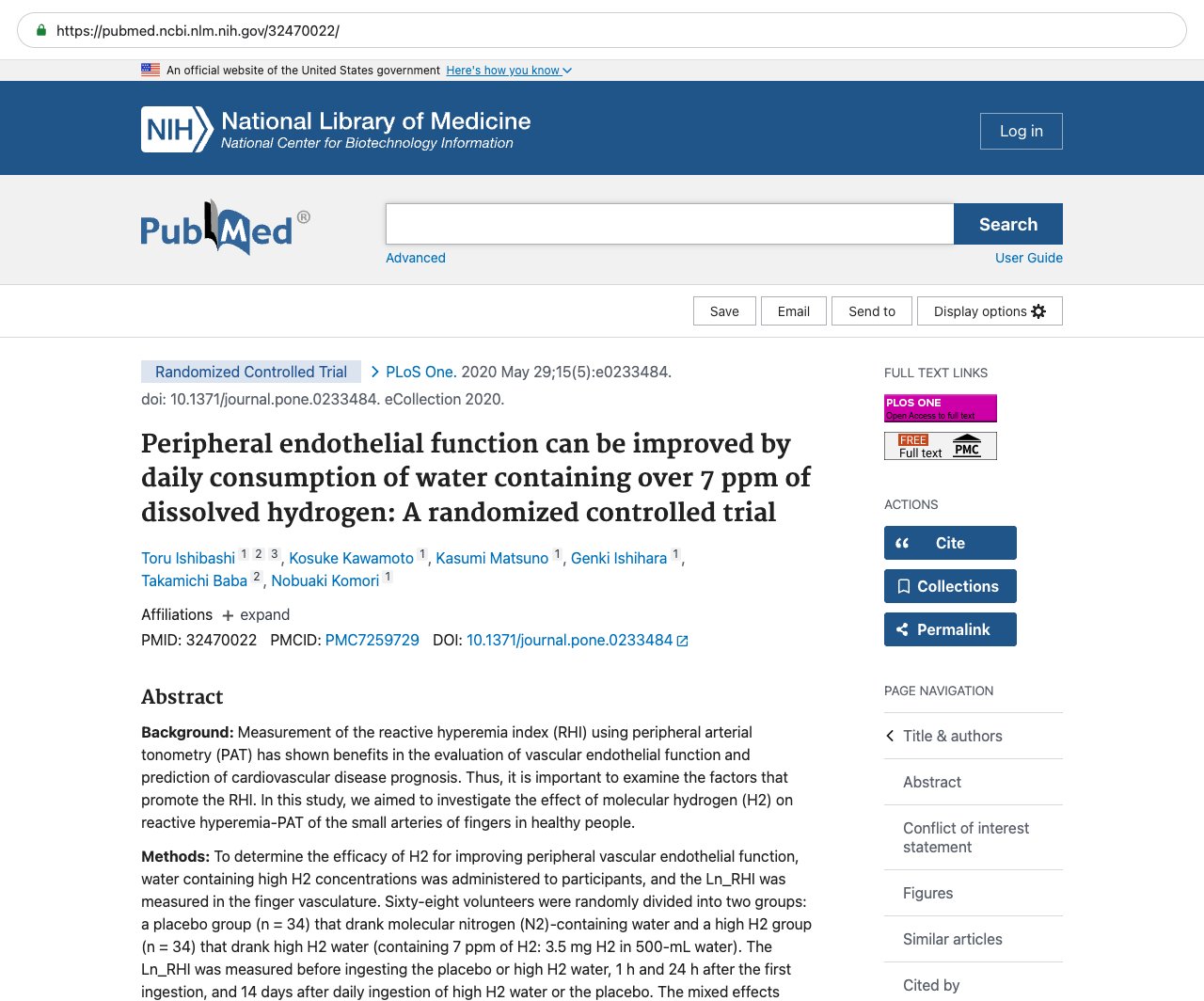
This page mirrors the published abstract (© the authors / publisher) for reference and citation. The canonical source is the PubMed record linked above. This is not medical advice.