2019 · Li et al. — Effect of hydrogen-rich water on the Nrf2/ARE signaling pathway in rats with myocardial ischemia-reperfusion injury.
Super-Abstract
In isolated rat hearts, drinking hydrogen-rich water before and during ischemia-reperfusion dramatically boosted the heart's own antioxidant defences — activating the Nrf2/ARE signalling pathway, increasing protective enzymes (NQO1, HO-1, SOD-1), and reducing oxidative damage (MDA). This is a preclinical animal study; the results do not yet constitute evidence for human heart disease.
Commentary
The study used a sophisticated ex-vivo Langendorff heart perfusion model: 60 rats were pre-treated with either hydrogen-rich water or control fluid, then their hearts were removed, mounted on a perfusion device, and subjected to a controlled ischemia-reperfusion protocol. The molecular analysis (RT-qPCR, immunohistochemistry, Western blot) showed that hydrogen-rich water significantly upregulated Nrf2, NQO1, HO-1, and SOD-1 at both mRNA and protein levels during the reperfusion period — the critical window when ROS production spikes. In parallel, SOD enzyme activity rose and the lipid-peroxidation marker MDA fell in the HRW group, while the opposite occurred in controls. The Nrf2/ARE pathway is considered one of H₂'s key signalling targets and this study adds mechanistic detail at the molecular level.
Key quotes
- „Hydrogen-rich water increased the activation of the Nrf2/ARE signaling pathway, and the levels of mRNA and protein Nrf2, NQO1, HO-1 and SOD-1 were significantly increased (P < 0.05) in the ischemia-reperfusion period.“ — the central molecular finding: HRW activates antioxidant gene expression during the critical reperfusion window
- „the ischemia-reperfusion phase showed significantly increased SOD activity and significantly decreased MDA content in the hydrogen-rich water group.“ — functional outcomes: more antioxidant enzyme activity, less oxidative damage
- „Hydrogen-rich water can activate the Nrf2/ARE signaling pathway, alleviate ischemia-reperfusion injury in isolated rat hearts and reduce the oxidative stress level of myocardial tissue.“ — the authors' conclusion — carefully scoped to isolated rat hearts
Our assessment
This is a well-designed preclinical animal study (rat ex-vivo model) with detailed molecular endpoint analysis. It provides mechanistic support for H₂ acting via the Nrf2/ARE pathway in cardiac ischemia-reperfusion. Limitations: the Langendorff perfusion model is an isolated ex-vivo system that does not replicate the complexity of a living animal or human patient; the study uses drinking-water pre-treatment in animals, which may not correspond to achievable H₂ concentrations or timing in human clinical settings; results cannot be directly extrapolated to human myocardial infarction or cardiac surgery.
Study design
- Type: preclinical animal study (rat, ex-vivo Langendorff heart perfusion model) · n: 60 rats (30 hydrogen-rich water, 30 control), subdivided by ischemic phase
- H₂ delivery: drinking hydrogen-rich water pre-treatment · Endpoints: Nrf2, NQO1, HO-1, SOD-1 (mRNA + protein via RT-qPCR, IHC, Western blot); SOD activity; MDA content · Result: ↑ protective enzymes, ↓ lipid peroxidation in HRW group during reperfusion
Abstract
The effects of hydrogen-rich water on oxidative stress via the Nrf2/ARE signaling pathway were studied in rats with myocardial ischemia-reperfusion injury (MIRI). Sixty rats were randomly divided into a hydrogen-rich water group and a control group, with 30 rats in each group. The two groups were randomly divided into three groups: pre-ischemic period, ischemic period and reperfusion period. After the heart was removed, it was fixed in a Langendorff device and perfused with an oxygen-balanced 37 °C perfusate. The control group was perfused with Kreb's-Ringers (K-R) solution, and the hydrogen-rich water group was perfused with K-R solution + hydrogen-rich water. The levels of mRNA and protein of Nrf2, NQO1, HO-1 and SOD-1 in cardiomyocytes were detected by RT-qPCR, immunohistochemistry (IHC) and Western blot analysis. SOD activity and MDA content were determined. Hydrogen-rich water increased the activation of the Nrf2/ARE signaling pathway, and the levels of mRNA and protein Nrf2, NQO1, HO-1 and SOD-1 were significantly increased (P < 0.05) in the ischemia-reperfusion period compared with the ischemic period. In the control group, the levels of mRNA and protein of Nrf2, NQO1, HO-1 and SOD-1 were significantly decreased (P < 0.05) in the ischemia-reperfusion period compared with the ischemic period. Compared with the ischemic period, the ischemia-reperfusion phase showed significantly increased SOD activity and significantly decreased MDA content in the hydrogen-rich water group, while SOD activity was significantly decreased, and MDA content was significantly increased in the control group (P < 0.05). Hydrogen-rich water can activate the Nrf2/ARE signaling pathway, alleviate ischemia-reperfusion injury in isolated rat hearts and reduce the oxidative stress level of myocardial tissue.
Source & links
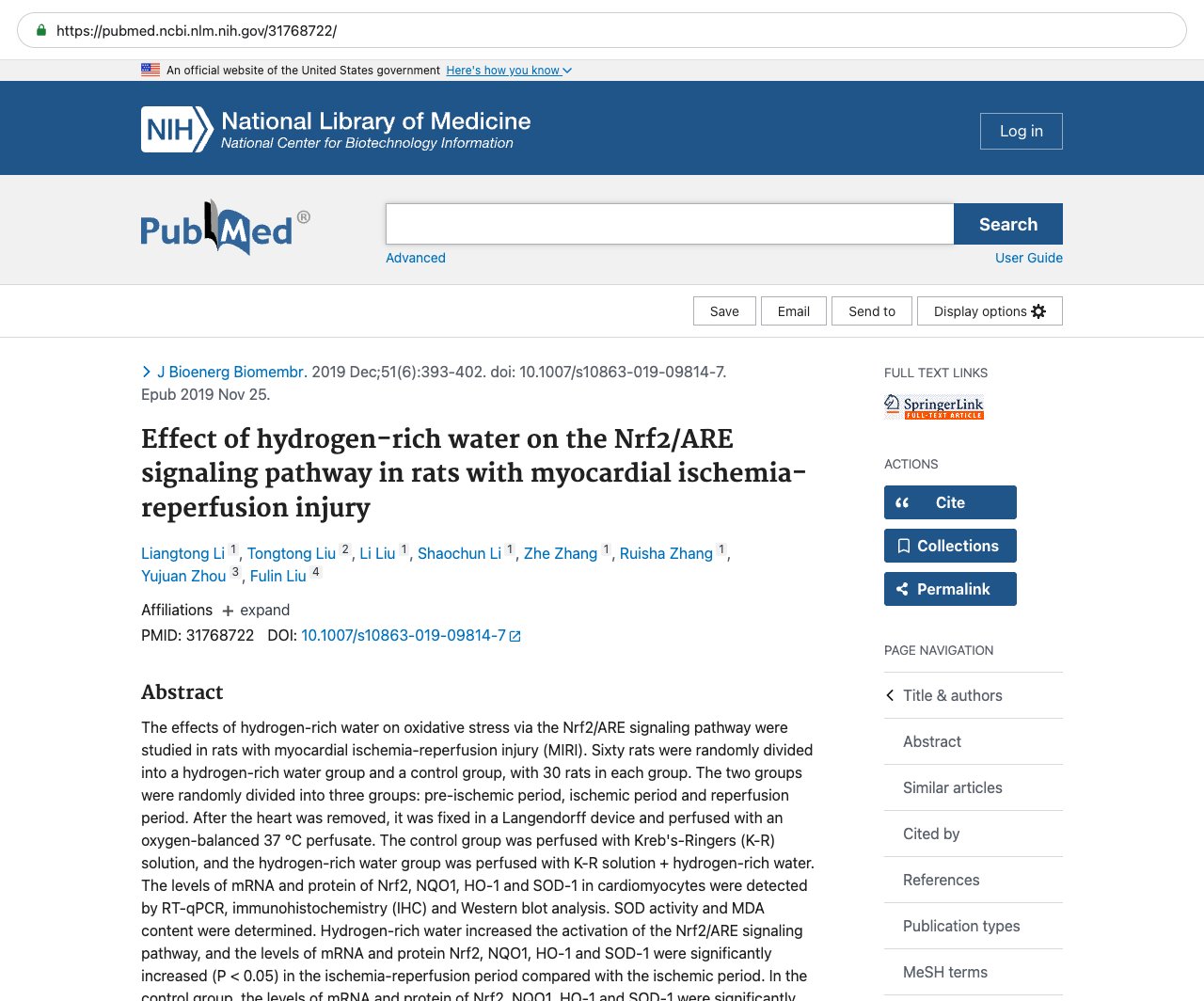
Screenshot of the PubMed page
This page mirrors the published abstract (© the authors / publisher) for reference and citation. The canonical source is the PubMed record linked above. This is not medical advice.