2019 · Iuchi — Molecular Hydrogen Suppresses Free-Radical-Induced Cell Death by Mitigating Fatty Acid Peroxidation and Mitochondrial Dysfunction
Super-Abstract
In human leukemia cells exposed to the oxidative stressor tert-butyl hydroperoxide, molecular hydrogen (H₂) reduced fatty acid peroxidation, preserved mitochondrial function, and prevented cell death. This in-vitro study provides mechanistic evidence that H₂ protects cells from radical-induced damage through two complementary pathways: suppression of lipid peroxidation and protection of mitochondrial integrity. These are cell-culture results and do not constitute proof of human therapeutic efficacy. (Canadian Journal of Physiology and Pharmacology, 2019.)
Commentary
This study from the group that originally reported H₂ as a therapeutic antioxidant (Ohsawa/Ohta lab lineage) addresses a key mechanistic question: by what cellular mechanisms does H₂ protect against oxidative injury? Using THP-1 cells (a human monocyte/macrophage cell line) stressed with tBHP, Iuchi et al. deploy a panel of fluorescent assays to track fatty acid peroxidation (Liperfluo, C11-BODIPY), mitochondrial oxidoreductase activity (alamarBlue), membrane potential (TMRM), and cell death (PI staining). H₂ reduced all damage markers. The mechanistic conclusion — H₂ protects via lipid peroxidation suppression AND mitochondrial protection — adds granularity to the simple „hydroxyl radical scavenger“ model. However, THP-1 is a cancer cell line in culture; the physiological relevance and dose-response in normal tissues and in vivo remains to be established.
Key quotes
- „H2 protected the cultured cells against the cytotoxic effects induced by tert-butyl hydroperoxide“ — primary result: H₂ prevents oxidative cell death in this model
- „H2 suppressed cellular fatty acid peroxidation and cell membrane permeability, mitigated the decline in mitochondrial oxidoreductase activity and mitochondrial membrane potential“ — dual mechanism: lipid peroxidation + mitochondrial protection
- „These results suggested that H2 suppresses free-radical-induced cell death through protection against fatty acid peroxidation and mitochondrial dysfunction.“ — mechanistic conclusion summarised
Our assessment
A mechanistically informative in-vitro study using established assays. The findings contribute to the mechanistic picture of how H₂ reduces oxidative injury at the cellular level. Honest limitations: (1) THP-1 is a leukemia cell line, not primary human cells; (2) the oxidative stressor (tBHP) is a synthetic model compound — not the same as physiological oxidative stress; (3) H₂ concentration in the cell medium is not explicitly quantified in the abstract; (4) no in-vivo validation. The study supports the mechanistic plausibility of H₂'s antioxidant effects but does not demonstrate efficacy in any human disease.
Study design
- Type: in-vitro cell study · Model: THP-1 human acute monocytic leukemia cell line · Stressor: tert-butyl hydroperoxide (tBHP) · H₂ intervention: dissolved H₂ in culture medium
- Assays: LDH release (membrane permeability), Hoechst/PI staining (cell death), Liperfluo/C11-BODIPY (fatty acid peroxidation), alamarBlue (mitochondrial oxidoreductase), TMRM (mitochondrial membrane potential)
- Result: H₂ reduced tBHP-induced cell death, membrane permeabilisation, lipid peroxidation, and mitochondrial dysfunction — consistent with dual protective mechanism
Abstract
Molecular hydrogen (H2) was believed to be an inert and nonfunctional molecule in mammalian cells; however, we overturned the concept by reporting the therapeutic effects of H2 against oxidative stress. Subsequently, extensive studies revealed multiple functions of H2 by exhibiting the efficacies of H2 in various animal models and clinical studies. Here, we investigated the effect of H2 on free-radical-induced cytotoxicity using tert-butyl hydroperoxide in a human acute monocytic leukemia cell line, THP-1. Cell membrane permeability was determined using lactate dehydrogenase release assay and Hoechst 33342 and propidium iodide staining. Fatty acid peroxidation and mitochondrial viability were measured using 2 kinds of fluorescent dyes, Liperfluo and C11-BODIPY, and using the alamarBlue assay based on the reduction of resazurin to resorufin by mainly mitochondrial succinate dehydrogenase, respectively. Mitochondrial membrane potential was evaluated using tetramethylrhodamine methyl ester. As a result, H2 protected the cultured cells against the cytotoxic effects induced by tert-butyl hydroperoxide; H2 suppressed cellular fatty acid peroxidation and cell membrane permeability, mitigated the decline in mitochondrial oxidoreductase activity and mitochondrial membrane potential, and protected cells against cell death evaluated using propidium iodide staining. These results suggested that H2 suppresses free-radical-induced cell death through protection against fatty acid peroxidation and mitochondrial dysfunction.
Source & links
Screenshot of the PubMed page
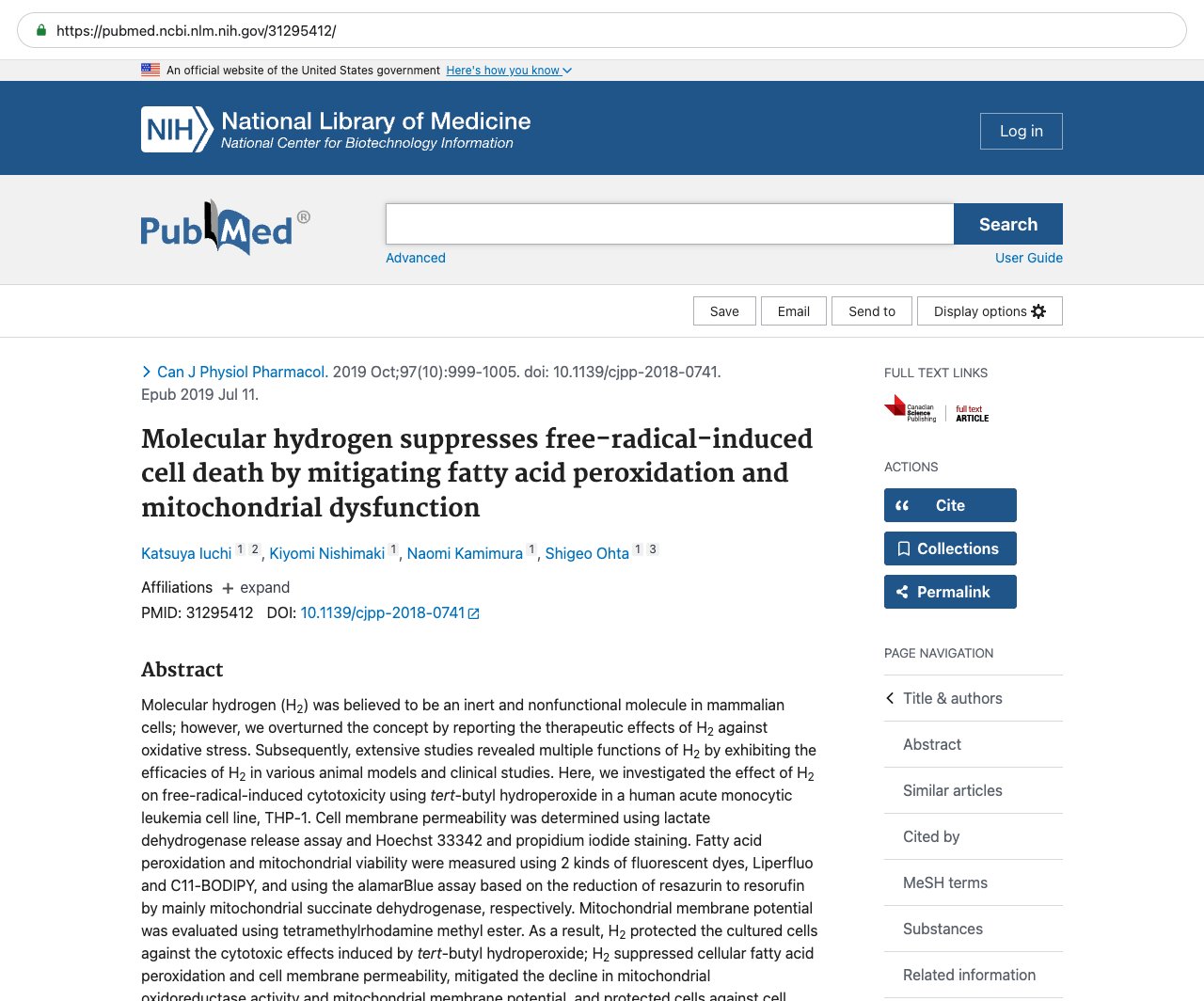
This page mirrors the published abstract (© the authors / publisher) for reference and citation. The canonical source is the PubMed record linked above. This is not medical advice.