2024 International journal of endocrinology and metabolism Review / Meta-analysis Drinking (HRW) Metabolic
2024 · Jamialahmadi et al. — The Effects of Hydrogen-Rich Water on Blood Lipid Profiles in Metabolic Disorders Clinical Trials: A Systematic Review and Meta-Analysis
Super-Abstract
Pooling eight randomised trials with 357 patients with metabolic disorders, this meta-analysis found a small decrease in triglycerides with hydrogen-rich water (−0.27, 95% CI −0.47 to −0.07), while the confidence intervals for LDL and HDL cholesterol included zero. The authors describe slight decreases in triglycerides, total cholesterol and LDL cholesterol. The interval printed for total cholesterol (−0.07, from −0.32 to −0.18) does not contain its own point estimate, which points to a reporting error. HDL results varied between studies (I² = 37.32%), and a meta-regression found an association between the outcomes and intervention duration. (International Journal of Endocrinology and Metabolism, 2024.)
Commentary
Serum lipids are common markers for tracking metabolic disorders, and this review asked whether hydrogen-rich water changes them. Following PRISMA guidelines, the authors searched PubMed, Web of Science, Embase and Google Scholar up to January 2024 for randomised controlled trials in metabolic disorders that measured lipid profiles. Eight trials with a total of 357 patients with various metabolic disorders were included. Study quality was rated with the Jadad scoring system, and the authors report no or low risk of bias in all studies. Outcomes were triglycerides, total cholesterol, LDL and HDL cholesterol. A meta-regression tested intervention duration as a moderator. The abstract does not name the effect measure or the statistical model, and it does not describe the comparison groups or the doses and durations used in the trials.
Key quotes
- „The overall levels of TG [95% CI: -0.27 (-0.47, -0.07)], TC [95% CI: -0.07 (-0.32, -0.18)], and LDL [95% CI: -0.06 (-0.28, 0.15)] demonstrated slight decreases across the studies.“ — the main results; only the triglyceride interval clearly excludes zero
- „However, there was some heterogeneity in HDL levels [95% CI: -0.11 (-0.37, 0.14)] among the studies (I² = 37.32%).“ — HDL showed no clear effect and some variation between studies
- „Hydrogen-rich water demonstrated modest lipid-lowering effects in patients with metabolic disorders.“ — the authors' conclusion, to be read against the reported confidence intervals
Our assessment
The review pools randomised trials, but the numbers in the abstract support less than its conclusion. Triglycerides are the only outcome with a consistently reported estimate whose confidence interval excludes zero. The intervals for LDL and HDL cholesterol include zero, and the interval given for total cholesterol does not contain its own point estimate, so it cannot be interpreted as printed. The authors' summary of “modest lipid-lowering effects” therefore goes beyond what the intervals show. Limitations: the analysis includes only eight trials, which cover various metabolic disorders. The effect measure and its units are not stated. Heterogeneity is reported only for HDL. Quality was rated with the Jadad scale, and no certainty-of-evidence rating is given. Doses, durations and comparison groups are not described, and the direction of the duration effect in the meta-regression is not explained.
Study design
- Type: systematic review and meta-analysis following PRISMA (PubMed, Web of Science, Embase and Google Scholar to January 2024, quality rated with the Jadad scale) · n: 357 patients in eight trials · H₂ delivery: drinking hydrogen-rich water
- Included studies: eight randomised controlled trials in patients with various metabolic disorders that measured blood lipids, all rated by the authors as having no or low risk of bias
- Result: triglycerides −0.27 (95% CI −0.47 to −0.07), total cholesterol −0.07 (printed interval −0.32 to −0.18, internally inconsistent), LDL −0.06 (95% CI −0.28 to 0.15), HDL −0.11 (95% CI −0.37 to 0.14, I² = 37.32%). Effect measure not named in the abstract
Abstract
CONTEXT: Metabolic disorders are a growing global concern, especially in developed countries, due to their increasing prevalence. Serum lipid profiles, including triglycerides (TG), total cholesterol (TC), high-density lipoprotein (HDL), and low-density lipoprotein (LDL), are commonly used clinical biomarkers for monitoring the progression of these metabolic abnormalities. In recent decades, hydrogen-rich water (HRW) has gained attention as a safe and effective treatment, with regulatory effects on lipid peroxidation and inflammatory responses in clinical trials. OBJECTIVES: This systematic review and meta-analysis aim to evaluate the effectiveness of HRW therapy on blood lipid profiles in randomized controlled trials (RCTs) for metabolic disorders. METHODS: Following the PRISMA guidelines, a search for RCT studies was conducted in the PubMed, Web of Science, Embase, and Google Scholar databases up to January 2024. Eight studies that met all eligibility criteria, including RCTs involving metabolic dysfunctions and evaluations of lipid profiles, were included for further analysis. Data extraction was followed by quality evaluation using the Jadad scoring system. Meta-analysis was conducted using STATA software. RESULTS: The eight selected RCTs included a total of 357 patients with various metabolic disorders. All studies showed either no or low risk of bias. The overall levels of TG [95% CI: -0.27 (-0.47, -0.07)], TC [95% CI: -0.07 (-0.32, -0.18)], and LDL [95% CI: -0.06 (-0.28, 0.15)] demonstrated slight decreases across the studies. However, there was some heterogeneity in HDL levels [95% CI: -0.11 (-0.37, 0.14)] among the studies (I² = 37.32%). Meta-regression analysis further indicated a positive association between the outcomes and the duration of the intervention as a moderating factor. CONCLUSIONS: Hydrogen-rich water demonstrated modest lipid-lowering effects in patients with metabolic disorders. However, due to the observed heterogeneity in HDL variations, further long-term trials involving larger populations are needed to clarify these inconsistencies.
Source & links
Screenshot of the PubMed page
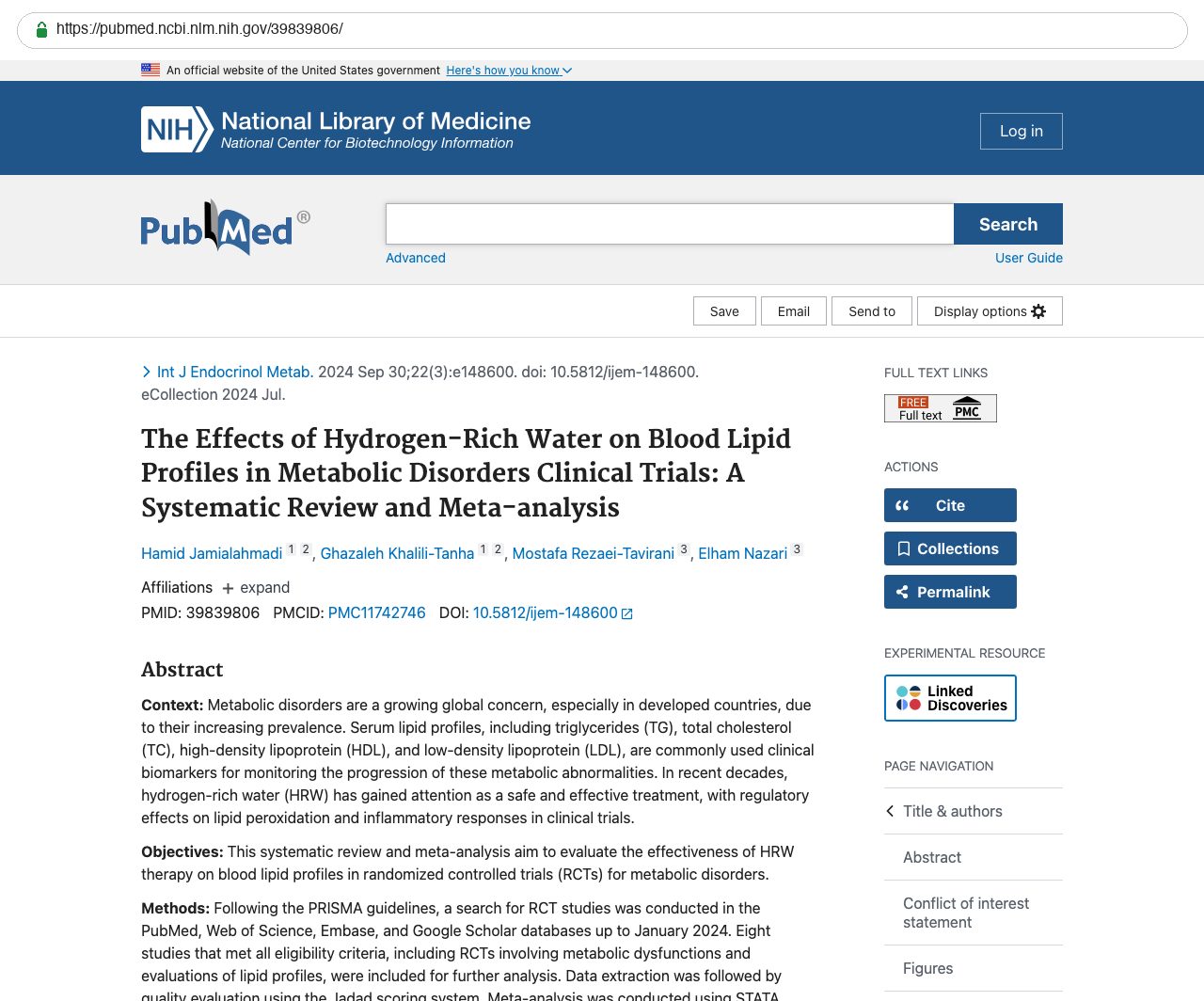
This page mirrors the published abstract (© the authors / publisher) for reference and citation. The canonical source is the PubMed record linked above. This is not medical advice.