2019 · Javorac et al. — Case Report: Buccal administration of hydrogen-producing blend after a mild traumatic brain injury in a professional athlete.
Super-Abstract
A professional soccer player with a mild sport-related traumatic brain injury (TBI) received a hydrogen-producing dissolving tablet buccally every 2 hours for 24 hours post-injury, starting ~15 minutes after the event; the SCAT2 concussion assessment score improved from 68 (severe disruption) to 84 (mild disruption) at 24-hour follow-up, and no side effects were reported. This is a single-case report — it establishes feasibility and safety in one individual but cannot determine whether H₂ drove the recovery. (F1000Research, 2019.)
Commentary
Sport-related concussion is a time-sensitive, high-stakes clinical scenario where effective acute interventions are lacking. The buccal (cheek-dissolved) route for H₂ delivery is novel and pragmatic for pitch-side use: it bypasses the need for water or inhalation equipment. The SCAT2 improvement from 68 to 84 over 24 hours is notable, but mild TBI typically shows substantial spontaneous recovery within hours. Without any control — even a historical comparison in the same athlete — we cannot attribute the improvement to H₂. The dosing description (frequency, formulation) is valuable for future study design. As with the same authors' ankle sprain report (PMID 32399209), the intervention logic is sound and the safety profile is clean, but evidence quality remains at the case-report level.
Key quotes
- „The overall score for Sport Concussion Assessment Tool 2 (SCAT2), a standardized method of evaluating injured athletes for concussion, increased from 68 points (severe disruption) at baseline to 84 points (mild disruption) at 24-h follow-up.“ — SCAT2 improvement — notable, but spontaneous recovery in mild TBI is expected
- „The patient received a formulated dosage of hydrogen every 2 hours, with the first intervention given immediately after an initial examination (~ 15 min after the injury).“ — early and frequent dosing — the intervention protocol is clearly described
- „This case has demonstrated that intensive consecutive therapy with oral transmucosal hydrogen formulation is a beneficial strategy with regard to the reduction of presence and severity of symptoms of sport-related mild TBI.“ — authors' conclusion — overstated for a single uncontrolled case; feasibility is the fair claim
Our assessment
The report provides a well-documented intervention protocol for buccal H₂ delivery post-concussion and confirms tolerability in one patient. The authors overstate conclusions slightly (using „beneficial strategy“ for a single uncontrolled case), though the clinical rationale — H₂ as neuroprotective in early TBI — has preclinical support. Limitations: n = 1; no control; rapid SCAT2 improvement is expected in mild TBI regardless of intervention; H₂ release kinetics from the buccal tablet not characterised; SCAT2 is self-reported in part. This is hypothesis-generating only.
Study design
- Type: single-patient case report · n: 1 (elite professional soccer player, mild sport-related TBI / grade II concussion) · H₂ delivery: buccally-dissolved hydrogen-producing tablet, every 2 hours for 24 hours post-injury (first dose ~15 min after injury)
- Outcome: SCAT2 score 68 → 84 at 24-h follow-up (severe → mild disruption category)
- Safety: no side effects reported; novel route (buccal/transmuco) — feasibility confirmed in one case
Abstract
Background: Sport-related mild traumatic brain injury (TBI) is a serious trauma that could impair brain function of an injured athlete. Treatment solutions for mild TBI typically concentrate on complete rest, while non-traditional therapeutic options remain largely ineffective. Molecular hydrogen (H 2 ) is an innovative neuroprotective agent that can easily reach the brain, yet no data are available concerning its value as a first-aid intervention after a mild TBI. Case report: This case report demonstrates the efficacy and safety of a hydrogen-producing dissolving tablet administered buccally during the first 24 hours post-injury in a professional soccer player who suffered a mild TBI. The patient received a formulated dosage of hydrogen every 2 hours, with the first intervention given immediately after an initial examination (~ 15 min after the injury). The overall score for Sport Concussion Assessment Tool 2 (SCAT2), a standardized method of evaluating injured athletes for concussion, increased from 68 points (severe disruption) at baseline to 84 points (mild disruption) at 24-h follow-up. The patient reported no side effects of hydrogen intervention. Conclusions: This case has demonstrated that intensive consecutive therapy with oral transmucosal hydrogen formulation is a beneficial strategy with regard to the reduction of presence and severity of symptoms of sport-related mild TBI.
Source & links
Screenshot of the PubMed page
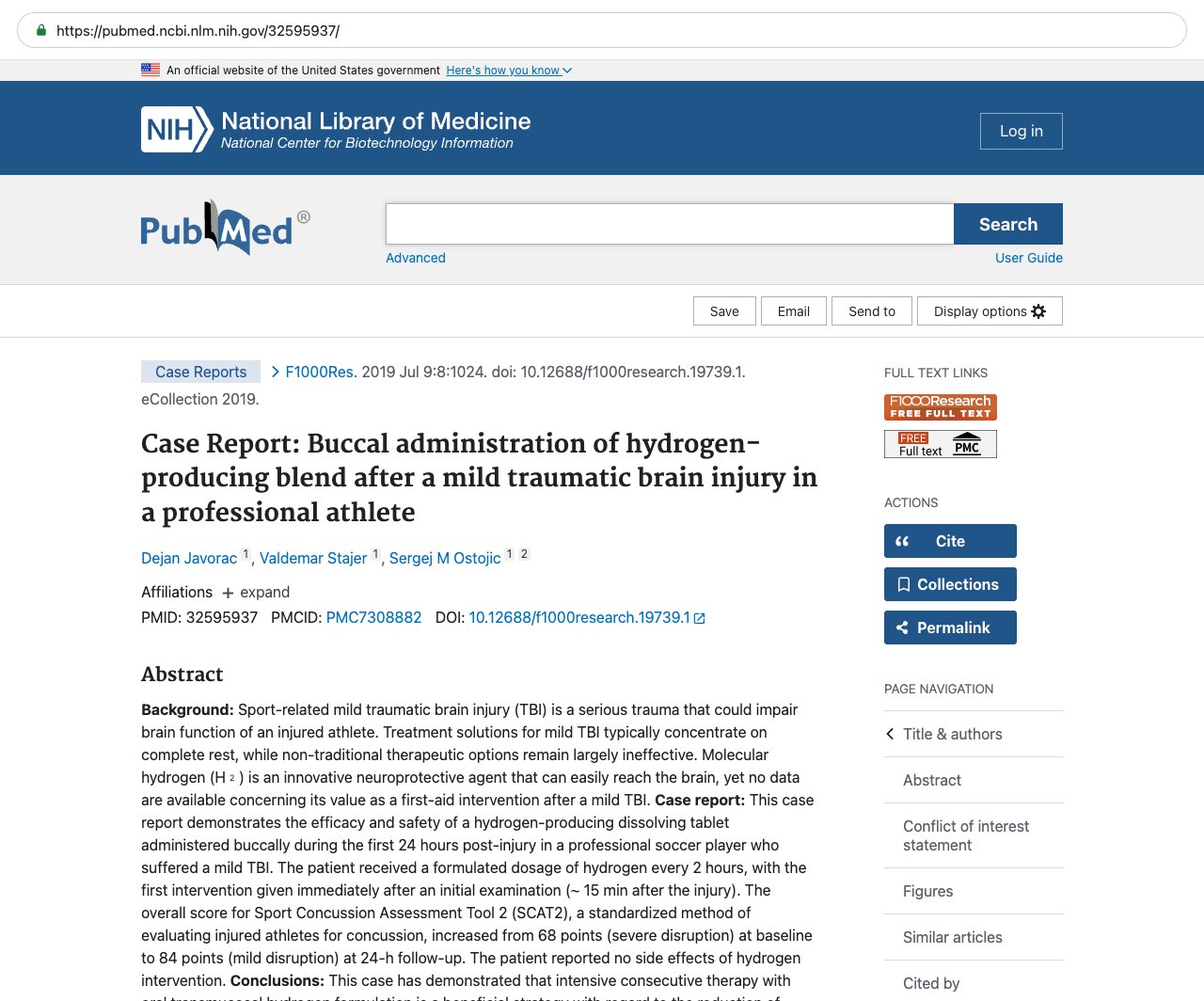
This page mirrors the published abstract (© the authors / publisher) for reference and citation. The canonical source is the PubMed record linked above. This is not medical advice.