2020 · Javorac et al. — Case Report: Acute hydrotherapy with super-saturated hydrogen-rich water for ankle sprain in a professional athlete.
Super-Abstract
A professional athlete with a grade II ankle sprain received six sessions of 30-minute H₂-rich water hydrotherapy within the first 24 hours post-injury, with notable improvements in pain (VAS 50 → 20), ankle swelling (–2.8 %), and dorsiflexion range of motion (+27.9 %) by the 24-hour follow-up. This is a single-patient case report — it shows feasibility and generates hypotheses but cannot establish effectiveness. (F1000Research, 2020.)
Commentary
Ankle sprain management has long relied on the RICE protocol (rest, ice, compression, elevation), though RICE has been challenged for limiting blood flow and potentially impairing healing. This case report tests an alternative acute intervention — repeated H₂-rich water hydrotherapy — in a well-documented single athlete case. The improvements in pain, swelling, and range of motion across 24 hours are encouraging and the intervention timeline is clearly described. However, the fundamental limit of any case report applies: without a control condition or comparison population, we cannot separate H₂ effects from the natural course of mild-to-moderate ankle sprains (which often improve substantially within 24 hours regardless of treatment). The super-saturation of H₂ used here is also not quantified, making reproducibility difficult.
Key quotes
- „The pain VAS self-completed by the patient dropped from 50 points (moderate pain) at baseline (immediately after injury) to 20 points (mild pain) at 24-h follow-up.“ — pain reduction — subjective self-report, no control comparison
- „Ankle swelling dropped by 2.8% and dorsiflexion range of movement improved by 27.9% from baseline to follow-up.“ — objective measurements — promising but uncontrolled
- „Our case has indicated that an acute multi-session hydrotherapy with hydrogen-rich water might be a helpful treatment in terms of pain, swelling reduction and regaining range of motion after an ankle sprain.“ — authors' cautious interpretation — correctly presented as a signal only
Our assessment
A single case report — useful as a hypothesis generator and for documenting feasibility and safety of the intervention, but carrying essentially no inferential weight regarding effectiveness. The comparison to the RICE protocol is asserted rather than tested. Limitations: n = 1; no control; natural recovery within 24 hours confounds all outcome changes; H₂ concentration in the water not specified; outcome assessor (the patient himself for VAS) is not blinded. The authors correctly frame conclusions as „might be helpful“ — this framing is appropriate and should be maintained.
Study design
- Type: single-patient case report · n: 1 (elite professional athlete, grade II ankle sprain) · H₂ delivery: super-saturated hydrogen-rich water hydrotherapy — six sessions of 30 min each, every 4 hours, within first 24 hours post-injury
- Outcomes: pain VAS (50 → 20), ankle swelling (–2.8 %), dorsiflexion range of motion (+27.9 %) at 24-hour follow-up
- Note: no control condition; natural recovery cannot be separated from treatment effect; H₂ concentration not quantified
Abstract
Background: The traditional treatment of soft tissue injuries consists of the RICE protocol - rest, ice, compression, and elevation, followed for up to 72 hours after a trauma. Although designed as an immediate therapy to reduce inflammation that occurs after an acute injury, the RICE protcol might not be the best way to promote healing due to limiting blood flow. Molecular hydrogen (H 2) has recently been put forward as a possible adjuvant treatment in musculoskeletal medicine, yet limited data are available concerning its effectiveness as a first-aid intervention. Case report: We report here a case of an elite professional athlete who suffered a grade II ankle sprain, and who subsequently received six sessions of ankle and foot hydrotherapy (e.g. 30-min at every four hours) with super-saturated hydrogen-rich water during the first 24 hours post-injury. The pain VAS self-completed by the patient dropped from 50 points (moderate pain) at baseline (immediately after injury) to 20 points (mild pain) at 24-h follow-up. Ankle swelling dropped by 2.8% and dorsiflexion range of movement improved by 27.9% from baseline to follow-up, respectively. Conclusions: Our case has indicated that an acute multi-session hydrotherapy with hydrogen-rich water might be a helpful treatment in terms of pain, swelling reduction and regaining range of motion after an ankle sprain.
Source & links
Screenshot of the PubMed page
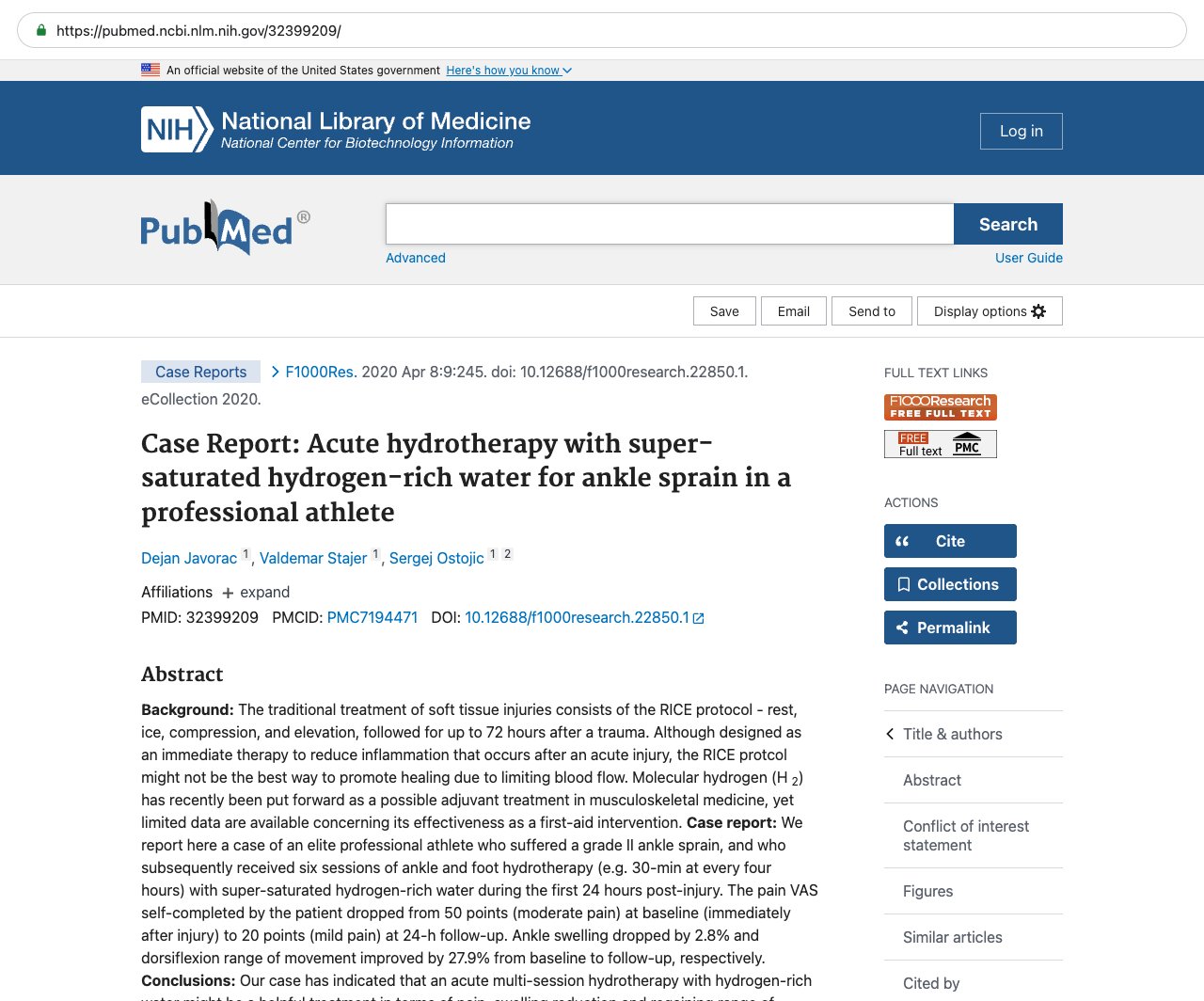
This page mirrors the published abstract (© the authors / publisher) for reference and citation. The canonical source is the PubMed record linked above. This is not medical advice.