2024 Frontiers in cardiovascular medicine Pilot / Observational Human H₂ therapy Inhalation Cardiovascular
2024 · Ji et al. — Effectiveness and Safety of Hydrogen Inhalation Therapy as an Additional Treatment for Hypertension in Real-World Practice: A Retrospective, Observational Study in China
Super-Abstract
In a retrospective analysis of 2,364 Chinese adults with hypertension, those who added hydrogen inhalation to routine treatment had a larger fall in systolic blood pressure than matched patients without it, with a difference of −7.81 mm Hg at week 24. Diastolic pressure also fell more (−2.89 mm Hg at week 24) and blood pressure control was more likely (odds ratio 2.24). Adverse events were similar in both groups. Because patients chose hydrogen inhalation themselves (per full text) and were not randomised, the study cannot show that hydrogen caused the difference. (Frontiers in Cardiovascular Medicine, 2024.)
Commentary
The study asked how hydrogen inhalation performs as an add-on to routine antihypertensive treatment in everyday Chinese practice. It is an observational, retrospective analysis of hypertensive patients treated with routine antihypertensives, with or without starting hydrogen inhalation, between 2018 and 2023. Patients were assigned to the hydrogen or control group after propensity score matching. In total 2,364 were analysed, per full text 1,182 per group out of 4,126 eligible, from hospitals and health examination centres in Qingdao. Per full text, the hydrogen group inhaled pure hydrogen gas by nasal tube at 2.0 L/min at self-chosen times, at least 15 hours per week (mean 21.3 hours). Also per full text, the recorded antihypertensive drugs had to stay the same during follow-up, but doses changed in 14.9% of the hydrogen group and 21.3% of controls. The primary outcome was the change in mean systolic blood pressure over 24 weeks. Secondary outcomes were diastolic blood pressure and the blood pressure control rate. Subgroup and sensitivity analyses and adverse events were also assessed.
Key quotes
- „Both mean SBP and DBP levels significantly decreased in the HI group compared to control group at each follow-up visit with the between group difference of -4.63 mm Hg (95% CI, -6.51 to -2.74) at week 8, -6.69 mm Hg (95% CI, -8.54 to -4.85) at week 16, -7.81 mm Hg (95% CI, -9.57 to -6.04) at week 24 for SBP“ — the primary outcome: systolic pressure differences between the matched groups
- „The incidences of AEs were similar between the HI group and control group with all p-value >0.05.“ — safety, based on adverse events recorded in medical files
- „The HI therapy is related to significant amelioration in BP levels with acceptable safety profile in Chinese hypertensive adults after 24 weeks of treatment, building a clinical ground for further research to evaluate the antihypertensive effect of HI therapy.“ — the authors' conclusion, worded as an association that needs further research
Our assessment
The study compares two matched groups from routine care over 24 weeks. Blood pressure fell more in the hydrogen group, but the design cannot separate hydrogen from other differences between the groups. Per full text, patients chose hydrogen inhalation themselves and received it in dedicated hydrogen treatment departments with staff monitoring each session, which the control group did not have. Propensity score matching balances only recorded characteristics, and the authors name unmeasured confounding as a limitation. Limitations: retrospective and non-randomised design, no placebo, blinding not reported, blood pressure taken from routine records, Chinese patients only and 24 weeks of follow-up. Adverse events came from physicians' notes and may be under-recorded, as the authors note. Per full text, 4.0% of the hydrogen group and 5.2% of controls had adverse events (p = 0.168). The difference of 7.81 mm Hg describes an association that a randomised trial would need to test.
Study design
- Type: retrospective, observational, multicentre study with propensity score matching (records 2018–2023), not randomised · n: 2,364 (1,182 per group per full text) · H₂ delivery: inhaled hydrogen added to routine antihypertensives for 24 weeks; per full text pure hydrogen gas at 2.0 L/min by nasal tube, at least 15 hours per week
- Comparator: matched patients on routine antihypertensives without hydrogen inhalation
- Result: primary: systolic difference −4.63 mm Hg (95% CI −6.51 to −2.74) at week 8, −6.69 (−8.54 to −4.85) at week 16, −7.81 (−9.57 to −6.04) at week 24. Diastolic difference −1.83, −2.57 and −2.89 mm Hg. Controlled blood pressure: odds ratio 1.44, 1.90 and 2.24. Adverse events similar (all p > 0.05)
Abstract
AIM: To evaluate the real-life effectiveness and safety of hydrogen inhalation (HI) therapy as an additional treatment in Chinese adults with hypertension. METHODS: This observational, retrospective clinical study included hypertensive patients receiving routine antihypertensives with or without HI initiation from 2018 to 2023. Participants were assigned to the HI group or non-HI group (control group) after propensity score matching. The changes in mean systolic blood pressure (SBP) level during the 24-week follow-up period in different groups were examined primarily. The secondary outcome was the changes in diastolic blood pressure (DBP) and blood pressure (BP) control rate during the study. Several subgroup and sensitivity analyses were performed to confirm the robustness of our main findings. Adverse event (AE) was also assessed in patients of both groups. RESULTS: In total, we selected 2,364 patients into the analysis. Both mean SBP and DBP levels significantly decreased in the HI group compared to control group at each follow-up visit with the between group difference of -4.63 mm Hg (95% CI, -6.51 to -2.74) at week 8, -6.69 mm Hg (95% CI, -8.54 to -4.85) at week 16, -7.81 mm Hg (95% CI, -9.57 to -6.04) at week 24 for SBP, and -1.83 mm Hg (95% CI, -3.21 to -0.45) at week 8, -2.57 mm Hg (95% CI, -3.97 to -1.17) at week 16, -2.89 mm Hg (95% CI, -4.24 to -1.54) at week 24 for DBP. Patients in the HI group were more likely to attain controlled BP at the follow-up period with odds ratio of 1.44 (95% CI, 1.21-1.72) at week 8, 1.90 (95% CI, 1.59-2.27) at week 16, and 2.24 (95% CI, 1.87-2.68) at the end. The trends of subgroup and sensitivity analyses were mostly consistent with the main analysis. The incidences of AEs were similar between the HI group and control group with all p-value >0.05. CONCLUSION: The HI therapy is related to significant amelioration in BP levels with acceptable safety profile in Chinese hypertensive adults after 24 weeks of treatment, building a clinical ground for further research to evaluate the antihypertensive effect of HI therapy.
Source & links
Screenshot of the PubMed page
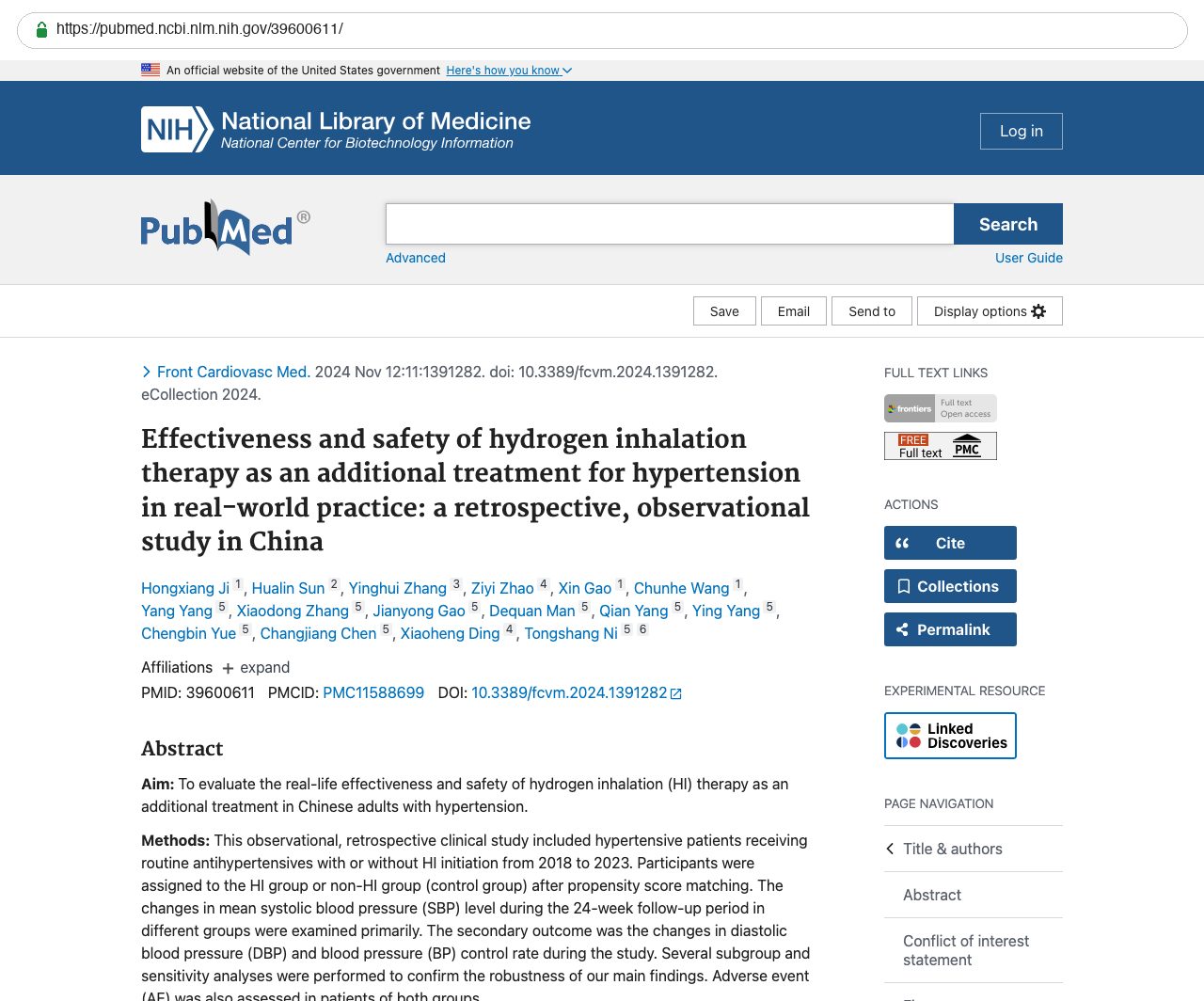
This page mirrors the published abstract (© the authors / publisher) for reference and citation. The canonical source is the PubMed record linked above. This is not medical advice.