2025 · Ji — Mitochondrial 'Birth-Death' Coordinator: An Intelligent Hydrogen Nanogenerator to Enhance Intervertebral Disc Regeneration
Super-Abstract
Researchers developed a smart nanoparticle (Fe@HP-OD) that releases molecular hydrogen (H₂) precisely inside degenerated intervertebral discs (IVDs) in response to the local microenvironment. In animal and cell models, this nanogenerator reduced oxidative stress, restored nucleus pulposus cell function, and promoted disc regeneration by coordinating two opposing mitochondrial processes — biogenesis (‚Birth') and mitophagy (‚Death'). This study is preclinical; its findings do not yet apply to humans.
Commentary
Intervertebral disc degeneration is a major driver of chronic back pain, and the underlying cause is largely mitochondrial dysfunction triggered by oxidative stress. This study introduces a mechanistically elegant concept: using a controlled H₂-releasing nanogenerator to simultaneously suppress pathological mitophagy and UPRmt (the ‚Death' overdrive) while activating AMPK-driven mitochondrial biogenesis (‚Birth'). The dual-action of this single H₂ nanogenerator — tuning both sides of mitochondrial turnover — is a notable conceptual advance. The response-triggered H₂ release in the acidic, ROS-rich IVD microenvironment adds a degree of targeting that passive H₂ delivery cannot achieve. However, all results derive from in vitro cell culture and rodent in vivo models; translation to human disc biology and clinical feasibility (delivery, dose, safety) remain entirely open.
Key quotes
- „Both in vitro and in vivo results prove alleviation of cellular oxidative stress and restoration of nucleus pulposus cells function, thereby facilitating successful IVD regeneration.“ — overall efficacy finding in preclinical models
- „this study for the first time proposes the mitochondrial 'Birth-Death' coordination mechanism: 1) attenuation of overactivated mitochondrial 'Death' process (UPRmt and unselective mitophagy); and 2) activation of Adenosine 5'-monophosphate-activated protein kinase (AMPK) signaling pathway for mitochondrial 'Birth-Death' balance“ — the novel mechanistic framework introduced by this paper
- „an intelligent hydrogen nanogenerator (Fe@HP-OD), which can sustainably release H2 in response to the unique microenvironment in degenerated IVDs“ — how targeted H₂ delivery is achieved
Our assessment
This is a preclinical proof-of-concept study (cell + rodent models) — not a human trial. The mechanistic framing of mitochondrial ‚Birth-Death' coordination via H₂ is novel and scientifically interesting, and the stimulus-responsive nanogenerator design is sophisticated. However, engineering such nanoparticles for safe spinal use in humans involves enormous hurdles: biocompatibility, regulatory approval, delivery route, and long-term safety. Conclusions must not be extrapolated to humans. The study contributes to mechanistic understanding; clinical relevance is speculative at this stage.
Study design
- Type: preclinical (in vitro + in vivo animal) · Model: nucleus pulposus cells + rodent IVD degeneration model · H₂ delivery: Fe@HP-OD nanogenerator (microenvironment-triggered H₂ release)
- Result: reduced oxidative stress markers, restored NP cell function, promoted IVD structural regeneration; AMPK pathway activation confirmed as mechanism for mitochondrial biogenesis/mitophagy balance
Abstract
Currently, mitochondrial dysfunction caused by oxidative stress is a growing concern in degenerative diseases, notably intervertebral disc degeneration (IVDD). Dysregulation of the balance of mitochondrial quality control (MQC) has been considered the key contributor, while it's still challenging to effectively harmonize different MQC components in a simple and biologically safe way. Hydrogen gas (H2) is a promising mitochondrial therapeutic molecule due to its bio-reductivity and diffusibility across cellular membranes, yet its relationship with MQC regulation remains unknown. Herein, we propose a mitochondrial 'Birth-Death' coordinator achieved by an intelligent hydrogen nanogenerator (Fe@HP-OD), which can sustainably release H2 in response to the unique microenvironment in degenerated IVDs. Both in vitro and in vivo results prove alleviation of cellular oxidative stress and restoration of nucleus pulposus cells function, thereby facilitating successful IVD regeneration. Significantly, this study for the first time proposes the mitochondrial 'Birth-Death' coordination mechanism: 1) attenuation of overactivated mitochondrial 'Death' process (UPRmt and unselective mitophagy); and 2) activation of Adenosine 5'-monophosphate-activated protein kinase (AMPK) signaling pathway for mitochondrial 'Birth-Death' balance (mitochondrial biogenesis and controlled mitophagy). These pioneering findings can fill in the gaps in molecular mechanisms for H2 regulation on MQC homeostasis, and pave the way for future strategies towards restoring equilibrium of MQC system against degenerative diseases.
Source & links
Screenshot of the PubMed page
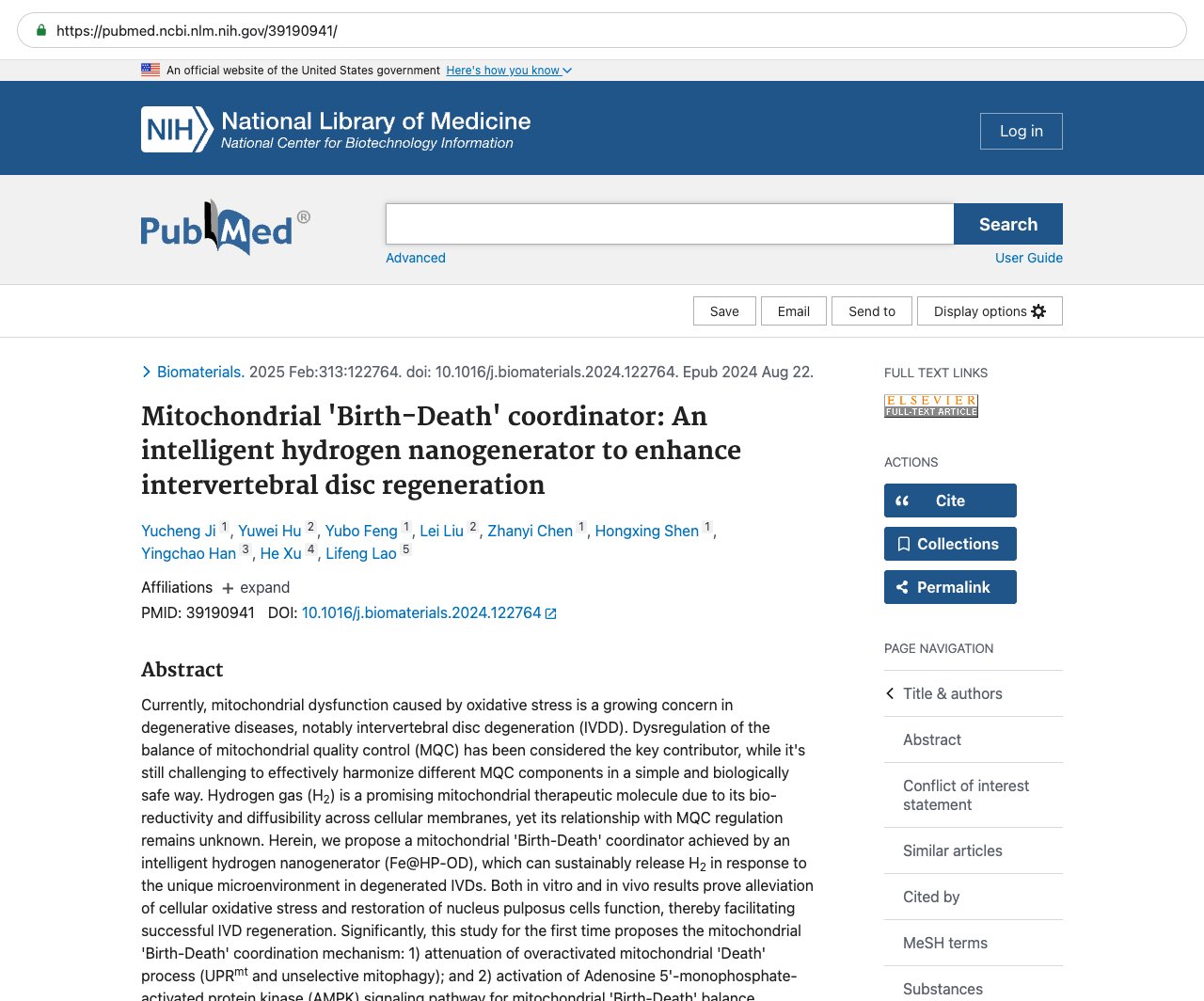
This page mirrors the published abstract (© the authors / publisher) for reference and citation. The canonical source is the PubMed record linked above. This is not medical advice.