2018 Lin chuang er bi yan hou tou jing wai ke za zhi = Journal of clinical otorhinolaryngology head and neck surgery RCT Human H₂ therapy Saline / IVBath / Topical
2018 · Jin — Clinical Study of Hydrogen-Rich Saline in the Treatment of Moderate to Severe Allergic Rhinitis
Super-Abstract
Nasal lavage with hydrogen-rich saline significantly improved symptoms, signs, and quality of life in patients with moderate-to-severe allergic rhinitis — with no relevant adverse effects. This randomized double-blind self-control study with 20 patients is one of the few H₂ trials targeting the upper respiratory tract. (Journal of Clinical Otorhinolaryngology Head and Neck Surgery, 2018.)
Commentary
Allergic rhinitis affects a substantial proportion of the global population and remains difficult to treat satisfactorily — antihistamines and corticosteroids help but come with side effects, and many patients seek alternatives. This study takes a different approach: hydrogen-rich saline applied locally as a nasal wash. The rationale is straightforward — allergic inflammation involves reactive oxygen species (ROS), and H₂ is an established selective antioxidant. By delivering H₂ directly to the nasal mucosa via lavage, local ROS can theoretically be quenched without systemic exposure. The study used a randomized double-blind self-control design, meaning each patient served as their own control, receiving both standard saline and hydrogen-rich saline in a randomized sequence. Outcomes across symptoms, signs, treatment index, total efficacy rate, and a validated quality-of-life questionnaire (BQLQ) all favored hydrogen-rich saline. The absence of significant adverse reactions is consistent with H₂'s established safety profile.
Key quotes
- „There were significant differences of the symptoms, signs scores, the treatment index, the total efficiency and BQLQ between the two kinds of lavage fluid used for patients before and after treatment (P<0.05).“ — all assessed outcomes — symptoms, signs, treatment index, QoL — favored hydrogen-rich saline
- „No significant adverse reactions occurred during follow-up.“ — safety signal: hydrogen-rich saline nasal lavage was well tolerated
- „Hydrogen-enriched saline is safe and effective for allergic rhinitis.“ — authors' conclusion — direct and unambiguous
Our assessment
A biologically plausible and clinically interesting study using H₂ in a novel topical delivery route. The self-control crossover design is efficient but limits generalizability compared to parallel-group RCTs. Limitations: n = 20 is small; the journal is a Chinese specialty publication and the article appears in Chinese (translated title), which limits independent verification of statistical details; the H₂ concentration of the lavage solution is not specified in the available data; follow-up duration is not clear. The results are encouraging but should be replicated in larger, properly powered trials before clinical recommendations can be made.
Study design
- Type: randomized, double-blind, self-control (crossover) study · n: 20 · H₂ delivery: hydrogen-rich saline nasal lavage (topical/local)
- Indication: moderate-to-severe persistent allergic rhinitis
- Result: significant improvements in symptoms, signs, treatment index, total efficacy rate, and BQLQ quality-of-life score (all P < 0.05) with hydrogen-rich saline vs. normal saline; no significant adverse reactions
Abstract
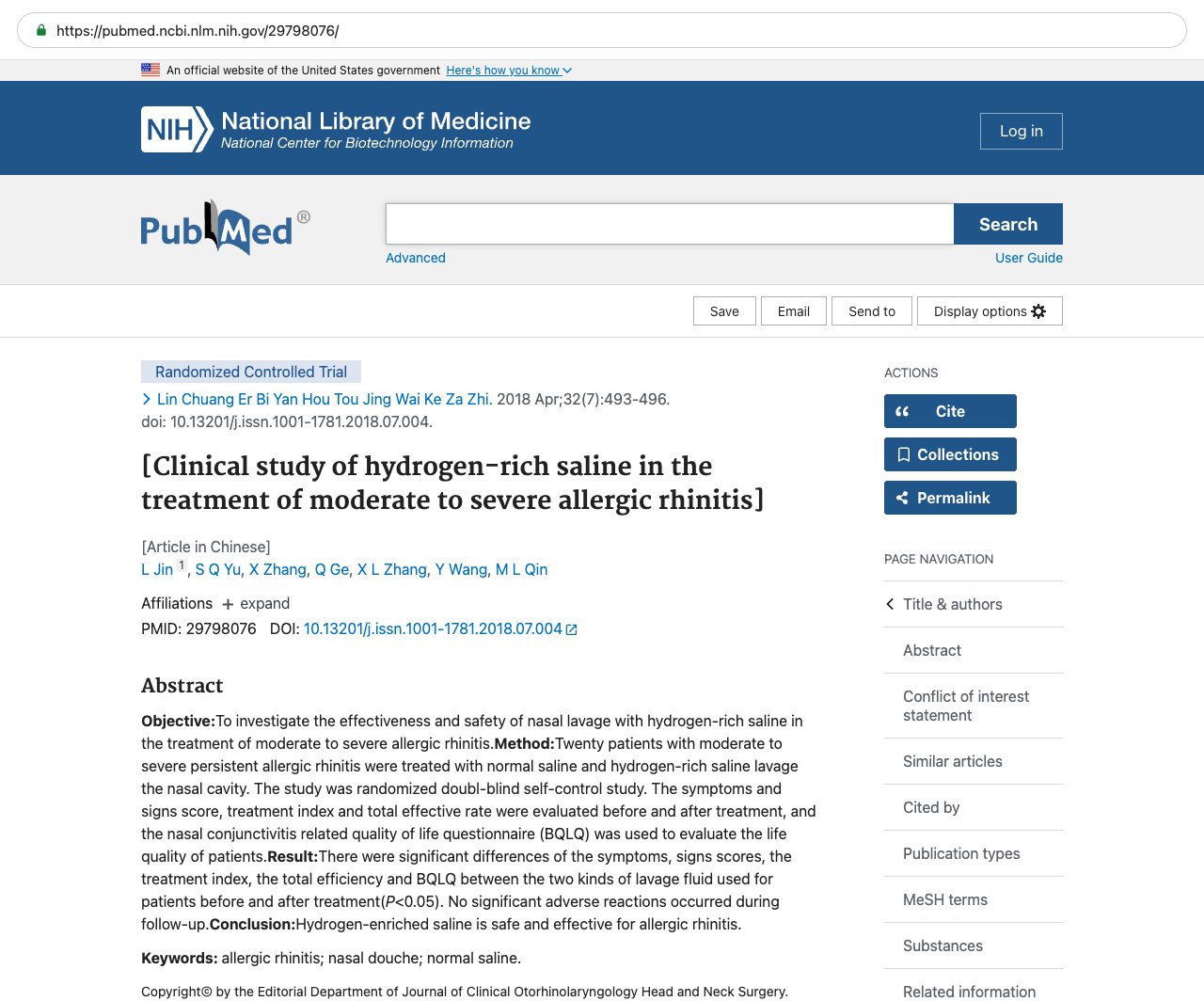
Objective:To investigate the effectiveness and safety of nasal lavage with hydrogen-rich saline in the treatment of moderate to severe allergic rhinitis.Method:Twenty patients with moderate to severe persistent allergic rhinitis were treated with normal saline and hydrogen-rich saline lavage the nasal cavity. The study was randomized doubl-blind self-control study. The symptoms and signs score, treatment index and total effective rate were evaluated before and after treatment, and the nasal conjunctivitis related quality of life questionnaire (BQLQ) was used to evaluate the life quality of patients.Result:There were significant differences of the symptoms, signs scores, the treatment index, the total efficiency and BQLQ between the two kinds of lavage fluid used for patients before and after treatment(P<0.05). No significant adverse reactions occurred during follow-up.Conclusion:Hydrogen-enriched saline is safe and effective for allergic rhinitis.
Source & links
Screenshot of the PubMed page
This page mirrors the published abstract (© the authors / publisher) for reference and citation. The canonical source is the PubMed record linked above. This is not medical advice.