2017 · Zhao — Changes in IL-4 and IL-13 Expression in Allergic Rhinitis Treated with Hydrogen-Rich Saline in a Guinea-Pig Model
Super-Abstract
Hydrogen-rich saline significantly reduced sneezing, scratching, IgE levels, and key allergy-driving cytokines (IL-4, IL-13) in guinea pigs with experimentally induced allergic rhinitis. Both blood markers and nasal tissue expression of these cytokines dropped with treatment. This is a preclinical animal study; no human data exist for this application.
Commentary
Allergic rhinitis is driven largely by Th2-type immune responses, with cytokines IL-4 and IL-13 playing central roles in promoting IgE production, mucus hypersecretion, and airway inflammation. This study sensitised guinea pigs with ovalbumin to create an allergic rhinitis model, then treated them with hydrogen-rich saline (HRS). The behavioral outcomes (sneezing, scratching frequency) improved significantly, and so did the key immunological markers — serum IgE, IL-4 and IL-13 — both in blood and in nasal mucosa tissue. The study uses a solid 3-group design (control, AR, HRS-treated) and multiple measurement methods (ELISA, RT-PCR, Western blot, immunofluorescence). However, guinea pigs sensitised with ovalbumin do not fully replicate human allergic rhinitis, which involves complex environmental and genetic factors. The route of HRS administration is also not entirely specified for direct translation. Still, as a mechanistic pointer toward anti-Th2 effects of H₂, the study is noteworthy.
Key quotes
- „HRS could affect anti-inflammation in AR and decreased the expression of IL-4 and IL-13.“ — the authors' core conclusion on immune modulation
- „The frequencies of sneezing and scratching, as well as the levels of IgE, IL-4, and IL-13, in the serum were higher in the AR group than in the control group (p<0.01), whereas all these parameters were decreased significantly after HRS treatment (p<0.05).“ — quantitative summary of behavioral and immunological improvements
- „The expression levels of IL-4 and IL-13 mRNA and protein in the nasal mucosa were also lower in guinea pigs treated with HRS than those in the AR group (p<0.05).“ — local tissue effect confirmed at the mRNA and protein level
Our assessment
This is a preclinical animal study — results cannot be transferred directly to humans with allergic rhinitis. The study demonstrates a clear signal: hydrogen-rich saline reduces Th2 cytokines and clinical allergy symptoms in a guinea pig model. The mechanistic finding (reduced IL-4/IL-13 at both mRNA and protein level) is internally consistent. Important limitations: the ovalbumin model oversimplifies human allergy; sample size is small (n=6 per group); the exact H₂ dose is not quantified; and no safety or long-term outcomes are reported. Clinical translation would require controlled human trials.
Study design
- Type: animal experiment · Model: guinea pigs, ovalbumin-sensitised allergic rhinitis model · n: 18 animals (6 per group) · H₂ delivery: hydrogen-rich saline (HRS)
- Outcome: reduced sneezing and scratching frequency; decreased serum IgE, IL-4, IL-13; lower IL-4 and IL-13 mRNA and protein in nasal mucosa (all p<0.05 vs. AR group)
Abstract
BACKGROUND: Medical gas hydrogen (H2) has a special role in airway inflammation; however, the effect of H2 on allergic rhinitis (AR) remains unclear. This study explored the possible roles of H2 on the pathogenesis of AR and observed the influences of H2 on cytokines IL-4 and IL-13. METHODS: An AR guinea pig model was established by nasal ovalbumin sensitisation. Eighteen guinea pigs were divided into three groups, namely, saline control, AR-sensitised, and hydrogen-rich saline (HRS)-treated groups, with each group having six guinea pigs. The frequencies of sneezing and scratching were recorded. The IgE level and cytokine (IL-4 and IL-13) levels in the serum were measured. The expression levels of IL-4 and IL-13 mRNA and protein in the nasal mucosa were also determined by real-time reverse transcriptase-polymerase chain reaction and Western blot. We also observed the infiltration of cytokine (IL-4 and IL-13) in nasal mucosa by immunofluorescence. RESULTS: The frequencies of sneezing and scratching, as well as the levels of IgE, IL-4, and IL-13, in the serum were higher in the AR group than in the control group (p<0.01), whereas all these parameters were decreased significantly after HRS treatment (p<0.05). The expression levels of IL-4 and IL-13 mRNA and protein in the nasal mucosa were also lower in guinea pigs treated with HRS than those in the AR group (p<0.05). CONCLUSIONS: HRS could affect anti-inflammation in AR and decreased the expression of IL-4 and IL-13.
Source & links
Screenshot of the PubMed page
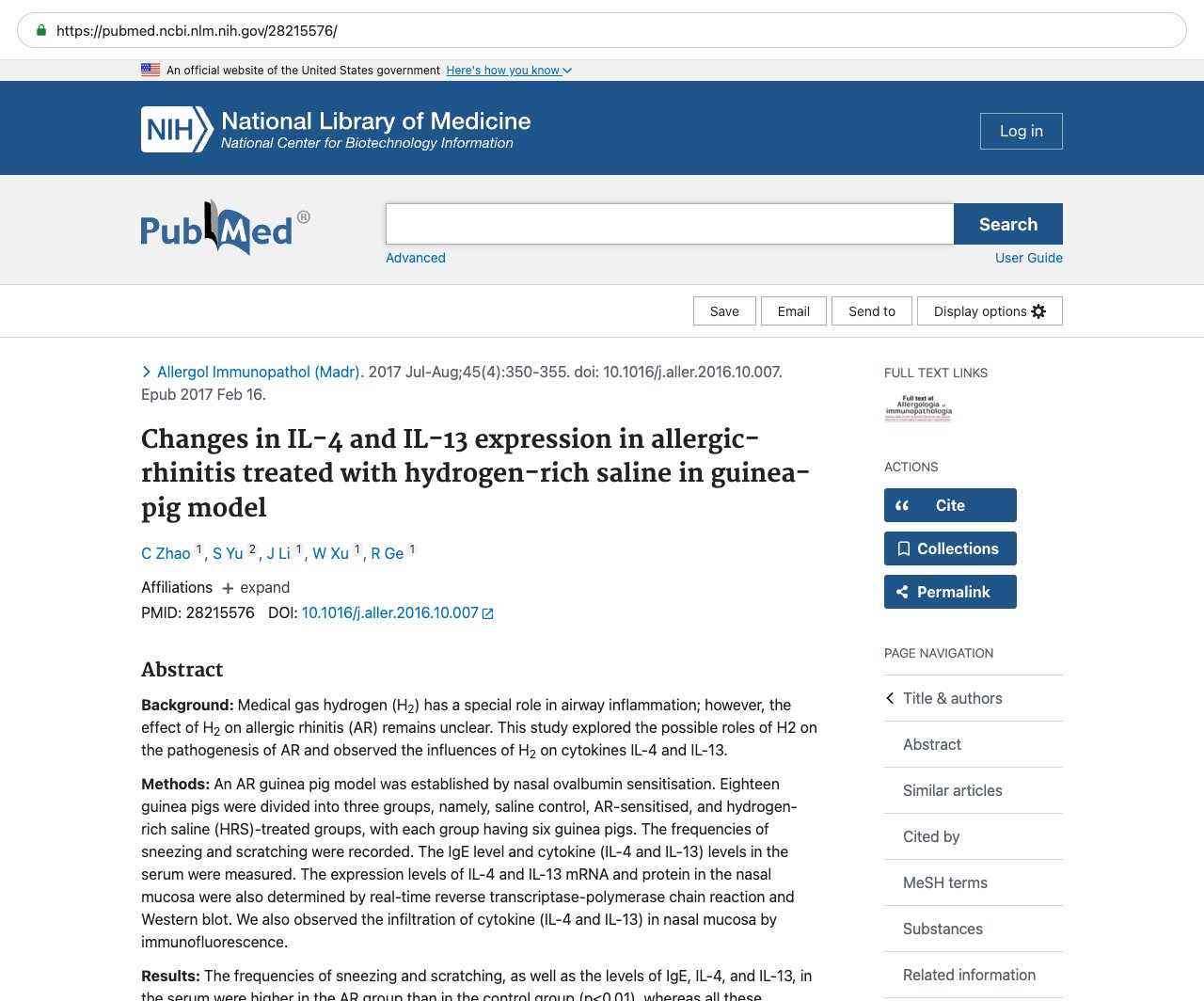
This page mirrors the published abstract (© the authors / publisher) for reference and citation. The canonical source is the PubMed record linked above. This is not medical advice.