2020 Lin chuang er bi yan hou tou jing wai ke za zhi (Journal of Clinical Otorhinolaryngology Head and Neck Surgery) RCT Human H₂ therapy Saline / IVBath / Topical
2020 · Jin — Changes of nasal nitric oxide in the treatment of allergic rhinitis with hydrogen-rich saline lavage of nasal cavity
Super-Abstract
A nasal lavage with hydrogen-rich saline significantly changed the nitric-oxide value in the nose and could thus offer a starting point for treating allergic rhinitis (hay fever). A small, randomized, double-blind self-controlled study with 20 patients. (J Clin Otorhinolaryngol Head Neck Surg, 2020.)
Commentary
This is about allergic rhinitis, i.e. classic hay fever with a blocked, runny nose. The team examined 20 patients with moderate-to-severe persistent allergic rhinitis in a randomized, double-blind self-controlled study. The special feature of the design: each patient served as their own control — the nose was lavaged once with hydrogen-rich saline and once with normal saline, and nasal nitric oxide (nNO) was measured weekly. Important for honesty: the actual therapy here is the hydrogen-rich water — the nitric oxide is only the measured marker, which is linked to the diagnosis and treatment success of allergic rhinitis. The difference in nNO values before and after treatment between the two lavage fluids was statistically significant (p < 0.01). The authors conclude that hydrogen-rich lavage triggers an nNO change in the nose that could be used therapeutically. Honestly: very small sample (n = 20), it is a Chinese-language contribution, and what was measured was primarily a biomarker — not the clinical symptom burden over a long period.
Key quotes
- „The nasal cavity was lavaged with hydrogen-rich normal saline and normal saline, and the nasal nitric oxide(nNO) value was tested weekly.“ — the design: H₂-rich vs. normal saline as nasal lavage, weekly nNO measurement
- „The difference of nNO test values before and after treatment of the two lavage fluids was statistically significant(P<0.01).“ — the significant effect on the nasal NO marker
- „Hydrogen-rich saline lavage can cause nNO change in nasal cavity which may be used in the treatment of allergic rhinitis.“ — the authors' cautious conclusion
Our assessment
Notable as an example of a topical H₂ application (nasal lavage) beyond drinking and inhalation — allergic rhinitis is a very common complaint. The strength of evidence is limited, however: this is a pilot study with only 20 participants, the primary endpoint is a biomarker (nasal NO), not a clearly measured clinical symptom score over the season. The contribution is in a foreign language (Chinese) and has no DOI, which makes it harder to find. Useful as supporting evidence for an anti-inflammatory H₂ principle at the nasal mucosa, not as solid proof of efficacy. Mechanistically the finding fits the preclinical Niu study, where H₂ dampens allergic inflammation in the animal model.
Study design
- Type: randomized, double-blind self-controlled pilot study (human study) · n: 20 (moderate-to-severe persistent allergic rhinitis) · Duration: weekly measurement · H₂ delivery: nasal lavage with hydrogen-rich saline vs. normal saline
- Result metrics: difference of nNO values before/after treatment between the two lavage fluids statistically significant (p < 0.01); nNO correlated with diagnosis and treatment success of allergic rhinitis
Abstract
Objective:To observe the effect of hydrogen-rich saline on the concentration of nitric oxide in the nose, and to explore the mechanism of its treatment of allergic rhinitis. Method:Twenty patients with moderate to severe persistent allergic rhinitis were enrolled in a randomized, double-blind, self-controlled study. The nasal cavity was lavaged with hydrogen-rich normal saline and normal saline, and the nasal nitric oxide(nNO) value was tested weekly. Result:The test value of nNO was correlated with the diagnosis and curative effect of allergic rhinitis. The difference of nNO test values before and after treatment of the two lavage fluids was statistically significant(P<0.01). Conclusion:Hydrogen-rich saline lavage can cause nNO change in nasal cavity which may be used in the treatment of allergic rhinitis.
Source & links
Screenshot of the PubMed page
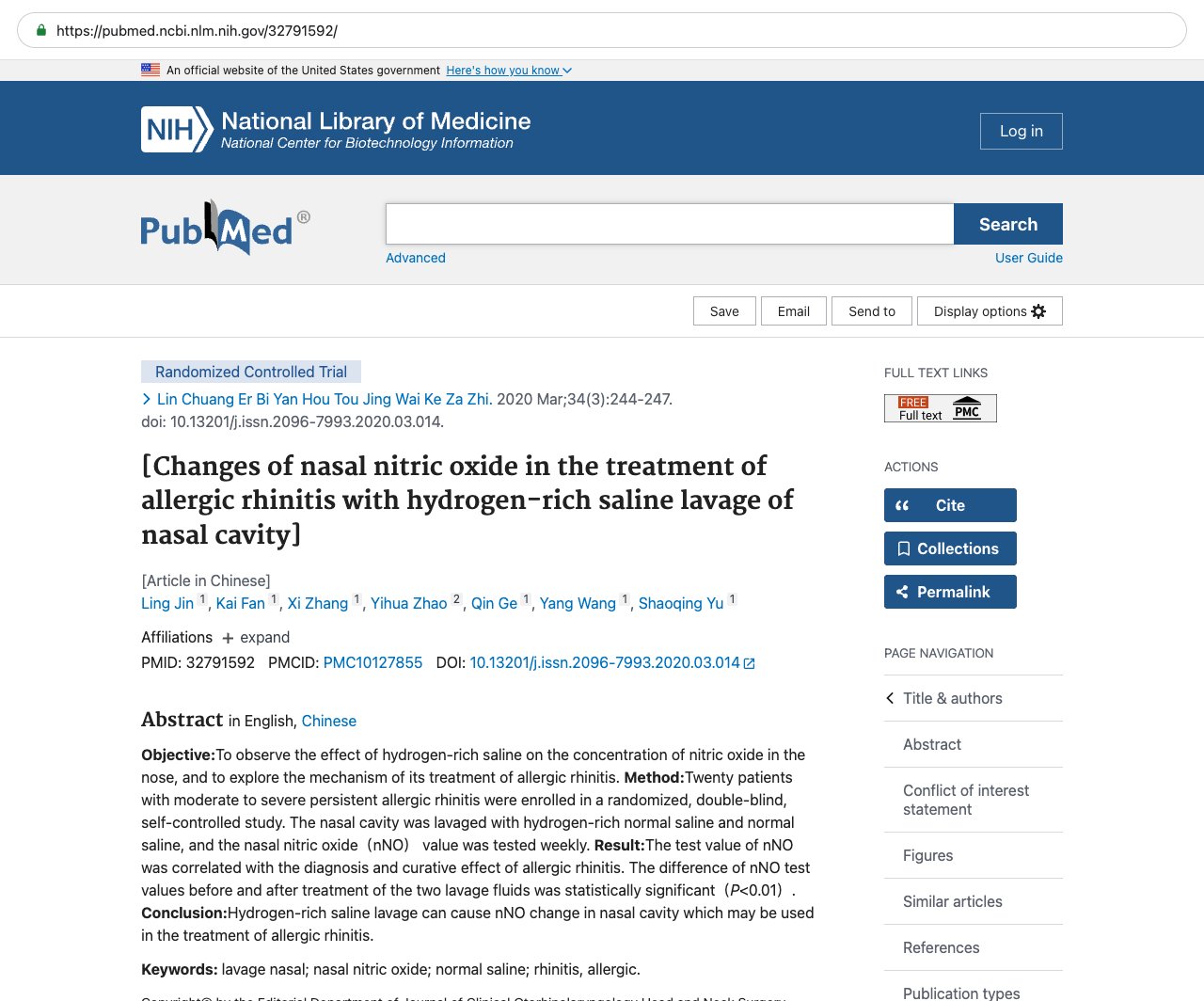
This page mirrors the published abstract (© the authors / publisher) for reference and citation. The canonical source is the PubMed record linked above. This is not medical advice.