2022 Journal of inflammation research RCT Human H₂ therapy Bath / Topical Respiratory / COVIDAllergy
2022 · Jin et al. — The Beneficial Effects of Hydrogen-Rich Saline Irrigation on Chronic Rhinitis: A Randomized, Double-Blind Clinical Trial
Super-Abstract
In 120 patients with chronic rhinitis, nasal irrigation with hydrogen-rich saline lowered the total nasal symptom score more than irrigation with normal saline, and the difference was statistically significant. Eosinophilic protein in nasal secretions also fell more in the hydrogen group, while levels of regulatory T and B cells showed no significant difference between the groups. The abstract reports only that P values were below 0.05 and gives no effect sizes, group sizes, hydrogen concentration or treatment duration. (Journal of Inflammation Research, 2022.)
Commentary
Nasal saline irrigation is an established treatment for chronic rhinitis (CR), and the authors tested whether hydrogen-rich saline (HRS) works better, citing its antioxidant and anti-inflammatory properties. The trial enrolled 120 patients with CR and randomly divided them into two groups: one irrigated the nose with HRS, the other with normal saline. The study is described as randomised and double-blind. The main outcome was the total nasal symptom score (TNSS). The researchers also compared eosinophilic protein (ECP) in nasal secretions, nasal nitric oxide (nNO) and levels of regulatory T cells (Treg) and regulatory B cells (Breg). Patients were further divided into allergic rhinitis (AR) and non-allergic rhinitis (NAR) subgroups based on serum-specific IgE. The abstract does not state the hydrogen concentration, how often or for how long patients irrigated, or how many patients were in each group.
Key quotes
- „Compared to saline irrigation, HRS nasal irrigation was found to improve CR clinical symptoms, especially in patients with AR.“ — the authors' summary of the main result, with the allergic subgroup singled out
- „There were no obvious adverse events observed in patients during the entire treatment period.“ — the only safety information in the abstract, without event counts
- „HRS could effectively be used for the clinical treatment of patients with CR.“ — the authors' recommendation, which rests on a single trial
Our assessment
This is a randomised, double-blind trial with 120 patients. In this sample, irrigation with hydrogen-rich saline reduced nasal symptoms more than normal saline. The abstract reports only that P values were below 0.05 and gives no effect sizes, so the size of the difference cannot be judged. The regulatory T and B cell levels did not differ. Limitations: the abstract does not give the hydrogen concentration, the irrigation schedule, the treatment duration or the number of patients per group. Results for nasal nitric oxide are announced in the methods but not reported. The symptom score is patient-reported. The subgroup findings for allergic and non-allergic rhinitis come from smaller groups whose sizes are not stated. Safety is summarised only as no obvious adverse events. The authors' view that HRS could be used for the clinical treatment of CR goes further than a single trial of this kind can show.
Study design
- Type: randomised, double-blind controlled trial · n: 120 patients with chronic rhinitis (group sizes not stated) · H₂ delivery: nasal irrigation with hydrogen-rich saline (concentration, frequency and duration not stated)
- Comparator: nasal irrigation with normal saline
- Result: TNSS (main outcome) and nasal ECP fell in both groups and were significantly lower with hydrogen-rich saline than with normal saline (P below 0.05). Treg and Breg: no significant difference. Subgroups: larger TNSS reduction in allergic rhinitis, larger ECP reduction in non-allergic rhinitis (both P below 0.05). Other inflammatory markers in the allergic subgroup: no significant difference. No obvious adverse events
Abstract
PURPOSE: Chronic rhinitis (CR) is a common chronic inflammation of the nasal mucosa. Nasal saline irrigation has been demonstrated to be an effective treatment for CR. In this study, we investigated the beneficial effects of hydrogen-rich saline irrigation as an anti-inflammatory irrigation therapy for CR and compared its effectiveness over saline irrigation. Hydrogen-rich saline (HRS) was investigated due to its antioxidant and anti-inflammatory properties. METHODS: A total of 120 patients with CR were randomly divided into two groups, patients irrigated with HR (HRS group) and the control group irrigated with saline (NS group). A randomized, double-blind control study was performed. The main observation index in this study was the total score of nasal symptoms (TNSS). In addition, eosinophilic protein (ECP) of the nasal secretions, nasal nitric oxide (nNO) levels, and levels of regulatory T cells (Treg) and regulatory B cells (Breg) were also compared between the two groups. Furthermore, patients with allergic rhinitis (AR) and non-allergic rhinitis (NAR) were also evaluated based on serum-specific IgE positivity. RESULTS: After treatment, TNSS and nasal ECP in the two groups decreased significantly (P<0.05), with patients in the HRS group showing significantly lower levels compared to the NS group (P<0.05). There were no significant differences in Treg and Breg levels between the two groups. Subgroup analysis showed that TNSS in the AR-HRS group showed a more significant reduction compared to the AR-NS group (P<0.05); however, there were no significant differences for the other inflammatory biomarkers (P>0.05). ECP levels were reduced significantly in the NAR subgroup compared to NS irrigation (P<0.05). There were no obvious adverse events observed in patients during the entire treatment period. CONCLUSION: Compared to saline irrigation, HRS nasal irrigation was found to improve CR clinical symptoms, especially in patients with AR. HRS could effectively be used for the clinical treatment of patients with CR.
Source & links
Screenshot of the PubMed page
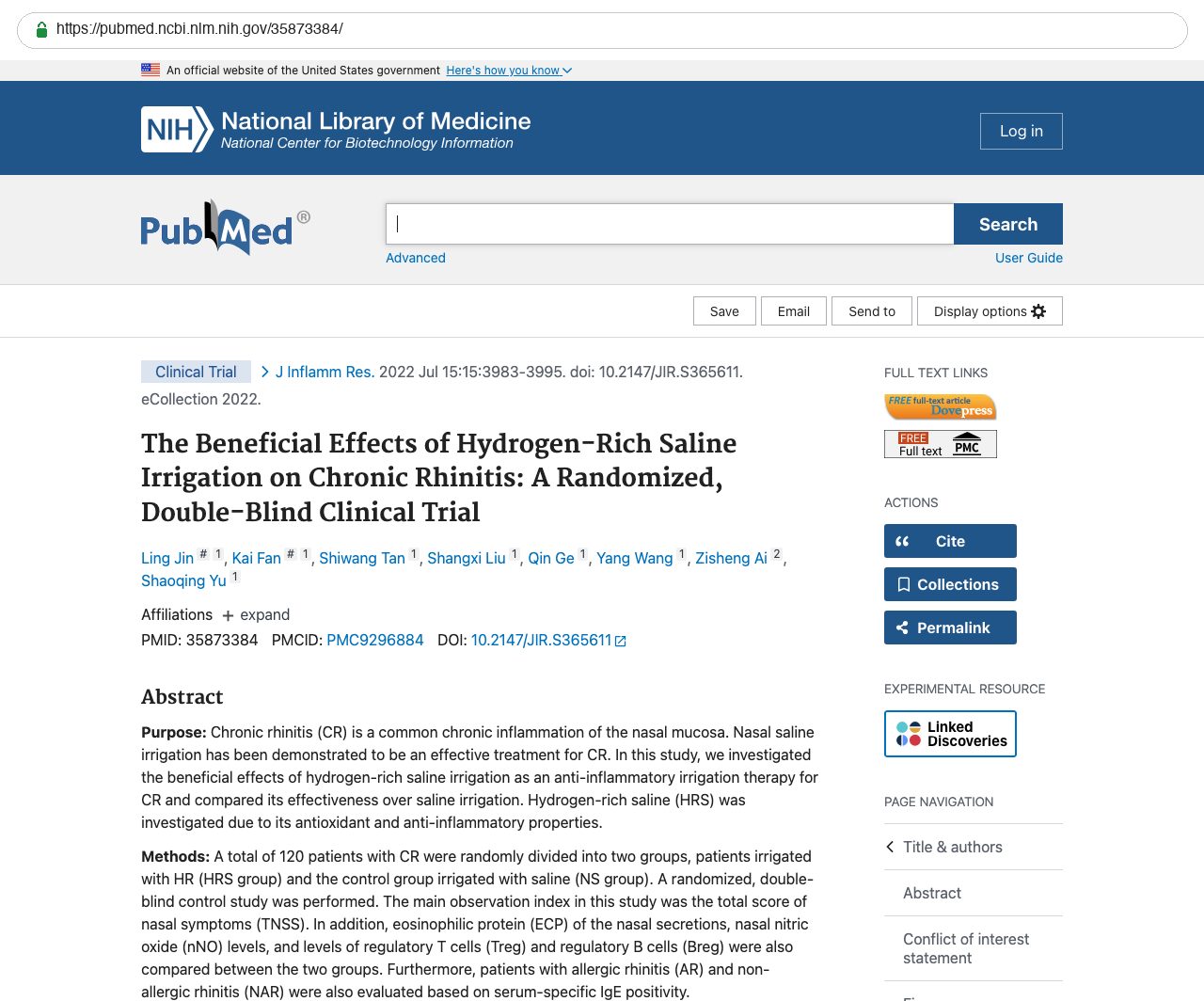
This page mirrors the published abstract (© the authors / publisher) for reference and citation. The canonical source is the PubMed record linked above. This is not medical advice.