2024 Journal of inflammation research RCT Human H₂ therapy Bath / Topical Respiratory / COVIDSurgery & Anesthesia
2024 · Jin et al. — Clinical Observation of Hydrogen-Rich Saline for Nasal Irrigation After Surgery for Chronic Sinusitis: A Randomized, Double-Blind, Controlled Trial
Super-Abstract
In 61 patients who had surgery for chronic rhinosinusitis, nasal irrigation with hydrogen-rich saline led to lower visual analogue scores after 12 weeks than normal saline (0.52 compared with 1.47, P=0.005). In the short-term evaluation, 20 of 31 patients in the hydrogen group and 11 of 30 in the saline group reached complete control (P=0.03). No obvious adverse reactions occurred. The abstract does not report results for the SNOT-22 questionnaire or the endoscopy scores. (Journal of Inflammation Research, 2024.)
Commentary
After functional endoscopic sinus surgery (FESS), nasal saline irrigation is the recognised local treatment for chronic rhinosinusitis (CRS), and the authors tested whether hydrogen-rich saline (HRS) works better. Patients after CRS surgery were randomly assigned to rinse the nose with HRS or with normal saline (NS). The title describes the trial as double-blind. In total, 61 patients completed the study: 31 in the HRS group and 30 in the NS group, according to the result figures. They were followed up once a week, 12 times, and assessed with a visual analogue score (VAS), the 22-item Sinonasal Outcomes Test (SNOT-22) and Lund-Kennedy endoscopy scores (LKES). The primary outcome was the VAS score. The abstract does not state how many patients were randomised, the hydrogen concentration, the rinsing schedule or the volume used.
Key quotes
- „After 12 weeks of follow-up, the VAS scores of both groups decreased, and the HRS group (0.52±0.85) was lower than the NS group (1.47±1.55), P=0.005.“ — the primary outcome: both groups improved, the hydrogen group more
- „The total number of cases with complete control (clinical cure) in the short-term efficacy evaluation was more in the HRS group (20/31) than in the NS group (11/30), P=0.03“ — a secondary result, using the authors' own term for complete control
- „This study found that HRS was more effective than NS alone in nasal irrigation after CRS surgery, and could shorten the time of nasal mucosal healing and epithelialization, with a higher rate of recent complete control.“ — the authors' conclusion, part of which the abstract gives no data for
Our assessment
The trial is randomised and reports a predefined primary outcome with group means and a p-value. In this sample, the primary outcome favoured hydrogen-rich saline (VAS 0.52 compared with 1.47 at 12 weeks), and more patients reached complete control. Limitations: only 61 patients completed the study, and the number randomised and any dropouts are not reported. The abstract does not describe how blinding was achieved, and the VAS is a patient-reported score. Results for SNOT-22 and the endoscopy scores are announced in the methods but not reported. The authors' statement that HRS shortens the time to mucosal healing and epithelialisation is not supported by any figures in the abstract. Adverse events are summarised only as no obvious adverse reactions. Follow-up ended at 12 weeks.
Study design
- Type: randomised controlled trial, double-blind per title · n: 61 completed (31 HRS, 30 NS) · H₂ delivery: nasal irrigation with hydrogen-rich saline after sinus surgery (concentration and schedule not stated)
- Comparator: nasal irrigation with normal saline
- Result: VAS at 12 weeks (primary) 0.52±0.85 vs. 1.47±1.55, P=0.005. Complete control in the short-term evaluation 20/31 vs. 11/30, P=0.03. SNOT-22 and LKES results not reported in the abstract. No obvious adverse reactions
Abstract
PURPOSE: The treatment of chronic rhinosinusitis (CRS) is often a difficult and long-term behavior, so it is necessary to seek a local treatment method that can be used for a long time, and is safe and effective. Nasal saline irrigation after functional endoscopic sinus surgery (FESS) is currently recognized as a local treatment method, but it has no anti-inflammatory, anti-damage, and healing-promoting functions. To investigate the efficacy and safety of hydrogen-rich saline (HRS) for nasal irrigation after CRS surgery. PATIENTS AND METHODS: A total of 61 patients after CRS completed the study. Subjects were randomly assigned to rinse the nasal cavity with HRS or normal saline (NS) after CRS. Participants were followed up once a week for 12 times, and were evaluated with visual analogue score (VAS), 22-item Sinonasal Outcomes Test (SNOT-22), and Lund-Kennedy endoscopy scores (LKES). The primary outcome was the VAS score of patients. RESULTS: After 12 weeks of follow-up, the VAS scores of both groups decreased, and the HRS group (0.52±0.85) was lower than the NS group (1.47±1.55), P=0.005. The total number of cases with complete control (clinical cure) in the short-term efficacy evaluation was more in the HRS group (20/31) than in the NS group (11/30), P=0.03<0.05. No obvious adverse reactions occurred in the two groups during the follow-up. CONCLUSION: This study found that HRS was more effective than NS alone in nasal irrigation after CRS surgery, and could shorten the time of nasal mucosal healing and epithelialization, with a higher rate of recent complete control.
Source & links
Screenshot of the PubMed page
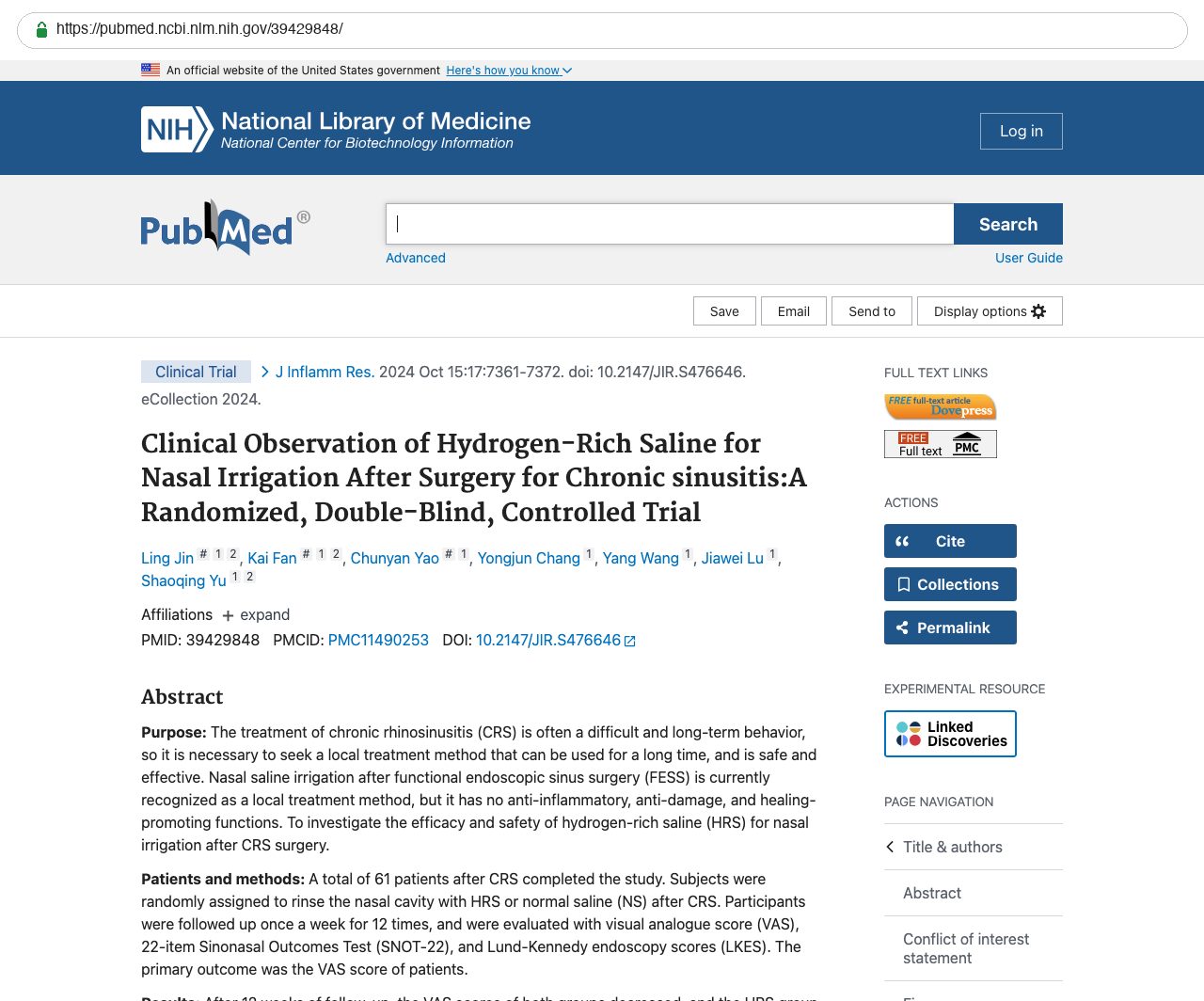
This page mirrors the published abstract (© the authors / publisher) for reference and citation. The canonical source is the PubMed record linked above. This is not medical advice.