2025 Bioinformation Pilot / Observational Human H₂ therapy Bath / Topical Oral healthSurgery & Anesthesia
2025 · Devi et al. — Hydrogen Water Versus Normal Saline for Post-Surgical Irrigation: A Study on Healing and Complication Rates After Third Molar Extraction
Super-Abstract
In 30 patients having impacted lower wisdom teeth removed, irrigating the surgical site with hydrogen water instead of normal saline was reported to give greater improvement in pain, swelling and restricted mouth opening and less dry socket from the second day after surgery. The abstract gives no numbers, effect sizes or p-values for these comparisons. It also does not say whether patients were randomised or whether assessors were blinded. (Bioinformation, 2025.)
Commentary
Removal of impacted lower third molars is a common operation that is often followed by pain and swelling, trismus or dry socket. This study compared hydrogen water with normal saline as the irrigant for the surgical site. 30 patients were divided into two groups of 15. Per full text, they were adults over 18 needing removal of fully impacted mandibular third molars under local anaesthesia, and the surgical procedure was kept uniform so that only the irrigant differed. Per full text, the hydrogen water was freshly made by electrolysis of drinking water for five minutes in a bottle with electrodes, and its hydrogen concentration is not reported. The full text describes data collection by a systematic randomized sampling method but does not explain how patients were allocated to the groups. Pain, swelling, trismus and dry socket were assessed on postoperative days 1, 2 and 7. The abstract does not name a primary endpoint and does not mention blinding or adverse events.
Key quotes
- „Results showed all patients improved over time and that patients in the hydrogen water group had significantly greater improvements in pain, swelling and trismus, as well as a lower incidence of dry socket from postoperative day 2 onward.“ — the main result, reported without numbers or p-values
- „The study included 30 patients total who were divided into 2 groups of 15 and clinical parameters were assessed post-operative days 1, 2 and 7.“ — the design as given in the abstract: small groups and one week of follow-up
- „The anti-inflammatory and antibacterial properties of hydrogen water appear to make it a better irrigant agent than normal saline in healing and reducing postoperative complications.“ — the authors' conclusion, based on mechanisms the study did not measure
Our assessment
The study compares two irrigants under otherwise similar surgical conditions, a reasonable set-up for a first test. The abstract reports better healing with hydrogen water but gives no figures at all, so the size of the differences cannot be judged from it. Limitations: 30 patients in groups of 15, follow-up of seven days and no stated primary endpoint. The abstract does not say whether allocation was random or whether patients and assessors were blinded, and pain and swelling are partly subjective measures. Per full text, the discussion states that some differences were not statistically significant, which does not match the abstract's summary. Anti-inflammatory and antibacterial effects were not measured, so the authors' explanation is an assumption. In this small sample the results suggest a possible benefit that a randomised, blinded trial with reported effect sizes would need to test.
Study design
- Type: comparative clinical study with two parallel groups, randomisation not stated in the abstract · n: 30 (15 hydrogen water, 15 normal saline) · H₂ delivery: hydrogen water used to irrigate the extraction site (per full text freshly made by electrolysis, concentration not reported)
- Comparator: normal saline as irrigant, with the same surgical procedure (per full text)
- Result: both groups improved over time. Hydrogen water group: greater improvements in pain, swelling and trismus and lower dry socket incidence from day 2 onward, described as significant. No numbers or p-values in the abstract
Abstract
Oral surgery involving impacted mandibular third molars is a common procedure. However, it results in postoperative complaints such as pain, swelling, trismus and dry socket. Therefore, it is of interest to compare hydrogen water and normal saline as surgical irrigants in patients undergoing third molar removal. The study included 30 patients total who were divided into 2 groups of 15 and clinical parameters were assessed post-operative days 1, 2 and 7. Results showed all patients improved over time and that patients in the hydrogen water group had significantly greater improvements in pain, swelling and trismus, as well as a lower incidence of dry socket from postoperative day 2 onward. The anti-inflammatory and antibacterial properties of hydrogen water appear to make it a better irrigant agent than normal saline in healing and reducing postoperative complications.
Source & links
Screenshot of the PubMed page
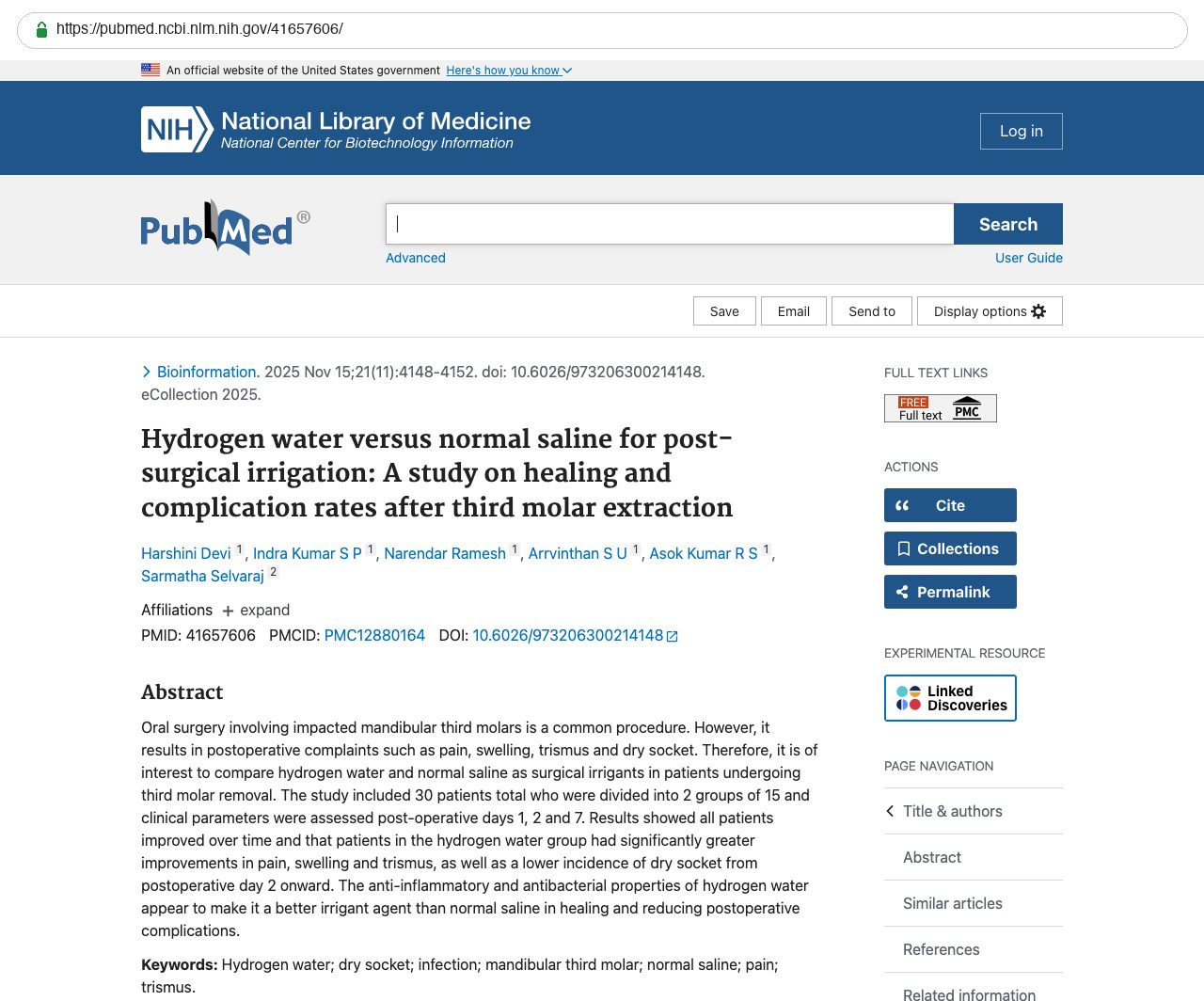
This page mirrors the published abstract (© the authors / publisher) for reference and citation. The canonical source is the PubMed record linked above. This is not medical advice.