2013 Applied radiation and isotopes : including data, instrumentation and methods for use in agriculture, industry and medicine Mechanism / Preclinical Inhalation
2013 · Johnsen — A non-aqueous reduction process for purifying ¹⁵³Gd produced in natural europium targets
Super-Abstract
This nuclear medicine radiochemistry study developed a methanol-based purification process for Gadolinium-153 (a medical imaging quality-assurance isotope) that nearly eliminates the hazardous hydrogen gas produced by conventional aqueous europium reduction. The hydrogen in this paper is a flammability hazard in radiological hot cells — not therapeutic molecular hydrogen (H₂). (Applied Radiation and Isotopes, 2013.)
Commentary
This is a purely technical radiochemistry paper about isotope production and purification, with no connection to molecular hydrogen medicine. Gadolinium-153 (¹⁵³Gd) is used in nuclear medicine imaging quality assurance. It is produced in nuclear reactors using natural europium oxide targets; the ¹⁵³Gd must then be separated from the europium matrix by chemical reduction. The conventional aqueous reduction method generates hydrogen gas as a byproduct — an explosion hazard in radiological containment facilities. The authors' solution replaces water with methanol as the process solvent, nearly eliminating H₂ gas evolution while achieving >98 % europium removal and 90 % gadolinium recovery. This paper is indexed in the H₂ database due to keyword matching on „hydrogen gas“ in an industrial chemistry context.
Key quotes
- „conventional aqueous europium reduction produces hydrogen gas, a flammability hazard in radiological hot cells.“ — the problem: H₂ gas as an unwanted dangerous byproduct of isotope purification
- „We altered the traditional reduction method, using methanol as the process solvent to nearly eliminate hydrogen gas production.“ — the solution: methanol instead of water eliminates the H₂ hazard
- „This new, non-aqueous reduction process demonstrates greater than 98% europium removal and gadolinium yields of 90%.“ — purification performance of the new method
Our assessment
This is a technical radiochemistry paper with no relevance to therapeutic or biological molecular hydrogen. H₂ gas here is an industrial process byproduct that poses a safety hazard and must be eliminated. This entry is in the H₂ database solely due to keyword matching. No conclusions whatsoever about H₂ health effects can be derived from this paper.
Study design
- Type: in-vitro radiochemistry / process chemistry · H₂ relevance: none (H₂ = flammability hazard from industrial isotope purification, suppressed by the new method)
- Method: non-aqueous (methanol) europium reduction for ¹⁵³Gd purification · Result: >98 % Eu removal, 90 % Gd yield, near-zero H₂ gas evolution
Abstract
Gadolinium-153 is a low-energy gamma-emitter used in nuclear medicine imaging quality assurance. Produced in nuclear reactors using natural Eu₂O₃ targets, ¹⁵³Gd is radiochemically separated from europium isotopes by europium reduction. However, conventional aqueous europium reduction produces hydrogen gas, a flammability hazard in radiological hot cells. We altered the traditional reduction method, using methanol as the process solvent to nearly eliminate hydrogen gas production. This new, non-aqueous reduction process demonstrates greater than 98% europium removal and gadolinium yields of 90%.
Source & links
Screenshot of the PubMed page
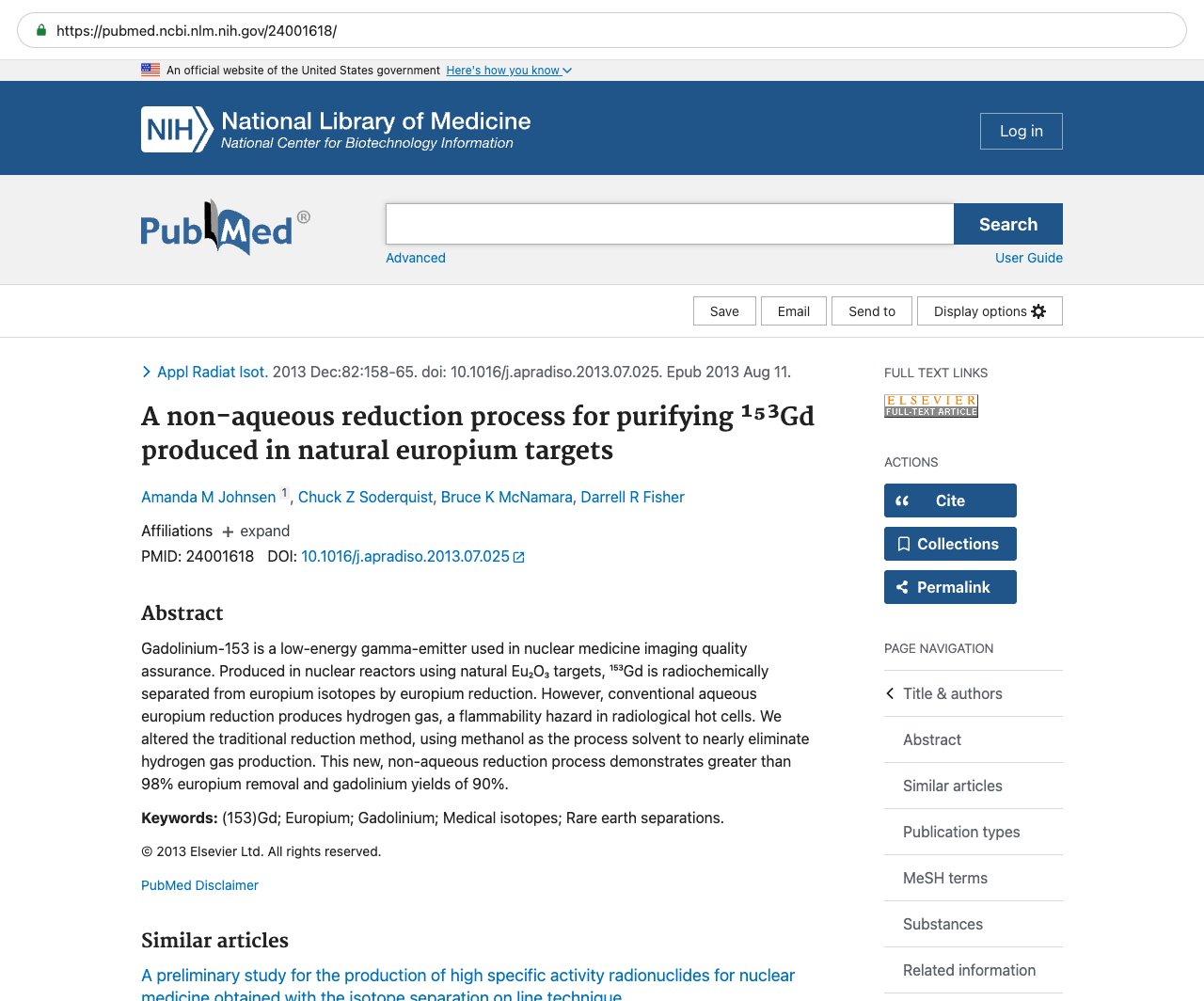
This page mirrors the published abstract (© the authors / publisher) for reference and citation. The canonical source is the PubMed record linked above. This is not medical advice.