2018 · Kadnikov — Lignite coal burning seam in the remote Altai Mountains harbors a hydrogen-driven thermophilic microbial community
Super-Abstract
In an underground coal fire site in the Altai Mountains, researchers identified thermophilic bacteria that survive by oxidising molecular hydrogen produced during coal combustion. This is a basic microbiology and geomicrobiology study — it has no direct relevance to H₂ medicine or human health. (Scientific Reports, 2018.)
Commentary
This paper describes a metagenomics investigation of a rare thermal ecosystem: the surface of a lignite coal seam burning underground in Siberia. The researchers found a microbial community dominated by three Firmicutes species that metabolise molecular hydrogen (H₂) as an energy source. This is basic environmental microbiology — the H₂ in question is produced by combustion of fossil coal, not consumed or produced in any biological health context. The study has no connection to H₂ supplementation, human health, or therapeutic hydrogen research. It is indexed in this database likely due to keyword overlap (hydrogen, microbial). Its scientific value lies entirely in geomicrobiology and the ecology of extreme environments.
Key quotes
- „All three Firmicutes species can gain energy from aerobic or anaerobic oxidation of molecular hydrogen, produced as a result of underground coal combustion along with other coal gases.“ — the ecological function of these bacteria: H₂ from coal fire as energy source
- „We propose that thermophilic Firmicutes, whose spores can spread from their original geothermal habitats over long distances, are the first colonizers of this recently formed thermal ecosystem.“ — biogeographic hypothesis about how these microbes colonised the burning coal site
- „Taxonomic classification revealed dominance of only a few groups of Firmicutes.“ — the extreme environment selects for a highly specialised microbial community
Our assessment
This study has no relevance to human H₂ medicine. It is a geomicrobiology paper about bacteria living in a coal-fire ecosystem. It is included here for completeness of the literature database, but contains no data on H₂ supplementation, human biology, disease, or therapy. No health-related conclusions of any kind can be drawn from it.
Study design
- Type: environmental metagenomics / geomicrobiology · Setting: open quarry with subsurface coal fire, Altai Mountains, Russia
- Methods: metagenomic DNA sequencing, taxonomic classification, near-complete genome assembly, phylogenetic analysis, RuBisCO type classification
- Result: three dominant thermophilic Firmicutes species identified (Ca. Carbobacillus altaicus, Brockia lithotrophica, Hydrogenibacillus schlegelii) — all capable of H₂ oxidation; proposed as pioneer colonisers of this thermal ecosystem
Abstract
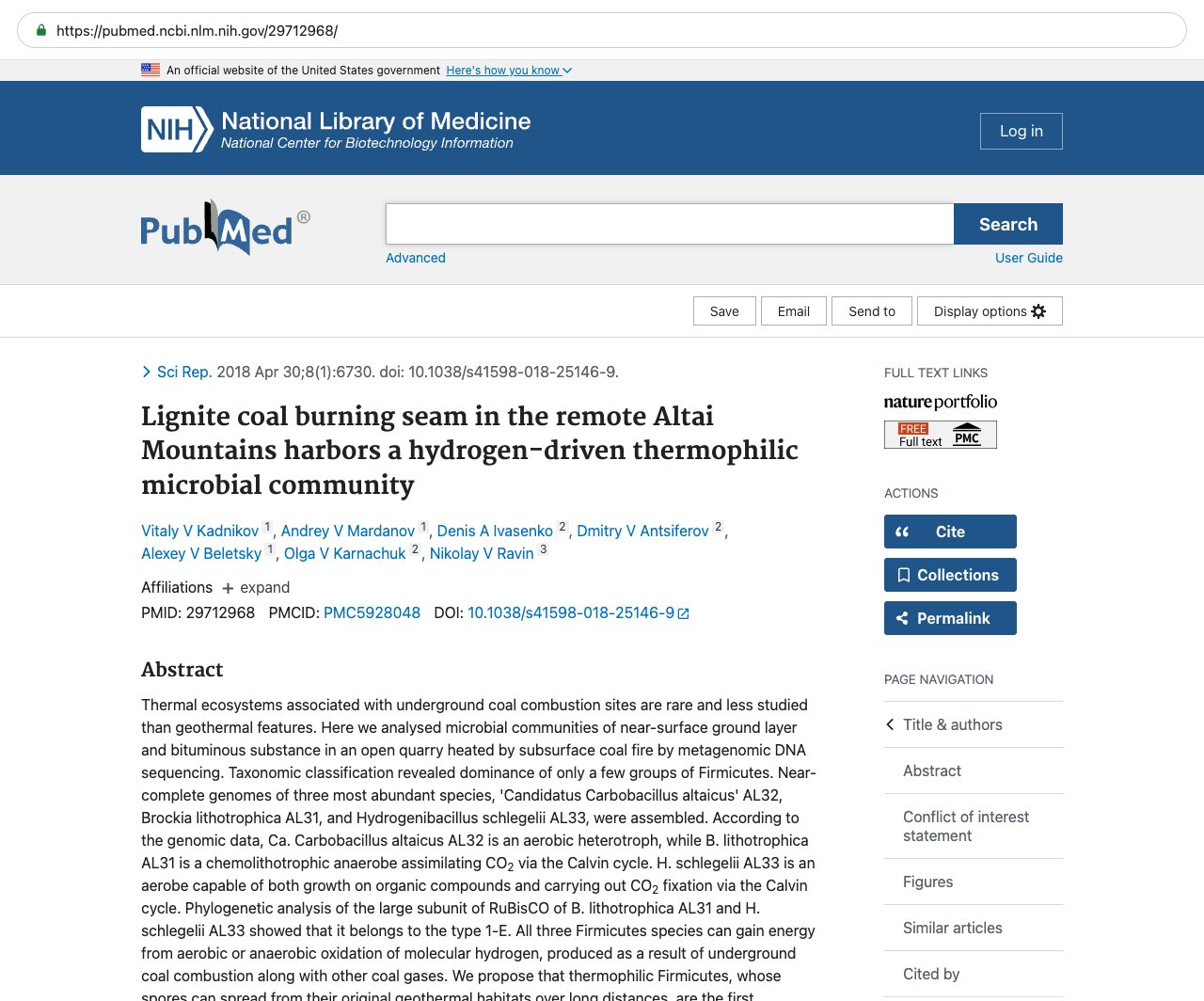
Thermal ecosystems associated with underground coal combustion sites are rare and less studied than geothermal features. Here we analysed microbial communities of near-surface ground layer and bituminous substance in an open quarry heated by subsurface coal fire by metagenomic DNA sequencing. Taxonomic classification revealed dominance of only a few groups of Firmicutes. Near-complete genomes of three most abundant species, 'Candidatus Carbobacillus altaicus' AL32, Brockia lithotrophica AL31, and Hydrogenibacillus schlegelii AL33, were assembled. According to the genomic data, Ca. Carbobacillus altaicus AL32 is an aerobic heterotroph, while B. lithotrophica AL31 is a chemolithotrophic anaerobe assimilating CO2 via the Calvin cycle. H. schlegelii AL33 is an aerobe capable of both growth on organic compounds and carrying out CO2 fixation via the Calvin cycle. Phylogenetic analysis of the large subunit of RuBisCO of B. lithotrophica AL31 and H. schlegelii AL33 showed that it belongs to the type 1-E. All three Firmicutes species can gain energy from aerobic or anaerobic oxidation of molecular hydrogen, produced as a result of underground coal combustion along with other coal gases. We propose that thermophilic Firmicutes, whose spores can spread from their original geothermal habitats over long distances, are the first colonizers of this recently formed thermal ecosystem.
Source & links
Screenshot of the PubMed page
This page mirrors the published abstract (© the authors / publisher) for reference and citation. The canonical source is the PubMed record linked above. This is not medical advice.