2021 · Kaibori — Effect of hydrogen gas inhalation on patient QOL after hepatectomy: protocol for a randomised controlled trial
Super-Abstract
This is a published trial protocol — not yet results — for a randomised, double-blind, controlled study testing whether inhaling hydrogen gas after liver surgery improves patients' quality of life and reduces post-operative complications. The trial was registered and approved in Japan as a specified clinical trial under the Clinical Trials Act. (Trials, 2021.)
Commentary
Liver resection (hepatectomy) involves cycles of blood-flow occlusion and reperfusion that generate reactive oxygen species, potentially harming the liver and impairing post-operative recovery. This paper is a study protocol — a pre-publication of the planned trial design — for a double-blind RCT comparing hydrogen gas inhalation versus air inhalation in the early post-operative period. The primary endpoint is the QoR-40 quality of recovery score on post-operative day 3; secondary endpoints include pain, liver function tests, urinary 8-OHdG (oxidative stress marker), complication grade, dietary intake, and step counts. The protocol was registered in Japan (jRCTs 03220332), conducted under the country's stringent Clinical Trials Act, and Ethics-Board-approved. <strong>No results are reported in this paper</strong> — it is a protocol only. The rationale is mechanistically sound, and the endpoints are clinically relevant. This entry documents the planned study for context; readers should seek the results publication when available.
Key quotes
- „Hydrogen gas inhalation in the early stages after hepatectomy is anticipated to inhibit liver dysfunction by inhibiting ROS.“ — the mechanistic rationale: H₂ as an antioxidant to protect the liver from ischaemia-reperfusion injury
- „The primary endpoint is patient QOL (score of a 40-item quality of recovery questionnaire, QoR40) on postoperative day 3.“ — the main outcome being measured — patient-reported recovery quality, not just biomarkers
- „This study is a randomized, controlled, double-blind superiority trial, which will be conducted as a 'specified clinical trial' in accordance with the Clinical Trials Act in Japan.“ — the rigorous regulatory framework — Japan's Clinical Trials Act requires strict quality standards
Our assessment
This is a protocol paper only — no results can be assessed. Its value is in demonstrating that a properly designed, pre-registered, double-blind RCT of H₂ inhalation post-hepatectomy was underway. The mechanistic rationale (H₂ neutralising ischaemia-reperfusion ROS) is well-supported by animal data cited in the introduction. Important caveats: until results are published, no conclusion about efficacy can be drawn; the QoR-40 on day 3 is a validated but subjective endpoint; and post-operative H₂ delivery requires specialised equipment not universally available.
Study design
- Type: published RCT protocol (results not yet reported) · n (planned): not specified in protocol · H₂ delivery: hydrogen gas inhalation (concentration not specified in abstract), post-hepatectomy, early post-operative period
- Design: randomised, controlled, double-blind, superiority trial — Group A: H₂ inhalation; Group B: air inhalation
- Primary endpoint: QoR-40 score on post-operative day 3 · Secondary: pain (NRS), liver function, 8-OHdG, Clavien-Dindo complications, dietary intake, steps
Abstract
INTRODUCTION: Molecular hydrogen had been considered inactive in vivo but is an antioxidant that selectively reduces highly toxic reactive oxygen species (ROS). Animal studies have reported that hydrogen gas inhalation helped alleviate cerebral and cardiac ischemia-reperfusion injuries. In humans, hydrogen inhalation therapy is presently approved as a treatment under Advanced Medical Care B in Japan (jRCTs031180352: limited to adult patients who suffered out-of-hospital cardiac arrest and are in a continuous coma) and its effectiveness is being examined in a clinical trial. The Japanese government has introduced the "Advanced Medical Care System" to promote the development of drugs and devices under governmental regulations. Advanced Medical Care B is a system designed for unapproved or off-label drugs or medical technologies used in a clinical trial setting. Hepatectomy is generally performed with repeated hepatic blood-flow occlusion and then reperfusion (ischemia and reperfusion). No report, however, has been made on ROS inhibition by hydrogen inhalation therapy or its effectiveness in post-hepatectomy patients. Hydrogen gas inhalation in the early stages after hepatectomy is anticipated to inhibit liver dysfunction by inhibiting ROS. METHODS AND ANALYSIS: This study is a randomized, controlled, double-blind superiority trial, which will be conducted as a "specified clinical trial" in accordance with the Clinical Trials Act in Japan. Trial registration was prospectively completed before the first participant was enrolled. The subjects will be patients who will undergo hepatectomy and will be allocated randomly into group A with hydrogen gas inhalation or group B with air inhalation after hepatectomy. The study will examine if hydrogen gas inhalation improves QOL of post-hepatectomy patients. The primary endpoint is patient QOL (score of a 40-item quality of recovery questionnaire, QoR40) on postoperative day 3 and the secondary endpoints are QoR40s besides that on postoperative day 3, grade of postoperative complications (Clavien-Dindo score), level of pain (Numerical Rating Scale (NRS)), amount of dietary intake, liver function, inflammation level, 8-hydroxydeoxyguanosine (urinary 8-OHdG) level, and number of pedometer-assessed steps. ETHICS AND DISSEMINATION: The study protocol has been approved by the Niigata University Central Review Board of Clinical Research. The findings of this study will be widely disseminated through peer-reviewed publications and conference presentations. TRIAL REGISTRATION: jRCTs 03220332 . Registered on 21 January 2021.
Source & links
Screenshot of the PubMed page
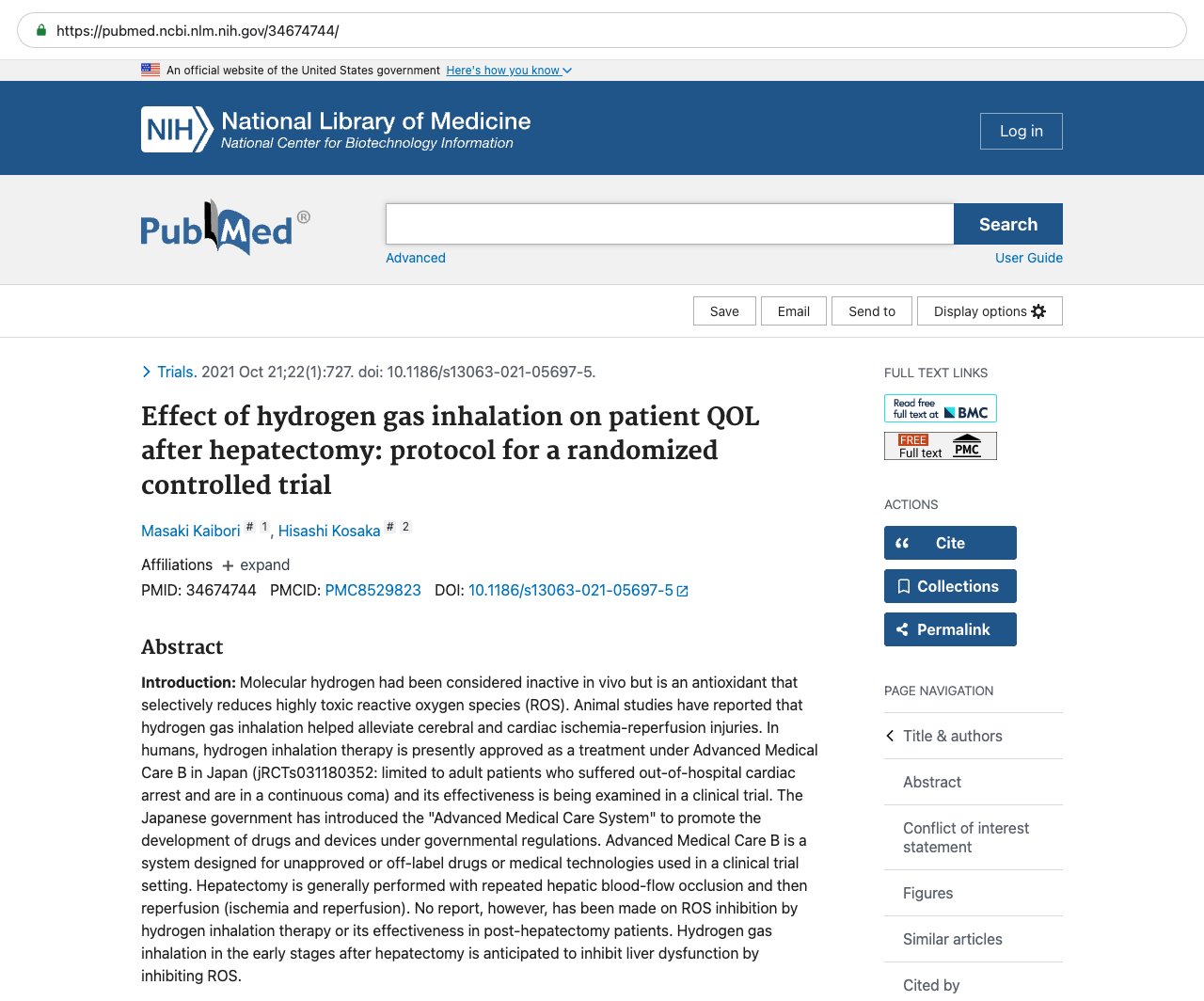
This page mirrors the published abstract (© the authors / publisher) for reference and citation. The canonical source is the PubMed record linked above. This is not medical advice.