2021 · Kato — Carcinostatic effects of alkanoyl ascorbate plus platinum nano-colloid and stabilization of the esterolytically resultant ascorbate by hydrogen
Super-Abstract
This in-vitro chemistry study found that a combination of a fatty-acid ascorbate ester (Asc6Palm) plus platinum nanoparticles suppressed human oesophageal cancer cell viability. Hydrogen-rich water appears as a supporting agent that stabilises ascorbate against oxidative breakdown — not as an anticancer therapy on its own. All findings are in cell culture; no human patients were involved.
Commentary
The paper sits at the intersection of nano-oncology and antioxidant chemistry. The core finding is that combining a lipophilic ascorbate ester (Asc6Palm) with colloidal platinum nanoparticles (PVP-Pt) synergistically suppresses KYSE70 oesophageal carcinoma cell viability, while either agent alone is less effective. The role of hydrogen-rich water (HRW) is secondary: the authors observed by HPLC analysis that HRW (dissolved H₂: 0.575 mg/L) significantly slowed the oxidative degradation of ascorbate compared with tap water or Mg-stick-derived water. This is an interesting antioxidative chemistry finding — HRW preserves the ascorbate needed for the anticancer effect — but it is far removed from any clinical application. The cytotoxicity assay is entirely in-vitro (KYSE70 cells), and the proposed combination therapy is highly experimental.
Key quotes
- „Cell viability was repressed by 'Asc6Palm + PVP-Pt' mixture more markedly than by Asc6Palm or PVP-Pt alone, together with cell shrinkage and fragmentation.“ — synergistic cytotoxicity of the ascorbate ester + platinum nanoparticle combination
- „Asc was necessitated to be retained for efficient carcinostasis, and demonstrated by HPLC-coulometric ECD analysis to be appreciably stabilized in electrolytically generated hydrogen (dissolved hydrogen: 0.575 mg/L)-water.“ — H₂-rich water's role: protecting ascorbate from oxidative degradation
- „Asc6Palm plus PVP-Pt with hydrogen-rich water supplement might be applicable for carcinostatic therapy.“ — speculative conclusion — entirely in-vitro, not clinically tested
Our assessment
A specialised in-vitro chemistry study with a narrow scope: the anticancer synergy of a specific ascorbate ester + platinum nanoparticle combination, with HRW playing an antioxidant stabilising role. The work is technically interesting but highly preliminary. The role of H₂ itself as an anticancer agent is not demonstrated here — H₂ is used instrumentally to stabilise ascorbate. The system tested (Asc6Palm + PVP-Pt + HRW) is far from any clinical application. No conclusions about H₂ therapy for cancer or ascorbate therapy in humans can be drawn.
Study design
- Type: in-vitro (preclinical) · Model: KYSE70 human oesophageal carcinoma cells · H₂ delivery: hydrogen-rich water (electrolytically generated, dissolved H₂: 0.575 mg/L) as antioxidant support
- Endpoints: cell viability (cytotoxicity assay); ascorbate stability by HPLC-coulometric electrochemical detection; comparison of HRW vs. tap water, Mg-stick water, H₂-gas-bubbled water
- Key finding: Asc6Palm + PVP-Pt > Asc6Palm alone or PVP-Pt alone for cytotoxicity; HRW most effectively preserved ascorbate compared to other H₂ sources; Mg-stick water (0.044 mg/L) and H₂-bubbled water (0.427 mg/L) less effective
Abstract
Carcinostatic effects of combined use of ascorbic acid (Asc), 2-O-phospho- or 6-O-palmitoyl ascorbate (Asc2Phos, Asc6Palm) or diverse alkanoyl Asc, and nano-sized platinum-poly(N-vinyl-pyrrolidone) colloid (PVP-Pt; 2-nm diameter) were examined on human esophagus carcinoma-derived cells KYSE70. Cell viability was repressed by 'Asc6Palm + PVP-Pt' mixture more markedly than by Asc6Palm or PVP-Pt alone, together with cell shrinkage and fragmentation, in contrast to no additive carcinostatic effect of 'Asc + PVP-Pt' or 'Asc2Phos + PVP-Pt'. The effects might be partly due to efficiency for intracellular uptake of PVP-Pt, as previously shown by our studies that Pt atoms composed of PVP-Pt were incorporated into human tongue carcinoma cells by 9.6-fold compared to normal human tongue epitheliocytes. Asc6Palm was advantageous for intracellular uptake, in terms of the proper balance for molecular hydrophilicity-lipophilicity (BMHL), whereas 6-O-stearoyl (C18) Asc or 2,6-O-dipalmitoyl (2 × C16) was demonstrated to be less carcinostatic owing to a lower BMHL. Although esterolytically converted from Asc6Palm, Asc was necessitated to be retained for efficient carcinostasis, and demonstrated by HPLC-coulometric ECD analysis to be appreciably stabilized in electrolytically generated hydrogen (dissolved hydrogen: 0.575 mg/L)-water, but scarcely in hydrogen-gas-bubbled water (0.427 mg/L), Mg stick-derived hydrogen (0.044 mg/L) water, or tap water, suggesting that hydrogen-rich water suppresses oxidative decomposition of Asc. Thus, Asc6Palm plus PVP-Pt with hydrogen-rich water supplement might be applicable for carcinostatic therapy.
Source & links
Screenshot of the PubMed page
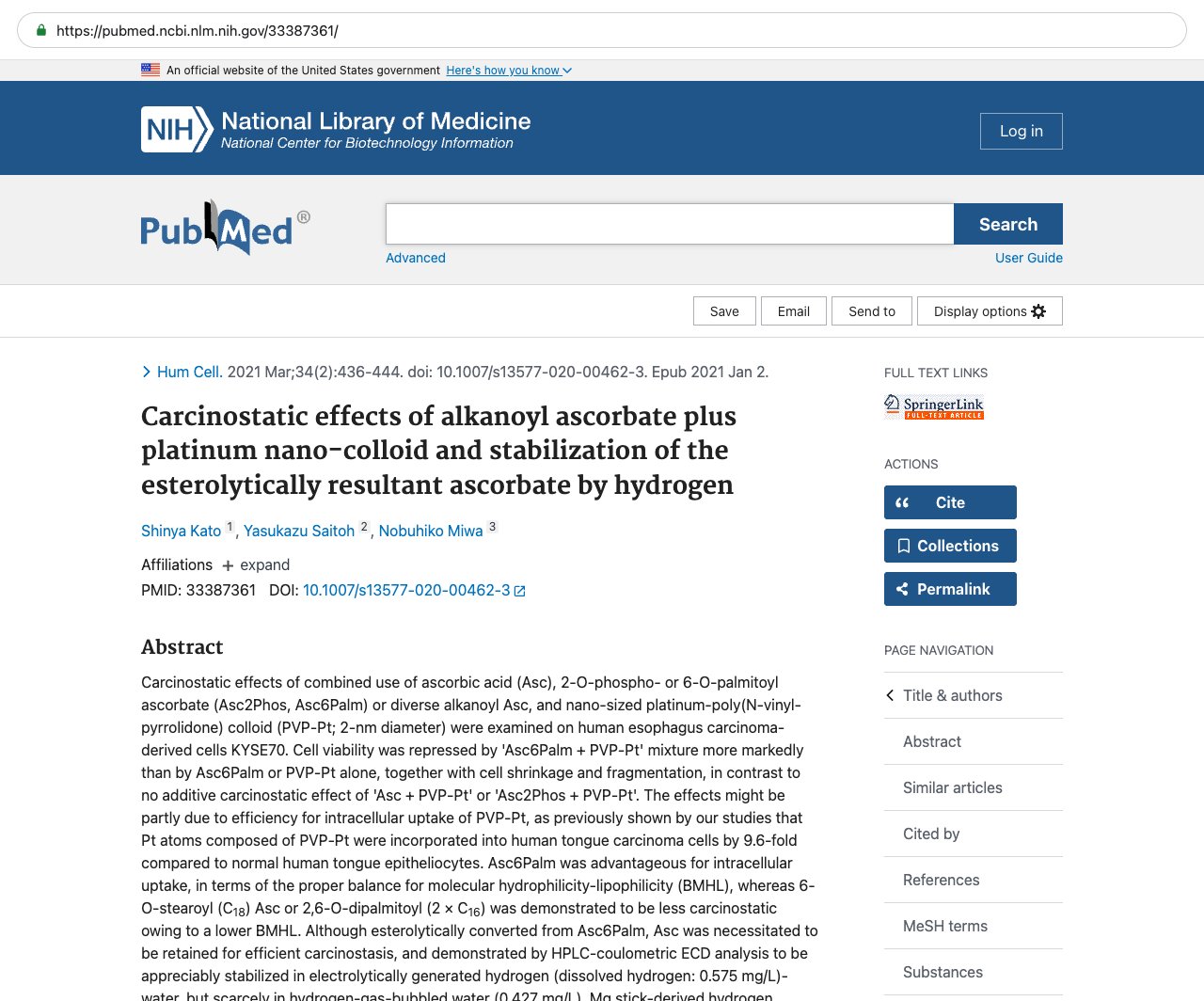
This page mirrors the published abstract (© the authors / publisher) for reference and citation. The canonical source is the PubMed record linked above. This is not medical advice.