2010 · Kawasaki — Hydrogen gas treatment prolongs replicative lifespan of bone marrow multipotential stromal cells in vitro while preserving differentiation and paracrine potentials.
Super-Abstract
This in-vitro study found that exposing mesenchymal stem cells (MSCs) to 3 % hydrogen gas during laboratory expansion significantly prolonged their replicative lifespan and preserved their ability to differentiate and secrete therapeutic factors. The finding is relevant to regenerative medicine, where ex-vivo expansion of MSCs is limited by cellular ageing. Note: this is a cell culture study, not a human trial, and the mechanism turned out to be more complex than simple hydroxyl radical scavenging.
Commentary
Bone marrow MSCs are promising for regenerative therapies, but their low abundance requires extensive ex-vivo expansion, which causes senescence and loss of therapeutic potential. Kawasaki et al. (2010) showed that adding 3 % H₂ gas to MSC culture conditions delayed this senescence, improved preservation of early colony-forming progenitors, and maintained differentiation and paracrine capabilities. Interestingly — and somewhat unexpectedly — H₂ treatment did not reduce the oxidative stress markers typically used to explain H₂'s effects (hydroxyl radicals, protein carbonyls, 8-OHdG). This suggests the anti-senescence mechanism may involve pathways other than hydroxyl radical scavenging, an important nuance for understanding how H₂ acts at the cellular level. The results are an early in-vitro proof-of-concept and cannot be directly translated to human clinical outcomes without further in-vivo validation.
Key quotes
- „Addition of 3% hydrogen gas enhanced preservation of colony forming early progenitor cells within MSC preparation and prolonged the in vitro replicative lifespan of MSCs without losing differentiation potentials and paracrine capabilities.“ — the core positive finding: H₂ extends MSC lifespan while preserving function
- „3% hydrogen gas treatment did not decrease hydroxyl radical, protein carbonyl, and 8-hydroxydeoxyguanosine, suggesting that scavenging hydroxyl radical might not be responsible for these effects of hydrogen gas in this study.“ — the surprising negative finding: the classic H₂ mechanism (ROS scavenging) was not operative here
- „Oxidative stress is one of the key insults promoting cell senescence in vivo as well as in vitro.“ — the biological rationale for testing H₂ in MSC expansion
Our assessment
This is an in-vitro preclinical study — results were obtained in cell culture and cannot be directly transferred to humans. The finding that H₂ prolongs MSC lifespan without the expected drop in oxidative stress markers is a scientifically honest and important result: it suggests H₂'s anti-senescence action involves mechanisms beyond simple ROS neutralisation. The study opens interesting questions but does not establish clinical efficacy. It is a useful mechanistic stepping stone for regenerative medicine research.
Study design
- Type: in-vitro study · Model: human/murine bone marrow MSC expansion cultures · H₂ delivery: 3 % H₂ gas added to culture atmosphere
- Result: prolonged replicative lifespan; preserved differentiation and paracrine function; colony-forming early progenitors better maintained; surprisingly, no reduction in hydroxyl radical, protein carbonyl or 8-OHdG — suggesting a non-ROS mechanism
Abstract
Cell therapy with bone marrow multipotential stromal cells/mesenchymal stem cells (MSCs) represents a promising approach in the field of regenerative medicine. Low frequency of MSCs in adult bone marrow necessitates ex vivo expansion of MSCs after harvest; however, such a manipulation causes cellular senescence with loss of differentiation, proliferative, and therapeutic potentials of MSCs. Hydrogen molecules have been shown to exert organ protective effects through selective reduction of hydroxyl radicals. As oxidative stress is one of the key insults promoting cell senescence in vivo as well as in vitro, we hypothesized that hydrogen molecules prevent senescent process during MSC expansion. Addition of 3% hydrogen gas enhanced preservation of colony forming early progenitor cells within MSC preparation and prolonged the in vitro replicative lifespan of MSCs without losing differentiation potentials and paracrine capabilities. Interestingly, 3% hydrogen gas treatment did not decrease hydroxyl radical, protein carbonyl, and 8-hydroxydeoxyguanosine, suggesting that scavenging hydroxyl radical might not be responsible for these effects of hydrogen gas in this study.
Source & links
Screenshot of the PubMed page
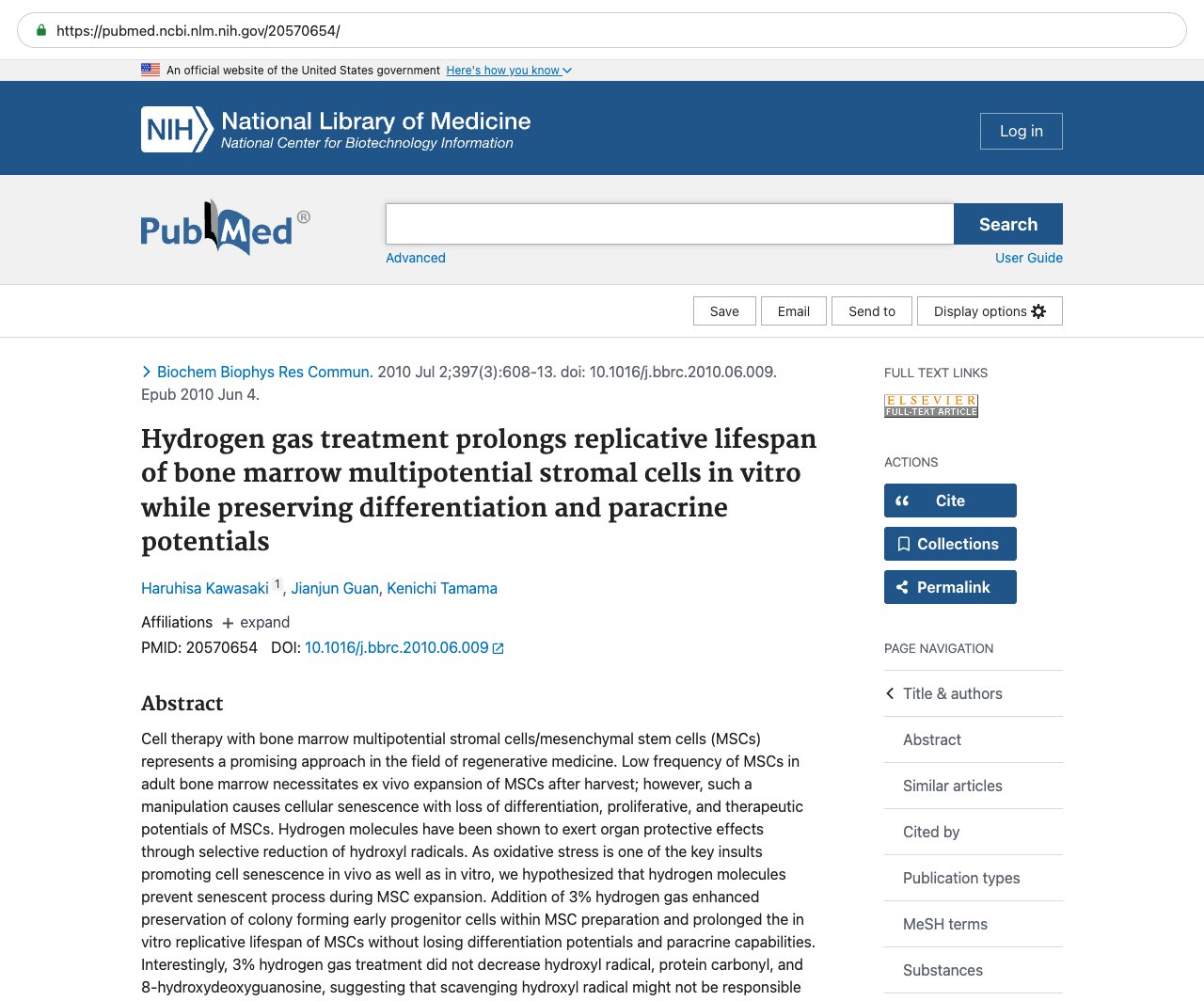
This page mirrors the published abstract (© the authors / publisher) for reference and citation. The canonical source is the PubMed record linked above. This is not medical advice.