2024 · Khalili-Tanha et al. — The Impact of Hydrogen-Rich Water on Liver Enzyme Levels in Clinical Populations: A Comprehensive Review and Meta-Analysis
Super-Abstract
This meta-analysis of eight randomised controlled trials with 433 participants with liver function disorders reports a slight decrease in the liver enzymes ALT, AST and ALP with hydrogen-rich water compared with the control group. The abstract gives no effect sizes, confidence intervals, p-values or heterogeneity figures, so the size and statistical significance of these decreases cannot be judged from it. GGT, named in the background as a marker of liver disorders, is not reported in the results. The authors call for further research to confirm the relationship. (Gastroenterology and Hepatology from Bed to Bench, 2024.)
Commentary
Raised liver enzymes such as ALT, AST, ALP and GGT are early signs of liver disorders, and this review asked whether hydrogen-rich water lowers them. Following PRISMA guidelines, the authors searched PubMed, Google Scholar and Embase from their start to January 2024. They included eight randomised controlled trials with a total of 433 participants with various liver function disorders. The intervention was drinking hydrogen-rich water. The comparison group is labelled “PW” in the abstract and not further defined. Results are reported for the liver enzymes ALT, AST and ALP. The abstract does not describe the individual trials, their doses or durations, the statistical model, a risk-of-bias assessment or a rating of the certainty of evidence.
Key quotes
- „Our results showed a slight decrease in ALT, AST, and ALP levels in the treated group with HRW compared to the PW group.“ — the only result statement, given without effect sizes or p-values
- „Eight Randomized controlled trial (RCT) studies were included, encompassing 433 participants with various liver function disorders.“ — the evidence base: few trials with mixed patient groups
- „Our findings suggest that consuming HRW may decrease liver enzyme levels in clinical populations. Further research is needed to confirm this relationship.“ — the authors' cautious conclusion and their call for confirmation
Our assessment
The review pools randomised trials, which suits the question, but the abstract reports its results only in words. It can at most point to a possible small reduction in liver enzymes. Limitations: no pooled effect sizes, confidence intervals, p-values or heterogeneity measures are given, so it is unclear whether the “slight decrease” is statistically significant or clinically meaningful. The evidence base is small, with eight trials and 433 participants, and it mixes participants with various liver function disorders. The comparison group (“PW”) is not defined. GGT is named as a marker in the background but not reported in the results. Doses, durations, risk of bias and certainty of evidence are not described. Liver enzymes are laboratory markers, and the abstract reports no clinical outcomes. The authors themselves state that further research is needed.
Study design
- Type: systematic review and meta-analysis following PRISMA (PubMed, Google Scholar and Embase searched to January 2024) · n: 433 participants in eight trials · H₂ delivery: drinking hydrogen-rich water
- Included studies: eight randomised controlled trials in participants with various liver function disorders, comparing hydrogen-rich water with a control group labelled “PW”
- Result: slight decrease in ALT, AST and ALP with hydrogen-rich water compared with the control group. The abstract gives no effect sizes, confidence intervals, p-values, heterogeneity or certainty rating
Abstract
AIM: This systematic review and meta-analysis aimed to assess the effect of hydrogen-rich water (HRW) on liver enzyme levels. BACKGROUND: Liver disease is a significant global health concern, greatly affecting mortality rates. Elevated levels of liver enzymes, such as ALT, AST, ALP, and GGT are early symptoms of liver disorders, and various approaches can help reduce them. Recent studies have shown the prospective therapeutic advantages of hydrogen as an antioxidant and anti-inflammatory agent in many circumstances. METHODS: The search strategy was developed following PRISMA guidelines. PubMed, Google Scholar, and Embase were searched from the beginning to January 2024. Eight Randomized controlled trial (RCT) studies were included, encompassing 433 participants with various liver function disorders. RESULTS: Our results showed a slight decrease in ALT, AST, and ALP levels in the treated group with HRW compared to the PW group. CONCLUSION: Our findings suggest that consuming HRW may decrease liver enzyme levels in clinical populations. Further research is needed to confirm this relationship.
Source & links
Screenshot of the PubMed page
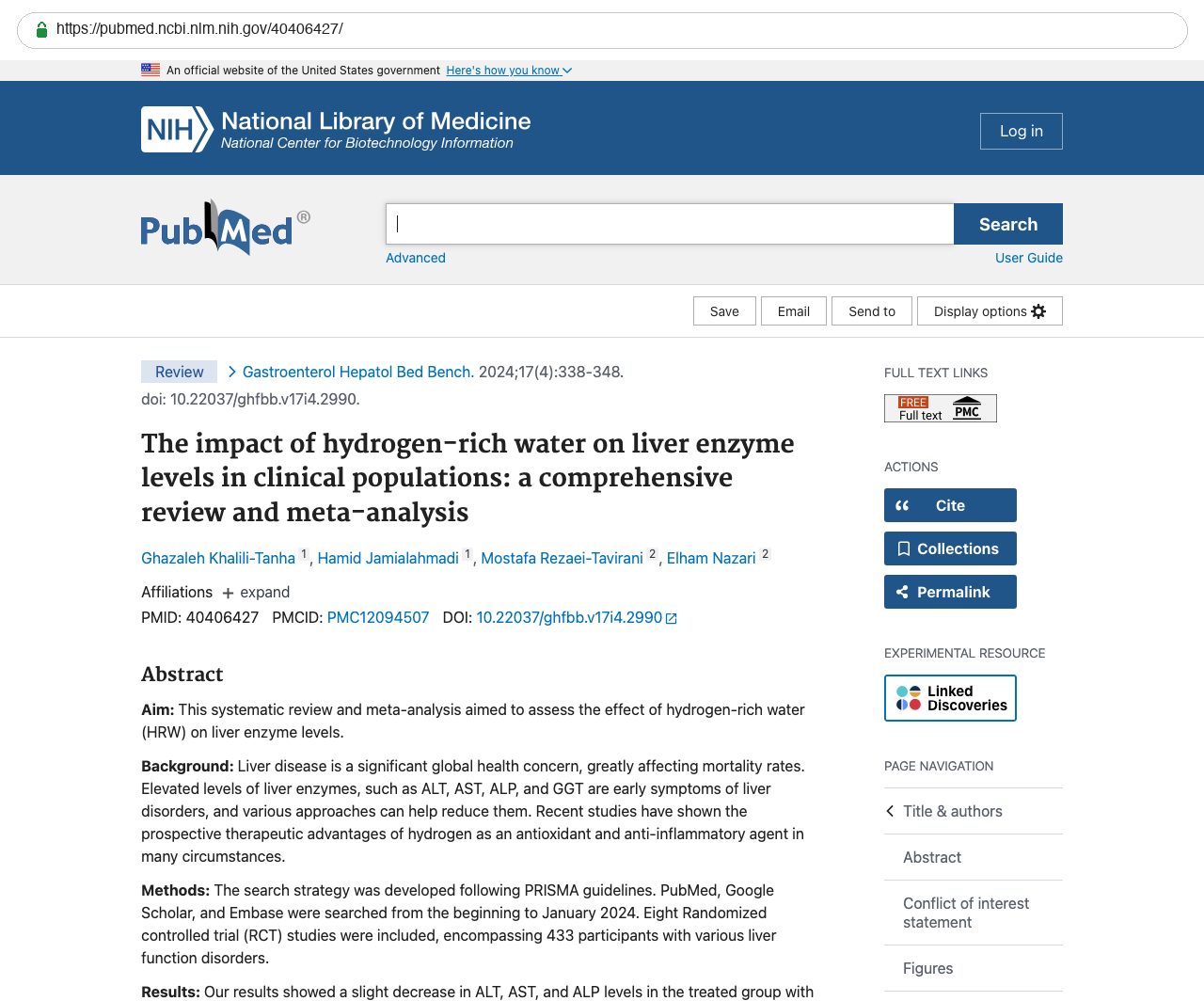
This page mirrors the published abstract (© the authors / publisher) for reference and citation. The canonical source is the PubMed record linked above. This is not medical advice.