2025 · Khlifi — Pre-Exercise Ingestion of Hydrogen-Rich Cold Water Enhances Endurance Performance and Lactate Response in Heat
Super-Abstract
Hydrogen-rich cold water before exercise improves endurance performance in heat and dampens the lactate rise. In a double-blind crossover it significantly raised maximal aerobic speed and the number of shuttle-run repetitions versus control (each p < 0.001) and lowered dehydration, lactate and perceived exertion. (Medicina, 2025.)
Commentary
Heat is one of the biggest performance killers in endurance sport. This study combines internal pre-cooling (cold drinking) with the antioxidant H₂ effect. Design: double-blind crossover with counterbalanced trials. After 30 minutes, participants completed a 20-meter shuttle-run test under three conditions: (1) hydrogen-rich cold water, (2) cold water plus external pre-cooling, (3) plain cold water as control. Measured were maximal aerobic speed, repetition count, dehydration, body temperature, heart rate, perceived exertion, blood lactate and mood. Result: with hydrogen-rich cold water, maximal aerobic speed and repetition count rose significantly (each p < 0.001), dehydration (p = 0.009), lactate (p < 0.001), perceived exertion (p = 0.05) and body temperature (p = 0.028) improved versus control, and mood was better. For heart rate there was no difference. Important for honesty: the H₂ arm was combined with cold water, and there was no separate „H₂ only at room temperature“ arm — so the pure H₂ contribution versus the cold effect is not fully isolated.
Key quotes
- „Post hoc tests revealed a significant change for MAS (HRCW: p < 0.001), number of shuttle run repetitions (HRCW: p < 0.001) ... compared to the control condition after the test.“ — clear performance increase in the H₂ cold water condition
- „blood lactate (HRCW: p < 0.001; IEPC: p < 0.001)“ — significantly lower lactate response
- „ingesting hydrogen-rich cold water effectively mitigates the effects of heat stress, thereby improving endurance performance, enhancing mood, and reducing ratings of perceived exertion.“ — the authors' overall statement
Our assessment
Directly relevant to endurance performance under heat stress, especially for heat scenarios. The findings (more endurance, less lactate, better perception) fit the antioxidant and anti-fatigue profile of H₂. Limitation, stated honestly: the H₂ effect is mixed with the cold-water pre-cooling effect — without a separate pure H₂ arm, the isolated H₂ contribution remains open. Crossover design (evidence level 3); sample size not quantified in the abstract. Solid signal, but causally not fully attributable to H₂.
Study design
- Type: RCT, double-blind crossover (counterbalanced) · n: not quantified in the abstract · Duration: 30 min intervention before the test, 3 conditions · H₂ delivery: hydrogen-rich cold water (HRCW) drunk before exertion
- Result figures: MAS and shuttle repetitions ↑ (HRCW p < 0.001); dehydration ↓ (p = 0.009); lactate ↓ (p < 0.001); RPE ↓ (p = 0.05); body temperature ↓ (p = 0.028); better mood; heart rate without difference
Abstract
Background and Objectives: Hyperthermia significantly limits endurance performance in hot environments. To enhance heat loss and optimize athletic performance, pre-cooling interventions can be employed to accelerate body cooling. Therefore, the aim of this study was to evaluate the effects of an internal pre-cooling intervention combined with external pre-cooling or hydrogen-rich water on endurance performance in the heat. Materials and Methods: In a double-blind crossover with counterbalanced trials, all participants underwent a shuttle run test after 30 min under the following conditions: (1) hydrogen-rich cold water ingestion (HRCW); (2) cold water ingestion and external pre-cooling (IEPC); and (3) cold-water ingestion (control). Maximal aerobic speed (MAS), number of shuttle run repetitions, dehydration, temperature, heart rate (HR), rate of perceived exertion (RPE), blood lactate, and feeling scale (FS) were measured during the 20 m shuttle run test. Results: Our results revealed a significant variation in dehydration, MAS, number of shuttle run repetitions, blood lactate, RPE, and FS (p = [0.001-0.036]); additionally, a significant group × time interaction was found for body temperature (p = 0.021). Post hoc tests revealed a significant change for MAS (HRCW: p < 0.001), number of shuttle run repetitions (HRCW: p < 0.001), dehydration (HRCW: p= 0.009; IEPC: p = 0.008), blood lactate (HRCW: p < 0.001; IEPC: p < 0.001), RPE (HRCW: p = 0.05; IEPC: p = 0.004), and FS (HRCW: p = 0.05; IEPC: p = 0.004), as well as a significant decrease in body temperature (IEPC: p < 0.001; HRCW: p = 0.028) compared to the control condition after the test. However, no significant differences were reported in HR among the different conditions. Conclusions: In conclusion, findings from this study suggest that ingesting hydrogen-rich cold water effectively mitigates the effects of heat stress, thereby improving endurance performance, enhancing mood, and reducing ratings of perceived exertion.
Source & links
Screenshot of the PubMed page
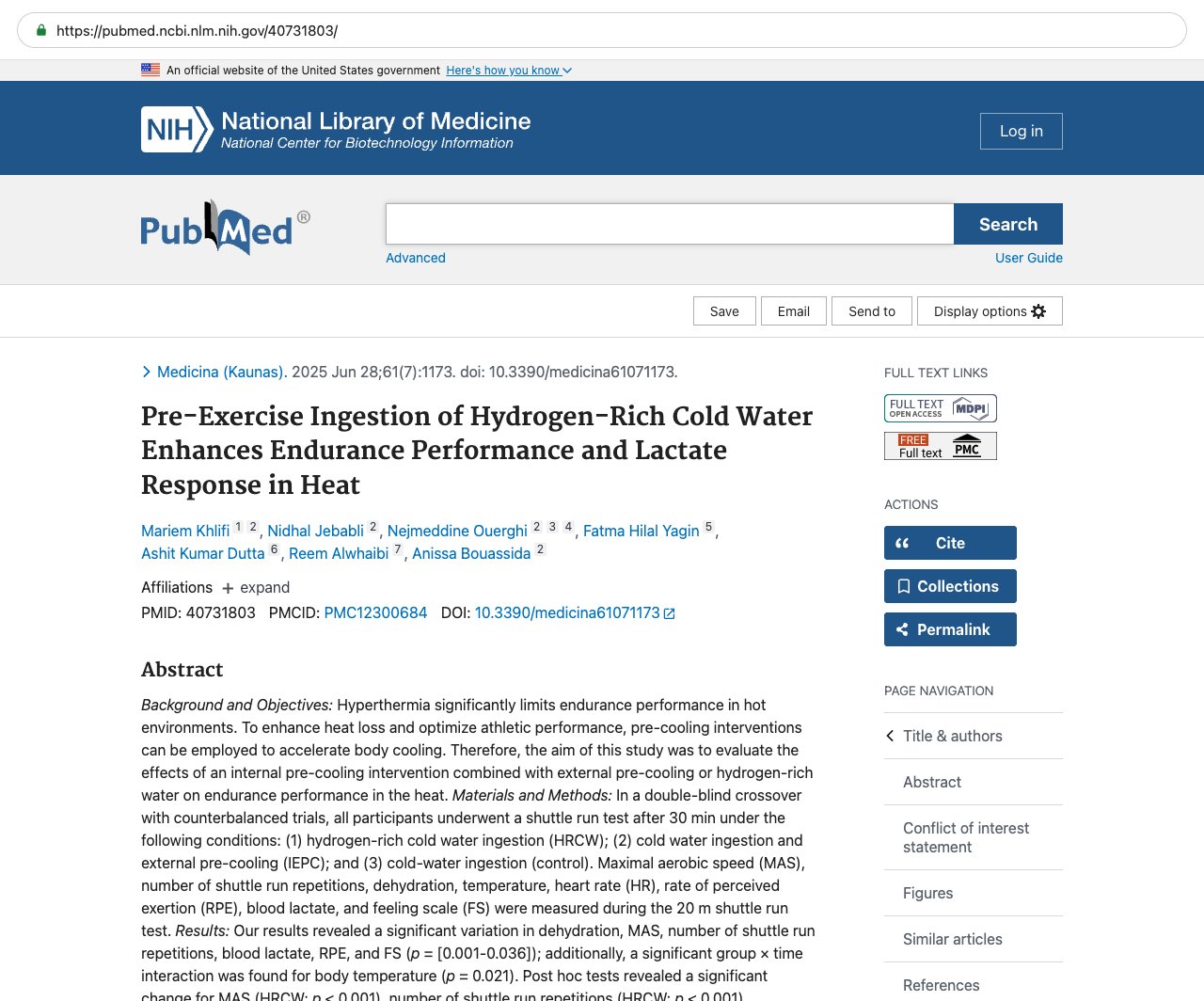
This page mirrors the published abstract (© the authors / publisher) for reference and citation. The canonical source is the PubMed record linked above. This is not medical advice.