2017 · Kim — Inhibition of Streptococcal Biofilm by Hydrogen Water
Super-Abstract
Electrolyzed hydrogen-rich water significantly inhibited streptococcal biofilm formation in laboratory cultures, reduced the expression of key biofilm-related genes, and — in a small oral-rinse trial — reduced the number of salivary streptococci compared with tap water. This is primarily an in-vitro study with a very small human pilot component; clinical evidence for dental disease prevention is not yet established.
Commentary
Oral bacterial biofilms — especially those formed by Streptococcus mutans — are the primary cause of dental caries and other oral diseases. This study took a dual approach: first, quantifying streptococcal biofilm growth in laboratory conditions with and without hydrogen water exposure; second, measuring how a one-week oral rinse with hydrogen water affected salivary streptococcal counts in participants. In-vitro results were clear: hydrogen water significantly reduced biofilm mass and suppressed the expression of glucosyltransferase genes (gtfB, gtfC, gtfI) and glucan-binding proteins (gbpC, dblB) — the molecular machinery that builds and stabilises the biofilm matrix. The salivary rinse result showed fewer streptococci with hydrogen water than tap water. However, the human component is extremely small and preliminary, with no clinical endpoints (no caries incidence, no gingival health measures). The antioxidant properties of H₂ may reduce oxidative stress in oral bacteria, but the exact antibacterial mechanism is not yet established.
Key quotes
- „Our data showed that H-water caused a significant decrease in in vitro streptococcal biofilm formation.“ — core in-vitro finding: reduced biofilm growth
- „The expression level of the mRNA of glucosyltransferases (gtfB, gtfc, and gtfI) and glucan-binding proteins (gbpC, dblB) were decreased remarkably in MS after H-water exposure for 60s.“ — molecular mechanism: suppression of biofilm-building gene expression
- „Our data suggest that oral rinse with H-water would be helpful in treating dental biofilm-dependent diseases with ease and efficiency.“ — authors' cautious clinical suggestion — still speculative given the small human component
Our assessment
Primarily an in-vitro study with a very small and preliminary human rinse experiment. The in-vitro findings are robust for a laboratory study: biofilm reduction and gene expression suppression at two mechanistic levels. The clinical relevance, however, remains entirely unproven — no randomised controlled trial with clinical dental outcomes exists. The human pilot rinse component lacks basic information on participant numbers, blinding, and controls. Interesting as a proof-of-concept for potential oral health applications, but far from clinical recommendation.
Study design
- Type: in-vitro study + preliminary human pilot · Model: Streptococcus mutans on polystyrene plates (in vitro); human oral rinse (pilot) · H₂ delivery: electrolyzed hydrogen-rich water
- Outcome: significant decrease in streptococcal biofilm formation (in vitro); suppressed gtf/gbp gene expression; reduced salivary streptococcal colony counts after 1-week oral rinse vs. tap water
Abstract
OBJECTIVES: The accumulation of oral bacterial biofilm is the main etiological factor of oral diseases. Recently, electrolyzed hydrogen-rich water (H-water) has been shown to act as an effective antioxidant by reducing oxidative stress. In addition to this general health benefit, H-water has antibacterial activity for disease-associated oral bacteria. However, little is known about the effect of H-water on oral bacterial biofilm. The objective of this study was to confirm the effect of H-water on streptococcal biofilm formation. METHODS: In vitro streptococcal biofilm was quantified using crystal violet staining after culture on a polystyrene plate. The effect of H-water on the expression of genes involved in insoluble glucan synthesis and glucan binding, which are critical steps for oral biofilm formation, was evaluated in MS. In addition, we compared the number of salivary streptococci after oral rinse with H-water and that with control tap water. Salivary streptococci were quantified by counting viable colonies on Mitis Salivarius agar-bacitracin. RESULTS: Our data showed that H-water caused a significant decrease in in vitro streptococcal biofilm formation. The expression level of the mRNA of glucosyltransferases (gtfB, gtfc, and gtfI) and glucan-binding proteins (gbpC, dblB) were decreased remarkably in MS after H-water exposure for 60s. Furthermore, oral rinse with H-water for 1 week led to significantly fewer salivary streptococci than did that with control tap water. CONCLUSIONS: Our data suggest that oral rinse with H-water would be helpful in treating dental biofilm-dependent diseases with ease and efficiency.
Source & links
Screenshot of the PubMed page
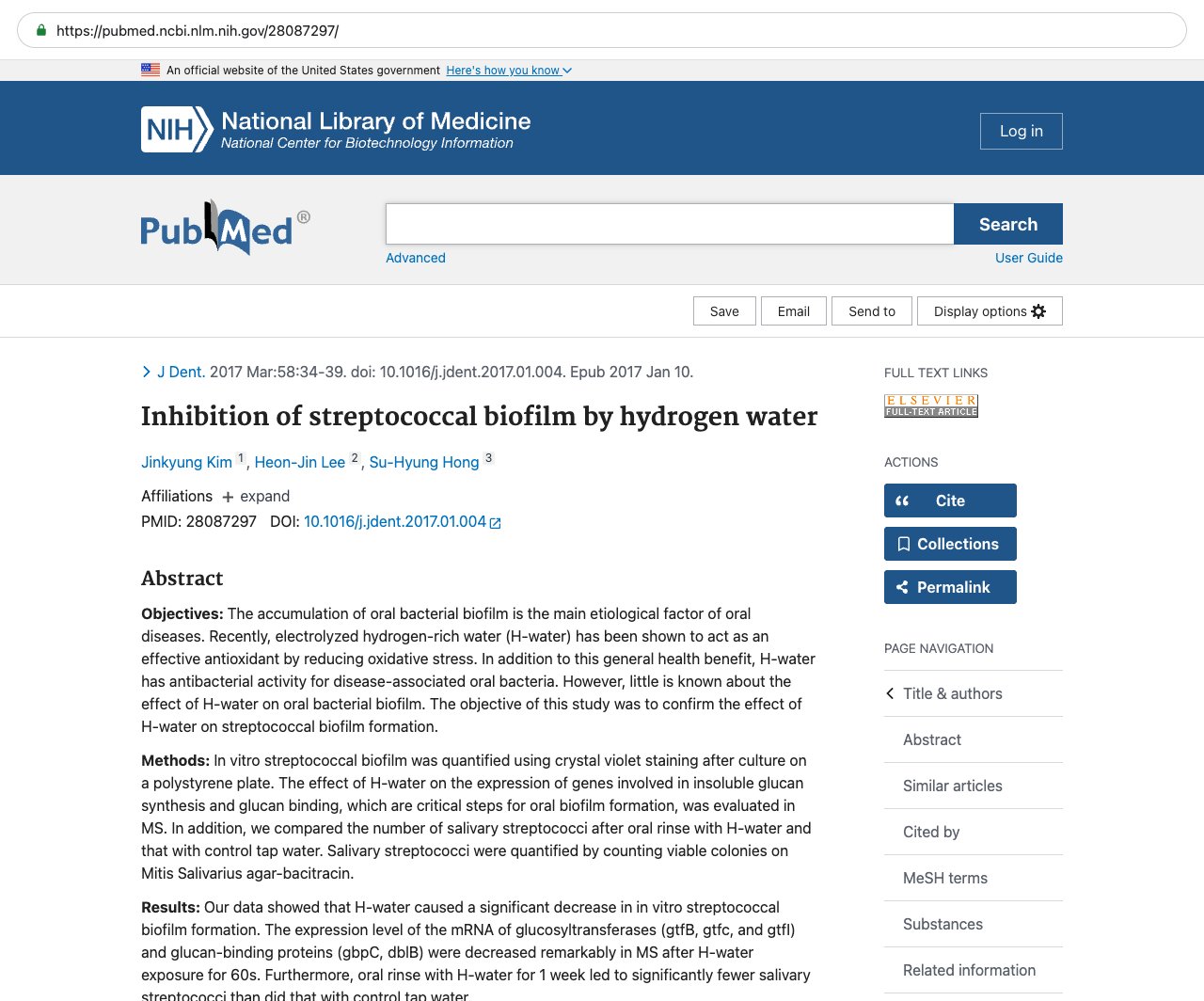
This page mirrors the published abstract (© the authors / publisher) for reference and citation. The canonical source is the PubMed record linked above. This is not medical advice.