2025 Voprosy kurortologii, fizioterapii, i lechebnoi fizicheskoi kultury RCT Human H₂ therapy Unspecified
2025 · Korchazhkina — Effectiveness of Non-Drug Technologies to Increase Stress Resistance in Persons with Extreme Work Profiles and Susceptibility for Professional Burnout
Super-Abstract
Medical workers with professional burnout showed measurable improvements in stress resistance and psychological wellbeing after courses of non-drug physical therapies — including hydrogen therapy — compared to exercise and psychocorrection alone. The combination of all physical factors (cryotherapy, magnetic therapy, hypoxic-hyperoxytherapy, and hydrogen therapy) produced the strongest synergistic effect. Hydrogen therapy as a standalone add-on improved outcomes by approximately 12–23% relative to the control group. (Voprosy kurortologii, fizioterapii, i lechebnoi fizicheskoi kultury, 2025.)
Commentary
This Russian clinical study is one of the few that positions hydrogen therapy explicitly in a mental health / occupational medicine context — here as part of a multi-factor rehabilitation package for burnout. 150 medical workers were divided into six groups; hydrogen therapy was one of four monofactorial add-ons tested against a control receiving only exercise and psychological correction. The result is plausible: any meaningful physiotherapeutic intervention will add something over a bare-minimum baseline. However, the study's main limitation is that hydrogen was never tested in isolation against a true sham — all groups received exercise and psychocorrection on top. The effect size of hydrogen therapy specifically is therefore difficult to disentangle from other shared components. The journal is a Russian specialty journal with limited international visibility. The ev score of 3 (lower evidence) reflects that no blinding or placebo control for the hydrogen arm is described.
Key quotes
- „Additional course application of therapeutic physical factors in the monofactorial impact mode (general air cryotherapy, general magnetic therapy, hypoxic-hyperoxytherapy and hydrogen therapy; respectively comparison groups 1-4) was accompanied by an increase in the positive dynamics of the assessed indicators by 12-23%.“ — the reported effect range of each mono-add-on, including hydrogen therapy, over the control baseline
- „The complex use of all physiotherapeutic effects, implemented in the main group, caused the development of the most pronounced corrective effect.“ — combination therapy outperformed any single modality
- „The maximum corrective effect, manifested with the complex use of physical factors, is the result of the synergistic interaction of various physiotherapeutic technologies.“ — the authors attribute added benefit to synergy, not to any single factor
Our assessment
This study documents that hydrogen therapy was part of a physical therapy protocol that showed benefit for burnout-related stress markers in medical workers — but no standalone placebo-controlled hydrogen arm was included. The 12–23% improvement attributed to each mono-add-on (including hydrogen) cannot be cleanly separated from the shared exercise/psychocorrection baseline. The MBI, DASS, and PSM-25 instruments are validated, which is a strength. Key limitations: no blinding described for hydrogen vs. other gas exposures, no sham hydrogen condition, Russian-language journal with limited peer-review transparency. The result is suggestive — not confirmatory — that H₂ may contribute to burnout recovery within a physiotherapy bundle.
Study design
- Type: randomized controlled trial (6 parallel groups) · n: 150 medical workers (n=25 per group) · H₂ delivery: hydrogen therapy (course application, specific modality not detailed in abstract)
- Comparators: physical exercise + psychocorrection (control); + cryotherapy; + magnetic therapy; + hypoxic-hyperoxytherapy; + hydrogen therapy; + all combined (main group)
- Result: all mono-add-ons improved burnout indicators by 12–23% over control; combined group showed the greatest improvement; hydrogen therapy alone was not isolated in a separate placebo-controlled comparison
Abstract
UNLABELLED: The high prevalence of professional burnout syndrome among medical workers significantly actualizes the search for the most effective methods aimed at reducing the severity of the negative consequences of professional stress. A certain perspective in solving this problem is associated with the course use of non-drug technologies, the sanogenetic potential of which ensures the implementation of high efficiency in the correction of the main manifestations of professional burnout. The complex use of therapeutic physical factors allows achieving a pronounced clinical result due to their synergistic interaction. OBJECTIVE: Comparative analysis of the efficiency of the course use of non-drug technologies (physical exercises, psychocorrection, general air cryotherapy, general magnetic therapy, hypoxic-hyperoxytherapy, hydrogen therapy and their combinations) in the correction of stress resistance and manifestations of professional burnout in medical workers. MATERIAL AND METHODS: The studies were conducted on the basis of the Federal State Budgetary Scientific Institution Russian Scientific Center of Surgery named after academician B.V. Petrovsky with the participation of 150 patients from among medical personnel aged 30 to 60 years. Using the simple fixed randomization method, all patients were divided into 6 groups: control (n=25), comparison groups 1-4 (n=25 each), and the main group (n=25). Patients in all groups received a course of physical exercises and psychological correction. For the control group, this type of correction was exhaustive. In comparison group 1, a course of general air cryotherapy was additionally carried out; comparison group 2 additionally received a course of general magnetic therapy procedures; comparison group 3 additionally received a course of hypoxic-hyperoxytherapy; comparison group 4 additionally received a course of hydrogen therapy; in the main group, patients received a course of complex exposure to therapeutic physical factors. The study design provided for a double examination of patients in all groups using the MBI questionnaire and the DASS and PSM-25 scales. RESULTS: Conducting a course of correction of the state of professional burnout made it possible to establish that its effectiveness was largely determined by the type of physical factor used. Less pronounced changes were noted in the control group with the use of physical exercises and psychological correction. Additional course application of therapeutic physical factors in the monofactorial impact mode (general air cryotherapy, general magnetic therapy, hypoxic-hyperoxytherapy and hydrogen therapy; respectively comparison groups 1-4) was accompanied by an increase in the positive dynamics of the assessed indicators by 12-23%. The complex use of all physiotherapeutic effects, implemented in the main group, caused the development of the most pronounced corrective effect. CONCLUSION: The use of non-drug technologies allows achieving high efficiency in the correction of stress resistance and manifestations of professional achievement in medical workers. The maximum corrective effect, manifested with the complex use of physical factors, is the result of the synergistic interaction of various physiotherapeutic technologies, implemented in the form of potentiation of sanogenetic mechanisms aimed at normalizing the psycho-emotional status of individuals with an extreme profile of service activity.
Source & links
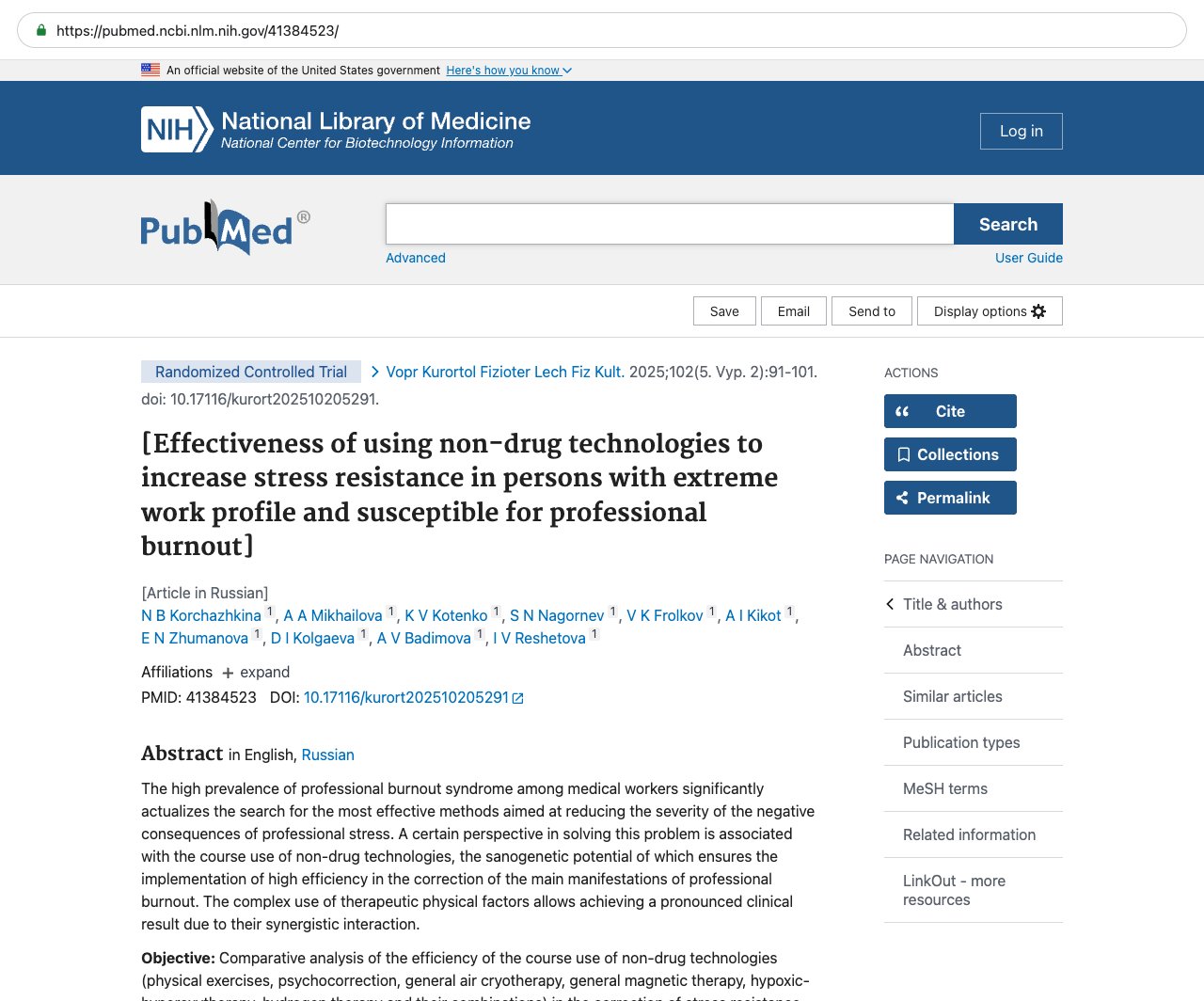
Screenshot of the PubMed page
This page mirrors the published abstract (© the authors / publisher) for reference and citation. The canonical source is the PubMed record linked above. This is not medical advice.