2025 · Kornieieva — Exploring the Potential of Molecular Hydrogen in Different Heart Failure Models: A Review
Super-Abstract
This is the first systematic review summarising all published research on molecular hydrogen (H₂) as a potential treatment in different heart failure models. The available preclinical literature indicates that H₂ may mitigate heart failure by reducing oxidative stress, inflammation, cardiomyocyte death, and adverse cardiac remodelling — but authors stress that clinical feasibility and efficacy in humans have yet to be established. (International Journal of Molecular Sciences, 2025.)
Commentary
Heart failure (HF) is a global epidemic: 5-year mortality can reach 75 %, and current pharmacological therapies — though effective — do not fully address the underlying molecular pathology of cardiac remodelling. H₂ has theoretical appeal because its antioxidant and anti-apoptotic properties could counteract several hallmarks of HF progression: oxidative stress drives cardiomyocyte loss, inflammation accelerates fibrosis, and mitochondrial dysfunction impairs cardiac energy. This review is the first to systematically compile H₂ studies across different HF types (ischemic, hypertensive, dilated cardiomyopathy, etc.). The authors are careful to frame findings as emerging and requiring further investigation — the field is still predominantly preclinical. This is a literature review with no new experimental data.
Key quotes
- „The available literature indicates that H2 may be effective in mitigating different HF pathologies via regulating cardiac oxidative stress and inflammation, cardiomyocyte death, and mitochondrial function/cell metabolism, as well as cardiac remodeling, including hypertrophy and fibrosis.“ — the summary finding: H₂ addresses multiple HF-relevant pathways in preclinical research
- „As this area of research is still in its infancy, the feasibility and efficiency of H2 treatment in different HF types need further investigation.“ — honest caveat: the authors themselves flag the field is too early-stage for clinical conclusions
- „HF is a complex clinical syndrome characterized by the heart's inability to pump blood effectively, resulting in significant morbidity and mortality. After an initial cardiac event, adaptive mechanisms are activated to preserve cardiac function.“ — setting the stage: why heart failure is a high-need therapeutic target
Our assessment
A useful, timely review — and the first of its kind to map H₂ research across HF subtypes. The authors navigate the evidence responsibly: they summarise preclinical promise while explicitly acknowledging the complete absence of human clinical trial data. All evidence they review comes from animal models and cell culture — no human clinical data for H₂ in heart failure yet exist. The review is therefore a research roadmap rather than evidence for clinical use. Readers should not interpret this summary as proof that H₂ is effective or safe in human heart failure patients.
Study design
- Type: systematic/narrative review · n: n/a (literature synthesis across HF animal and cell culture studies) · H₂ delivery: various (inhalation, hydrogen-rich water, hydrogen saline — as reported in source studies)
- Result: no pooled effect sizes; narrative synthesis identifies antioxidant, anti-inflammatory, anti-apoptotic, and cardiac remodelling-modulating effects of H₂ in preclinical HF models; authors conclude human feasibility needs to be established
Abstract
Heart failure (HF) is increasing in prevalence in many countries around the world. HF is a complex clinical syndrome characterized by the heart's inability to pump blood effectively, resulting in significant morbidity and mortality. After an initial cardiac event (e.g., myocardial infarction, valve dysfunction, hypertension, etc.), adaptive mechanisms are activated to preserve cardiac function. Sustained activation of these mechanisms leads to cellular and structural changes involving cardiac remodeling and hypertrophy. This ultimately leads to impaired cardiac contractility and reduced cardiac output, with a 5-year HF-associated mortality rate up to 75%. The current treatment strategies for HF are not sufficient to cover all the underlying complex mechanisms. It has been demonstrated that molecular hydrogen (H2) exerts cardioprotective effects via its antioxidant, anti-inflammatory, and anti-apoptotic action. The number of studies exploring beneficial effects of H2 in different HF models is increasing. This is the first review summarizing the knowledge in this field. The available literature indicates that H2 may be effective in mitigating different HF pathologies via regulating cardiac oxidative stress and inflammation, cardiomyocyte death, and mitochondrial function/cell metabolism, as well as cardiac remodeling, including hypertrophy and fibrosis. As this area of research is still in its infancy, the feasibility and efficiency of H2 treatment in different HF types need further investigation.
Source & links
Screenshot of the PubMed page
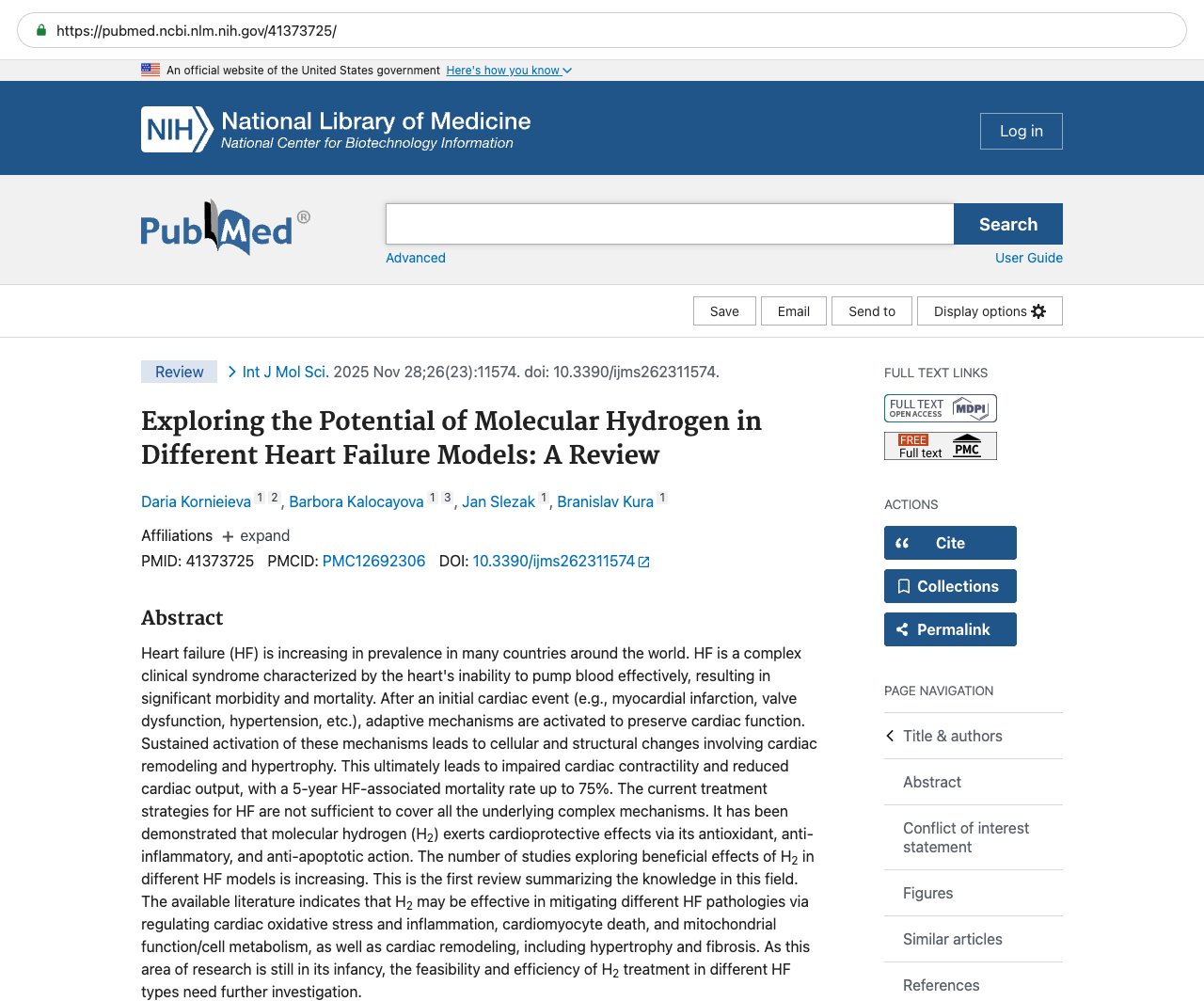
This page mirrors the published abstract (© the authors / publisher) for reference and citation. The canonical source is the PubMed record linked above. This is not medical advice.