2025 Voprosy kurortologii, fizioterapii, i lechebnoi fizicheskoi kultury Pilot / Observational Human H₂ therapy Unspecified
2025 · Kotenko et al. — Biochemical Markers of Stress in Medical Workers With Occupational Burnout Syndrome and Their Dynamics Under Physiotherapeutic Factors
Super-Abstract
In 175 healthcare professionals diagnosed with occupational burnout syndrome, various non-drug physiotherapy interventions — including hydrogen therapy — were tested in a randomised design. Hydrogen therapy alone improved burnout and oxidative stress markers by 12–38 % compared to exercise and psychocorrection alone; the greatest benefit came from combining all physiotherapy approaches together. (Voprosy Kurortologii, Fizioterapii i Lechebnoy Fizicheskoy Kultury, 2025.)
Commentary
Occupational burnout in healthcare workers is both a major public health issue and an underexplored therapeutic target. This Russian study from a national research centre is notable for its scale (175 participants, six groups) and for combining subjective psychological scores with objective biochemical readouts (oxidative stress markers, hormonal regulators of metabolic homeostasis). Hydrogen therapy was tested as one of five individual add-on physiotherapy modalities alongside cryotherapy, magnetic therapy, and hypoxic-hyperoxytherapy — all delivered as courses on top of standard exercise and psychocorrection. The study design (simple fixed randomisation, n = 25 per group) is methodologically modest but appropriate for an exploratory comparison. The 12–38 % additional improvement for hydrogen monotherapy over control is encouraging but modest, and the combination group performed best — which argues for synergy rather than a specific hydrogen effect. A limitation relevant to H₂ research: the type and dose of „hydrogen therapy“ is not described in the abstract, making it difficult to compare results with published H₂ trials.
Key quotes
- „Additional course application of therapeutic physiotherapeutic procedures in the monopharmaceutical mode (general air cryotherapy, general magnetic therapy, hypoxic-hyperoxytherapy and hydrogen therapy) was accompanied by an increase in the positive dynamics of the estimated indicators by 12-38%.“ — the quantified benefit of hydrogen therapy as a standalone add-on
- „The complex use of all physiotherapeutic effects, implemented in the main group, caused the development of the most pronounced corrective effect.“ — combination therapy outperformed any single modality including hydrogen
- „Individual signs of professional burnout syndrome may appear in medical professionals who have not yet verified this syndrome.“ — an important preventive observation: subclinical burnout precedes diagnosis
Our assessment
A randomised comparative study — stronger design than case reports, but with important limitations. Hydrogen therapy as a standalone add-on showed a modest, real-world benefit in a relevant population (burnt-out healthcare workers). Key limitations: hydrogen therapy protocol not described (type, dose, frequency unknown); small group sizes (n = 25 each); published in a Russian-language journal (abstract quality may not fully represent the original methodology); no blinding mentioned; short-term outcome only. The finding that combination physiotherapy is superior to any single modality is robust and clinically actionable — but the specific contribution of H₂ within the combination cannot be isolated.
Study design
- Type: randomised controlled trial (6 groups, simple fixed randomisation) · n: 175 medical staff (25 per group, including 25 healthy controls) · H₂ delivery: hydrogen therapy course (protocol unspecified in abstract)
- Groups: control (exercise + psychocorrection only); comparison groups 1–4 (+ cryotherapy / + magnetic therapy / + hypoxic-hyperoxytherapy / + hydrogen therapy); main group (all combined)
- Result: hydrogen monotherapy add-on: +12–38 % improvement in burnout/oxidative stress markers vs. control; combined physiotherapy group: greatest overall effect
Abstract
UNLABELLED: Professional burnout syndrome is becoming an increasingly important social and medical problem, as it can occur in almost every third doctor or nurse. This syndrome is based on chronic stress, which provokes the development of a close relationship between the indicators of various psychological tests and questionnaires, hormonal and biochemical markers of metabolic disorders of carbohydrates and lipids, as well as parameters characterizing oxidative stress. One of the promising directions in the treatment and prevention of occupational burnout syndrome is physiotherapy technologies with the combined use of factors with a fundamentally different mechanism of action, which, due to synergistic effects, can significantly increase the effectiveness of therapeutic effects. OBJECTIVE: To evaluate the possibility of using non-drug technologies (physical exercises, psychocorrection, general air cryotherapy, general magnetic therapy, hypoxic-hyperoxytherapy, hydrogen therapy and their combined use) to activate stress-limiting mechanisms and manifestations of professional burnout in medical professionals. MATERIALS AND METHODS: The research was conducted on the basis of the Scientific and Clinical Center 1 of the Russian National Research Center named after B.V. Petrovsky Academy with the participation of 175 patients from among the medical staff aged 30 to 60 years (25 of them without signs of professional burnout syndrome) and a group of somatic healthy non-medical workers. By the method of simple fixed randomization, patients with this syndrome were divided into 6 groups: control (n=25), comparison groups 1-4 (n=25 each) and main (n=25). Patients of all groups received a course of physical exercises and psychological correction. For the control group, this type of correction was exhaustive. In comparison group 1, an additional course of general air cryotherapy was performed; comparison group 2 additionally received a course of general magnetic therapy procedures; comparison group 3 additionally received a course of hypoxic-hyperoxytherapy; comparison group 4 additionally received a course of hydrogen therapy; in the main group, patients received a course of complex effects of therapeutic physical factors. The study design provided for a double examination of patients in all groups using the MBI questionnaire, the Spielberger-Hanin test and the Beck scale, as well as biochemical and hormonal stress markers. RESULTS: Individual signs of professional burnout syndrome may appear in medical professionals who have not yet verified this syndrome. At the same time, in its presence, the formation of pathological correlational pleiades is noted, integrating the relationship of the emotional and psychological parameters of this syndrome with indicators of oxidative stress and hormonal regulation of metabolic and energy homeostasis. The use of physiotherapeutic factors of various nature in patients with occupational burnout syndrome has made it possible to establish their effectiveness. Less pronounced changes were noted in the control group with the use of physical exercises and psychocorrection. Additional course application of therapeutic physiotherapeutic procedures in the monopharmaceutical mode (general air cryotherapy, general magnetic therapy, hypoxic-hyperoxytherapy and hydrogen therapy;) This was accompanied by an increase in the positive dynamics of the estimated indicators by 12-38%. The complex use of all physiotherapeutic effects, implemented in the main group, caused the development of the most pronounced corrective effect. CONCLUSION: The use of non-medicinal technologies makes it possible to achieve high efficiency in terms of activation of stress-limiting body systems and sanogenetic processes in medical workers with occupational burnout syndrome. The maximum corrective effect, manifested in the complex application of physiotherapeutic factors, is due to the realization of the additive supra-additive effect of the interaction of their therapeutic potentials.
Source & links
Screenshot of the PubMed page
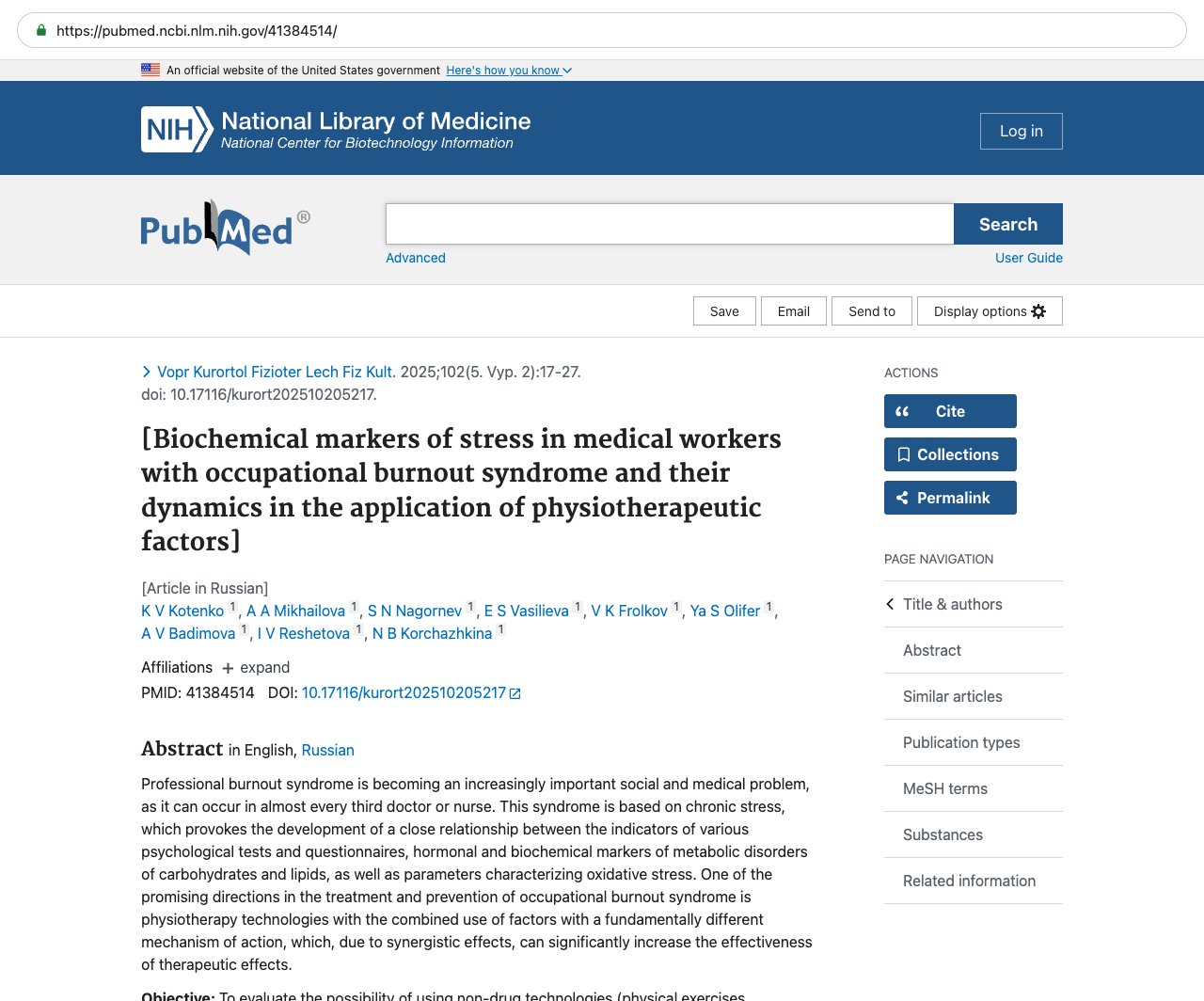
This page mirrors the published abstract (© the authors / publisher) for reference and citation. The canonical source is the PubMed record linked above. This is not medical advice.