2016 · Wolf — H₂ metabolism is widespread and diverse among human colonic microbes
Super-Abstract
A large-scale genomic and metagenomic analysis shows that 70% of microbial species in the human colon encode genes for metabolising molecular hydrogen (H₂), and that electron-bifurcating fermentation — rather than respiratory H₂ oxidation — is the dominant mechanism of H₂ recycling in the gut. This is a bioinformatics and microbiome study; it characterises natural gut H₂ cycling, not exogenous H₂ supplementation. (Gut Microbes, 2016.)
Commentary
Molecular hydrogen is continuously produced in the human gut as an end product of carbohydrate fermentation by anaerobic bacteria. This H₂ is then reoxidised by other microorganisms through sulfate reduction, acetogenesis, or methanogenesis. Despite the central role of H₂ cycling in colonic microbial ecology, the specific hydrogenase enzymes responsible were poorly characterised at the population level. This study surveyed the genomic content of the Human Microbiome Project dataset and the metagenomes of 20 healthy stool samples, finding that [FeFe]-hydrogenases dominate — particularly those involved in fermentative H₂ production and electron-bifurcating H₂ transfer. Contrary to expectation, respiratory H₂ oxidation is not the dominant mode of H₂ reoxidation; instead, electron-bifurcating [FeFe]-hydrogenases — which generate reduced ferredoxin to sustain acetogenesis and other metabolic processes — appear to dominate. This work provides foundational microbiome context for understanding endogenous H₂ biology in the gut, which may be relevant (though indirectly) to questions about how gut microbiota interact with exogenous H₂ supplementation.
Key quotes
- „70% of gastrointestinal microbial species listed in the Human Microbiome Project encode the genetic capacity to metabolise H2.“ — the scope of H₂ metabolism in the human gut microbiome
- „The hydrogenase gene content of all samples was overwhelmingly dominated by fermentative and electron-bifurcating [FeFe]-hydrogenases emerging from the Bacteroidetes and Firmicutes.“ — the dominant mechanism identified: fermentative rather than respiratory H₂ cycling
- „This work provides the first comprehensive bioinformatic insight into the mechanisms of H2 metabolism in the human colon.“ — the authors' own characterisation of the study's novelty
Our assessment
This is an in-vitro / bioinformatics microbiome study — it characterises endogenous gut hydrogen cycling using genomic and metagenomic data from healthy human stool samples. It provides no clinical intervention data and does not study exogenous H₂ supplementation. Results cannot be used to support or refute claims about the health benefits of H₂ supplementation. Its value is as a basic science foundation: understanding how the gut naturally cycles H₂ is relevant background for interpreting how oral H₂ consumption might interact with the microbiome.
Study design
- Type: bioinformatics/metagenomic survey · Model: Human Microbiome Project genome database + 20 healthy human stool metagenomes · H₂ context: endogenous gut H₂ metabolism — no exogenous H₂ administration
- Result: 70% of gut microbial species encode H₂ metabolism genes; [FeFe]-hydrogenases dominate (from Bacteroidetes and Firmicutes); electron-bifurcation (not respiration) is the primary H₂ reoxidation mechanism; supports fermentative H₂ production + interspecies H₂ transfer as dominant colonic H₂ cycling
Abstract
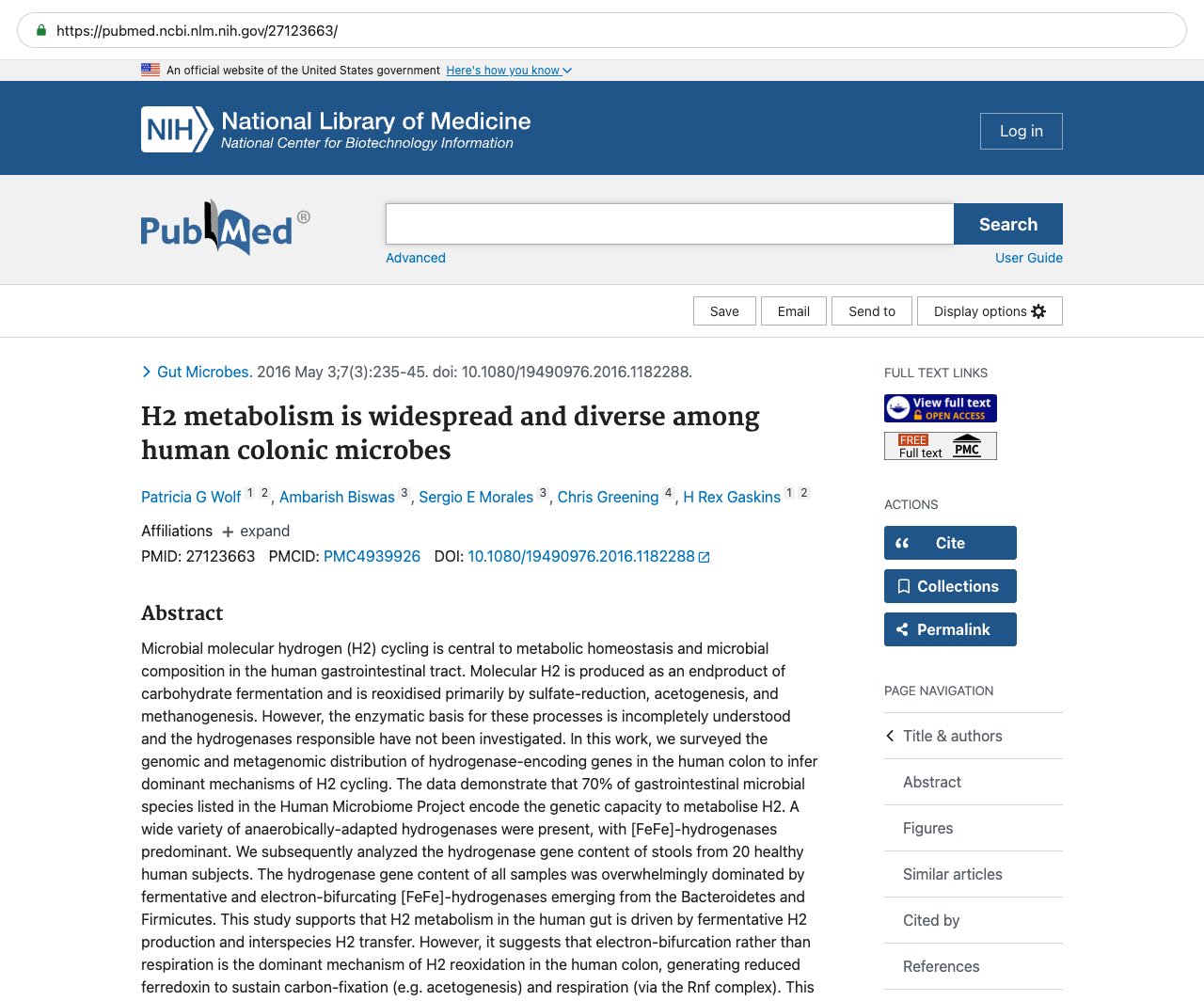
Microbial molecular hydrogen (H2) cycling is central to metabolic homeostasis and microbial composition in the human gastrointestinal tract. Molecular H2 is produced as an endproduct of carbohydrate fermentation and is reoxidised primarily by sulfate-reduction, acetogenesis, and methanogenesis. However, the enzymatic basis for these processes is incompletely understood and the hydrogenases responsible have not been investigated. In this work, we surveyed the genomic and metagenomic distribution of hydrogenase-encoding genes in the human colon to infer dominant mechanisms of H2 cycling. The data demonstrate that 70% of gastrointestinal microbial species listed in the Human Microbiome Project encode the genetic capacity to metabolise H2. A wide variety of anaerobically-adapted hydrogenases were present, with [FeFe]-hydrogenases predominant. We subsequently analyzed the hydrogenase gene content of stools from 20 healthy human subjects. The hydrogenase gene content of all samples was overwhelmingly dominated by fermentative and electron-bifurcating [FeFe]-hydrogenases emerging from the Bacteroidetes and Firmicutes. This study supports that H2 metabolism in the human gut is driven by fermentative H2 production and interspecies H2 transfer. However, it suggests that electron-bifurcation rather than respiration is the dominant mechanism of H2 reoxidation in the human colon, generating reduced ferredoxin to sustain carbon-fixation (e.g. acetogenesis) and respiration (via the Rnf complex). This work provides the first comprehensive bioinformatic insight into the mechanisms of H2 metabolism in the human colon.
Source & links
Screenshot of the PubMed page
This page mirrors the published abstract (© the authors / publisher) for reference and citation. The canonical source is the PubMed record linked above. This is not medical advice.